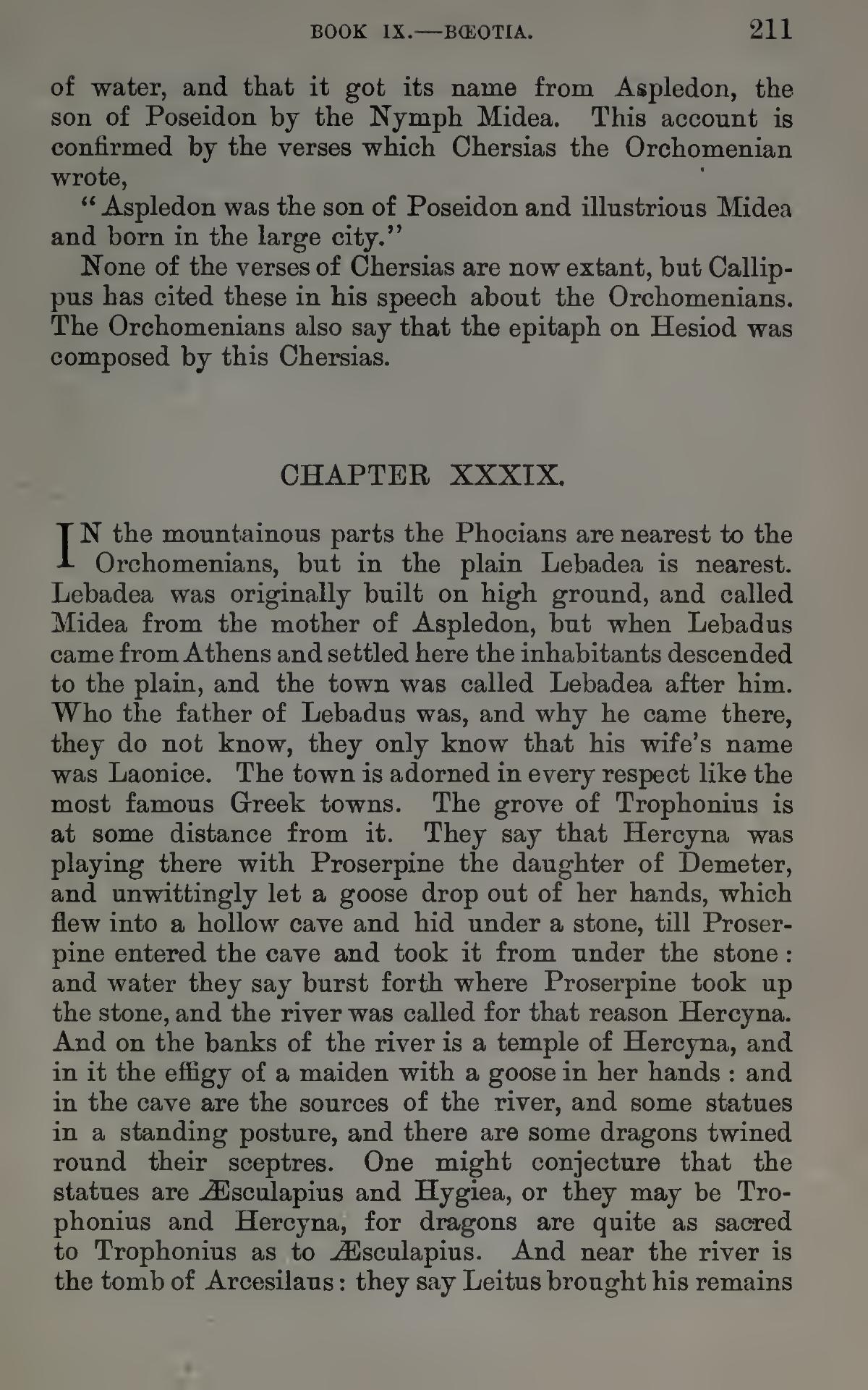
Pausanias, MS 2. yüzyılda yaşamış Yunan gezgin ve yazardır. Hellas'ın Betimlemesi, Yunanistan'ın şehirlerini, tapınaklarını ve yerel anlatılarını gezi biçiminde anlatan on kitaplık bir eserdir. Aktarılan bölüm Boiotia'daki Lebadeia şehrinde bulunan Trophonios kehanet mağarasını anlatır ve Arthur Shilleto'nun 1886 çevirisinden alınmıştır.
BÖLÜM XXXIX.
Dağlık kesimlerde Orkhomenoslulara en yakın olanlar Phokislilerdir, fakat ovada en yakın olan Lebadeia'dır. Lebadeia başlangıçta yüksek bir yerde kurulmuştu ve Aspledon'un annesinden ötürü Mideia olarak adlandırılıyordu; fakat Lebados Atina'dan gelip buraya yerleştiğinde halk ovaya indi ve kasabaya onun ardından Lebadeia adı verildi. Lebados'un babasının kim olduğunu ve oraya neden geldiğini bilmezler, yalnızca karısının adının Laonike olduğunu bilirler. Kasaba en ünlü Yunan kasabaları gibi her bakımdan donatılmıştır. Trophonios'un korusu kasabadan biraz uzaktadır. Anlatıldığına göre Herkyna orada Demeter'in kızı Persephone ile oynarken elinden istemeden bir kaz kaçırmış; kaz oyuk bir mağaraya uçup bir taşın altına gizlenmiş, ta ki Persephone mağaraya girip onu taşın altından çıkarana dek. Persephone'nin taşı kaldırdığı yerden suların fışkırdığı ve nehrin bu nedenle Herkyna olarak adlandırıldığı söylenir. Nehrin kıyısında Herkyna'nın bir tapınağı ve içinde elinde bir kaz tutan genç bir kız heykeli vardır; mağarada ise nehrin kaynakları ile ayakta duran bazı heykeller yer alır ve asalarının çevresine yılanlar sarılmıştır. Bu heykellerin Asklepios ile Hygieia olduğu tahmin edilebilir, ya da Trophonios ile Herkyna da olabilirler; zira yılanlar Asklepios kadar Trophonios için de kutsaldır. Nehrin yakınında Arkesilaos'un mezarı bulunur; kalıntılarını Troya'dan Leitos'un getirdiği söylenir. Korudaki en dikkate değer şeyler ise Trophonios Tapınağı ve Asklepios'a benzeyen heykelidir; bu heykel Praksiteles'in eseridir. Ayrıca Europa olarak adlandırılan Demeter'in bir tapınağı ve açık havada Zeus Hyetios'un bir heykeli bulunmaktadır. Kehanet ocağına çıkarken, dağın önünden geçildiğinde Persephone'nin Avı ve Kral Zeus'un tapınağı yer alır. Bu tapınak ya büyüklüğü yüzünden ya da bitmek bilmeyen savaşlar nedeniyle yarım kalmıştır; bir diğer tapınakta ise Kronos, Hera ve Zeus'un heykelleri vardır. Ayrıca bir Apollon tapınağı mevcuttur. Kehanet ocağına gelince, uygulanan yöntem şöyledir: Biri Trophonios'un mağarasına inmek istediğinde, öncelikle belirli günleri İyi Tanrı ve İyi Talih tapınağında geçirmelidir. Burada kaldığı süre boyunca diğer her bakımdan kendini arındırır, sıcak banyolardan kaçınır, Herkyna nehrinde yıkanır ve çeşitli kurbanlardan bolca et yer; zira Trophonios'a ve Trophonios'un oğullarına, ayrıca Apollon'a, Kronos'a, Kral Zeus'a, Arabacı Hera'ya ve Europa dedikleri, Trophonios'un dadısı olduğunu söyledikleri Demeter'e kurban kesmek zorundadır. Her kurbanda kâhin öne çıkarak kurbanın iç organlarını inceler ve bunu yaptıktan sonra Trophonios'un kehanetine başvuran kişiyi lütufla kabul edip etmeyeceğini bildirir. Bununla birlikte, diğer kurbanların iç organları, mağaraya inecek her kişinin indiği gece bir çukurda Agamedes'i çağırarak kurban ettiği koçun iç organları kadar Trophonios'un niyetini göstermez. Önceki kurbanlar elverişli görünmüş olsa bile, bu koçun iç organları da elverişli çıkmadıkça onlara itibar etmezler; fakat bunlar da elverişli olursa, o zaman kişi büyük bir umutla aşağı iner. Yöntem şöyledir: İlk yaptıkları şey kehanete başvurmak isteyen kişiyi geceleyin Herkyna nehrine götürmek, bedenini yağla ovmaktır; Hermai adını verdikleri on üç yaşındaki iki yurttaş çocuk onu yıkar ve diğer her hususta ona hizmet eder. Rahipler bundan sonra onu hemen kehanet ocağına götürmez, birbirine çok yakın olan nehir kaynaklarına götürürler. Burada kişi, geçmişteki tüm düşüncelerini unutsun diye Lethe adı verilen sudan içmelidir; ardından da Hafıza suyundan içmelidir ki inişinde göreceği şeyleri hatırlayabilsin. Daidalos tarafından yapıldığı söylenen ve rahipler tarafından Trophonios'a inecek olanlar dışında hiç kimseye gösterilmeyen heykeli gördükten sonra, ibadet ve duaların ardından şeritlerle bağlanmış keten bir tunik giymiş ve ayaklarında yöreye özgü ayakkabılarla kehanet ocağına gider. Kehanet ocağı dağın üzerindeki korunun yukarısındadır. Çevresinde çevresi çok dar, yüksekliği iki arşından biraz az olan yuvarlak bir taş duvar vardır. Üzerinde bronz sütunlar ve bunları bağlayan kirişler bulunur, bunların arasından kapılar geçer. İçeride ise doğal olmayan, insan yapımı ve büyük bir ustalıkla inşa edilmiş toprakta bir oyuk yer alır. Bu oyuğun biçimi bir fırına benzer: Genişliği (çaprazlama ölçüldüğünde) yaklaşık dört arşın, derinliği ise en fazla sekiz arşın sayılabilir. Dibe inen basamaklar yoktur; ancak biri Trophonios'a indiğinde ona dar ve hafif bir merdiven temin ederler. Yukarı ile dip arasındaki iniş yolunda iki karış genişliğinde ve bir karış yüksekliğinde bir açıklık bulunur. İnen kişi oyuğun dibine boylu boyunca yatar ve ellerinde balla yoğrulmuş çörekler tutarak açıklıktan içeri önce ayaklarını, ardından dizlerini sokar; sonra hızla akan büyük bir nehrin anaforuna kapılan birini yutması gibi bütün bedeni içeri çekilir. Kutsal alanın içine girildiğinde gelecek her zaman aynı şekilde bildirilmez; bazıları geleceğin bilgisini gözleriyle, bazıları ise kulaklarıyla edinir. Girdikleri yerden, önce ayakları çıkacak şekilde geri dönerler. Aşağı inenlerden hiç kimsenin öldüğü görülmemiştir; yalnızca Demetrios'un muhafızlarından biri ölmüştür ki o, alışılagelmiş usullerin hiçbirini yerine getirmemiş ve kehanete danışmak için değil, kutsal alandaki altın ve gümüşün bir kısmını çalma umuduyla inmiştir. Ayrıca onun cesedinin her zamanki çıkış yerinden dışarı atılmadığını da söylerler. Gerçekten de onun hakkında başka anlatılar da vardır; ben yalnızca en dikkate değer olanından söz ediyorum. Trophonios'un oyuğundan çıkıldığında rahipler, kehanete danışan kişiyi alıp kutsal alandan pek uzak olmayan Hafıza Koltuğu'na oturturlar ve oraya oturtulduğunda ona ne gördüğünü ya da ne duyduğunu sorarlar; bilgi edindikten sonra onu, hâlâ dehşet içinde ve nerede olduğunu güçlükle bilebilecek bir durumdayken, İyi Talih ve İyi Tanrı tapınağına geri götürecek uygun kişilere teslim ederler. Ancak daha sonra bunu artık düşünmeyecek, hatta gülecektir. Bunları sadece bir rivayet olarak değil, başkalarının başına geldiğini gördüğüm şeylerden ve bizzat Trophonios'un kehanetine danışmış biri olarak yazıyorum. Trophonios'un kehanet ocağından dönen herkes gördüklerini ya da duyduklarını bir tablet üzerine yazmak zorundadır. Aristomenes'in kalkanı da hâlâ oradadır; bununla ilgili ayrıntıları zaten anlatmıştım.
Özgün metin (İngilizce)
CHAPTER XXXIX.
In the mountainous parts the Phocians are nearest to the Orchomenians, but in the plain Lebadea is nearest. Lebadea was originally built on high ground, and called Midea from the mother of Aspledon, but when Lebadus came from Athens and settled here the inhabitants descended to the plain, and the town was called Lebadea after him. Who the father of Lebadus was, and why he came there, they do not know, they only know that his wife's name was Laonice. The town is adorned in every respect like the most famous Greek towns. The grove of Trophonius is at some distance from it. They say that Hercyna was playing there with Proserpine the daughter of Demeter, and unwittingly let a goose drop out of her hands, which flew into a hollow cave and hid under a stone, till Proserpine entered the cave and took it from under the stone: and water they say burst forth where Proserpine took up the stone, and the river was called for that reason Hercyna. And on the banks of the river is a temple of Hercyna, and in it the effigy of a maiden with a goose in her hands: and in the cave are the sources of the river, and some statues in a standing posture, and there are some dragons twined round their sceptres. One might conjecture that the statues are Æsculapius and Hygiea, or they may be Trophonius and Hercyna, for dragons are quite as sacred to Trophonius as to Æsculapius. And near the river is the tomb of Arcesilaus: they say Leitus brought his remains home from Troy. And the most notable things in the grove are a temple of Trophonius, and statue like Æsculapius. It is by Praxiteles. There is also a temple of Demeter called Europa, and in the open air a statue of Zeus Hyetius. And as you ascend to the oracle, and pass on in front of the mountain, is Proserpine's Chase, and a temple of Zeus the King. This temple either owing to its size or continual wars is left unfinished; and in another temple are statues of Cronos and Hera and Zeus. There is also a temple of Apollo. As to the oracle the following is the process. When any one desires to descend to the cave of Trophonius, he must first take up his residence for certain days in the temple of the Good Deity and Good Fortune. While he stays here he purifies himself in all other respects, and abstains from warm baths, and bathes in the river Hercyna, and has plenty of animal food from the various victims: for he must sacrifice to Trophonius and the sons of Trophonius, and also to Apollo and Cronos, and to Zeus the King, and to Hera the Chariot-driver, and to Demeter whom they call Europa, and who they say was the nurse of Trophonius. And at each of the sacrifices the seer comes forward and inspects the victim's entrails, and having done so declares whether or not Trophonius will receive with favour the person who consults his oracle. The entrails of the other victims however do not show the mind of Trophonius so much as those of the ram, which each person who descends into his cave sacrifices on the night he descends in a ditch, invoking Agamedes. And though the former sacrifices have seemed propitious they take no account of them, unless the entrails of this ram are favourable too, but if these are so, then each person descends with good hope. This is the process. The first thing they do is to bring the person who wishes to consult the oracle by night to the river Hercyna, and to anoint him with oil, and two citizen lads of the age of 13 whom they call Hermæ wash him, and minister to him in all other respects. The priests do not after that lead him immediately to the oracle, but to the sources of the river which are very near each other. And here he must drink of the water called Lethe, that he may forget all his former thoughts, and afterwards he must drink of the water of Memory, and then he remembers what he will see on his descent. And when he has beheld the statue which they say was made by Dædalus, and which is never shown by the priests to any but those who are going to descend to Trophonius, after worship and prayer he goes to the oracle, clad in a linen tunic bound with fillets, and having on his feet the shoes of the country. And the oracle is above the grove on the mountain. And there is round it a circular wall of stone, the circumference of which is very small, and height rather less than two cubits. And there are some brazen pillars and girders that connect them, and through them are doors. And inside is a cavity in the earth, not natural, but artificial, and built with great skill. And the shape of this cavity resembles that of an oven: the breadth of which (measured diametrically) may be considered to be about 4 cubits, and the depth not more than 8 cubits. There are no steps to the bottom: but when any one descends to Trophonius, they furnish him with a narrow and light ladder. On the descent between top and bottom is an opening two spans broad and one high. He that descends lies flat at the bottom of the cavity, and, having in his hands cakes kneaded with honey, introduces into the opening first his feet and then his knees: and then all his body is sucked in, like a rapid and large river swallows up anyone who is sucked into its vortex. And when within the sanctuary the future is not communicated always in the same way, but some obtain knowledge of the future by their eyes, others by their ears. And they return by the place where they entered feet foremost. And they say none who descended ever died, except one of Demetrius' body-guard, who would perform none of the accustomed routine, and who descended not to consult the oracle, but in the hope of abstracting some of the gold and silver from the sanctuary. They also say that his corpse was not ejected by the usual outlet. There are indeed several other traditions about him: I mention only the most remarkable. And on emerging from the cavity of Trophonius, the priests take and seat the person who has consulted the oracle on the Seat of Memory, not far from the sanctuary, and when he is seated there they ask him what he has seen or heard, and, when they have been informed, they hand him over to the fit persons, who bring him back to the temple of Good Fortune and the Good Deity, still in a state of terror and hardly knowing where he is. Afterwards however he will think no more of it, and even laugh. I write no mere hearsay, but from what I have seen happen to others, and having myself consulted the oracle of Trophonius. And all on their return from the oracle of Trophonius must write down on a tablet what they have seen or heard. There is also still there the shield of Aristomenes: the particulars about which I have already narrated.
Bu metin neden önemli
Pausanias bu bölümde Lebadeia'nın tarihini, Trophonios'un korusunu ve Herkyna kaynağını anlatır. Ardından kehanet mağarasına danışmaya gelenlerin uyması gereken adımları sıralar. Kendisinin de bu kehanete danıştığını belirtir. Metin, antik Yunan kehanet kültünün ayinlerini bir gözlemcinin ve katılımcının ağzından aktaran en ayrıntılı kaynaklardan biridir.
Bu eser İnisiyasyon Koleksiyonu'nun parçasıdır →
- Kaynak eser
- Pausanias, Description of Greece, Arthur Richard Shilleto çevirisi, Londra, Bohn, 1886
- Neşir
- MS 2. yüzyıl / 1886 çeviri
- Konum
- IX. Kitap, 39. bölüm
- Çeviren
- Şira Nur Uysal
- Dijital nüsha
- Internet Archive
Uysal, Ş. N. (Çev.). (2026). Pausanias, Trophonios'un Kehanet Mağarası. Kadim Kütüphane. https://kadimkutuphane.com/pausanias-trophonios-magarasina-inis@misc{kk_pausanias_trophonios_magarasina_inis,
author = {Uysal, Şira Nur},
title = {{Pausanias, Trophonios'un Kehanet Mağarası}},
year = {2026},
publisher = {Kadim Kütüphane},
url = {https://kadimkutuphane.com/pausanias-trophonios-magarasina-inis},
note = {Türkçe çeviri, özgün eser: Pausanias},
}Yeni metinlerden ilk sen haberdar ol
Tam çeviriler, PDF'ler ve yeni eklenen kaynaklar hazırlandıkça e-postana düşsün.