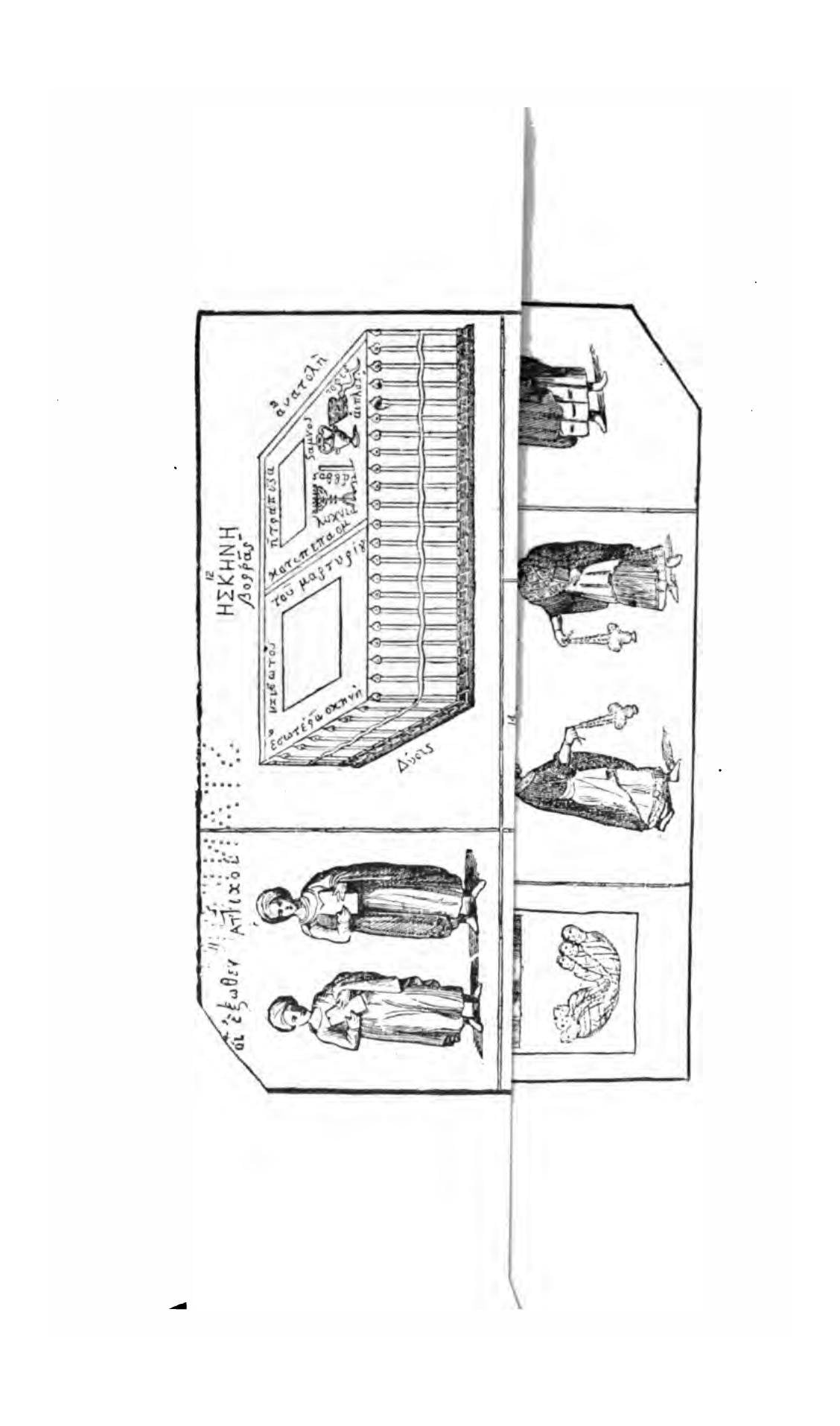
Altıncı yüzyıl İskenderiyesinde yaşamış, ticaret için Hint Okyanusuna dek uzanan yolculuklara çıkmış bir keşiş olan Cosmas Indicopleustes, evrenin gerçek yapısının Musanın çölde kurduğu Buluşma Çadırında gizli olduğunu savundu. Ona göre kutsal çadırın her bölmesi, her eşyası göklerin ve yerin bir suretiydi. Aşağıdaki satırlar, eserin çevirmeninin bu olağanüstü tasavvuru özetlediği giriş bölümünden alınmıştır. Kilise düşüncesinin küreyi reddedip yeryüzünü dört köşeli, düz bir zemin olarak tahayyül ettiği bu okuma, kozmolojinin nasıl bir ilahiyat diline dönüştüğünü gösterir.
Cosmasa göre evrenin gerçek sureti, en iyi Musanın çölde kurduğu Çadırın yapısı ve eşyaları incelenerek anlaşılabilirdi. Bu olağanüstü tasavvur onunla başlamıyordu: Kendisinden önceki bazı Hristiyan Kilise Babaları da bunu belli belirsiz, genel bir biçimde benimsemiş, Pavlusun İbranilere Mektubunun dokuzuncu bölümünün 23. ve 24. ayetlerindeki -Çadırın ve içindekilerin, gerçek olanın "suretleri" (hypodeigmata) ve "timsalleri" (antitypa) olduğu yolundaki- ifadelerin buna dayanak oluşturabileceğine inanmışlardı. Bu tasavvuru geliştirip bütün ayrıntılarıyla işlemek Cosmasa kalmıştı.
Böylece o, tekrar tekrar şunu açıklar: Çadırın perde vasıtasıyla iki mekâna bölünmesi, evrenin de gök kubbe vasıtasıyla biri üstte biri altta olmak üzere iki âleme bölünmesini temsil ediyordu. Kenarı dalgalı biçimde işlenmiş adak ekmeği masası ise okyanusla çevrelenmiş yeryüzünü gösteriyordu; masanın öteki parçaları ve üzerindeki her bir nesne de doğadaki şu ya da bu varlığı simgeliyordu.
Şimdi, masa eninin iki katı uzunluğunda olduğuna, boyu doğudan batıya, eni kuzeyden güneye doğru yerleştirildiğine göre, bundan şunu öğreniriz: Yeryüzü, uzunluğu doğudan batıya, genişliği kuzeyden güneye uzanan, eninin iki katı uzunlukta, dört köşeli düz bir zemindir. Bize bildirdiğine göre okyanus, üzerinde gemi yüzdürülemeyen bir sudur; bizim bu yeryüzümüzü kuşatırken kendisi de, Tufanın dalgaları üzerinde yüzen Geminin Nuhu ve ailesini taşıyıncaya dek Cennetin bulunduğu ve insanın yaşadığı başka bir kara parçası tarafından kuşatılmıştır.
Gökler bize dört duvar biçiminde iner; bu duvarların alt kenarları, okyanusun ötesindeki yeryüzünün dört kenarına, her biri kendi karşılığına kaynaşmış haldedir. Kuzey duvarının, göğün tepesindeki üst kenarı kavis çizerek güney duvarının üst kenarıyla birleşir; böylece, Cosmasın bir hamamın kubbeli tavanına benzettiği, uzunlamasına bir kubbe biçiminde göğün örtüsü oluşur. Bu geniş, dört köşeli salon, gök kubbe vasıtasıyla ortadan ikiye bölünür; gök kubbe böylece alt kata tavan, üst kata ise taban olur. Alt kat, insanların ve meleklerin Diriliş gününe dek yaşadığı bu dünyadır; üst kat ise gelecek hayatın yeri olan gökyüzüdür.
Yeryüzünün evrendeki konumu bakımından Kutsal Kitap, Cosmasa hiçbir kuşku bırakmıyordu. Mezmurlar yazarı, Yaradanın yeryüzünü kendi sağlamlığı üzerine kurduğunu bildirmişti; Eyüp, onu hiçliğin üzerine astığını; İşaya ise gökyüzü Onun tahtı iken yeryüzünün Onun ayak taburesi olduğunu söylemişti. Öyleyse yeryüzünün yeri, açıkça, evrenin en altıydı; bu, yaratıldığı anda doğal olarak batmış olması gereken bir konumdu. Öyleyse yeryüzünün evrenin ortasında olduğu yolundaki Pagan öğretisinden daha saçma ne olabilirdi? Eğer ortada olsaydı, hem altında hem üstünde bir şey olması gerekirdi; oysa altında hiçbir şey yoktur, çünkü Tekvinden Tanrının gökle yeri yarattığını, bunların ötesinde başka bir şey yaratmadığını öğreniyoruz. Böylece Paganlar burada kutsal Yazıyla çatışma halindedir; ama bununla da yetinmeyip sağduyunun ve doğanın yasalarının kendisiyle de çatışırlar: Yeryüzünün merkezi bir küre olduğunu, başaşağı durmak zorunda kalan ve üzerine yağmurun yukarı doğru yağdığı Antipodların (karşı-ayaklıların) var olduğunu ileri sürerler.
Cosmasın bu şekilde tasavvur ettiği dünyanın biçimine değinen Sir Henry Yule, acımasız bir mizahla, günümüz kadın yolcularının elbiselerini taşımak için kullandığı o kocaman bavullardan birinin, Cosmasın Kozmosunun kusursuz bir modelini oluşturduğunu söylemiştir. Cosmasın gece ile gündüzün birbirini izlemesini açıklama biçimi de, dünyanın biçimine dair görüşü kadar saçmadır. Yeryüzünün küre biçiminde olduğu ve evrenin merkezinde bulunduğu, gök cisimlerinin de onun çevresinde döndüğü yolundaki Pagan kuramı, güneşin geceleyin gözden kaybolmasını tatmin edici biçimde açıklıyordu; oysa felsefesinde ne küresel bir yeryüzüne ne de bir yeraltı dünyasına yer olan Cosmas, o büyük ışık kürenin görünmez olduğu zamanlarda onu nereye yerleştirebilirdi? Bu sorun onun icat gücünü aşmadı. Güneşin doğarken önce güneye, sonra kuzeye döndüğünü, orada battığını, sonra da doğduğu yere hızla döndüğünü bildiren Süleymanın sözlerine dayanarak şu olağanüstü kuramı kurdu: Yeryüzü, güneyden yavaş yavaş yükselerek batıya doğru uzanır ve sonunda, uzak, buzlu kuzeyde bir yerde, kocaman koni biçimli bir dağda son bulur. Güneş, günün sonunda bu muazzam koninin arkasında gözden kaybolur ve yaşadığımız dünyayı karanlıkta bırakır; ta ki koninin çevresini dolaşıp doğuda yeniden görününceye ve yeni bir günü doğuruncaya dek. Gece dönüşü sırasında yüksekte ya da alçakta oluşuna göre gecelerin uzunluğu değişir; hareketindeki hafif bir eğiklik yüzünden de tutulmalar meydana gelir. Büyük ışık kürenin büyüklüğü konusunda Cosmas, Pagan filozoflardan tümüyle ayrılır ve altıncı kitabını, güneşin -onların düşündüğü gibi- yeryüzünden kat kat büyük olmadığını, İskenderiye ile Rodos, Rodos ile Konstantinopolis enlemleri arasındaki iki iklim kuşağı büyüklüğünde, yani yaklaşık 635 coğrafi mil genişliğinde olduğunu kanıtlamaya ayırır. Ne var ki Süleymanın sözleri, doğa düzenine dair bu görüşün tek Kutsal Kitap dayanağı değildir: Adak ekmeği masasının güneyine yerleştirilen şamdan, güneşin yeryüzünü güneyden kuzeye doğru aydınlattığını simgelerken, masayı çevreleyen dalgalı kenar da, dev dağın çevresinde dönerken güneş tarafından aydınlatılan, dış yeryüzüyle çevrili okyanusu simgeliyordu.
Cosmasın özellikle nefret ettiği ve öfkeli, sert saldırılarının en sık hedefi haline getirdiği Pagan kuram, göklerin küre biçiminde olup sürekli döndüğü öğretisiydi. Bu en zararlı öğretinin savunucularını çürütmek için metin üstüne metin yığar; çünkü ona göre bu öğretinin kabulü, gelecek hayatı ortadan kaldırır ve Mesihin dirilişini anlamsız kılardı. Cosmas, göklerin döndüğü öğretisini dinsizlik sayarken, gök cisimlerinin devinimini kabul ediyordu; ona göre bu cisimler, gökte değil gök kubbenin altındaki hava boşluklarıyla sınırlı olan meleklerce, Diriliş gününe dek, yörüngelerinde sürülüyordu.
Cosmas bütün bu görüşleri -ve bunlar kadar saçma, yine de ilgi çekici başka birçok görüşü- yorulmak bilmez bir ısrarla defalarca dile getirir; bunları sağduyu ve kutsal Yazının üstün otoritesiyle onaylanmış, hayati gerçekler sayarak, bunları benimsemek yerine sapkın aptallıkları ya da doğrudan kötülükleri yüzünden yeryüzüyle göğün küre biçiminde olduğu ve üzerine yağmurun yukarı doğru yağdığı Antipodların var olduğu yolundaki zavallı Pagan inancını benimsemeyi yeğleyen o sapkın Hristiyanları defalarca kınar.
Özgün metin (İngilizce)
...the figure of the universe can best be learned from a study of the structure and furniture of the Tabernacle which Moses prepared in the wilderness. This wonderful conception did not originate with himself. Some of the Christian Fathers who preceded him had entertained it in a vague and general way, believing it might be warranted by the expressions in Hebrews, ix, 23 and 24, where the Tabernacle and its contents are said to be patterns (ὑποδείγματα) and antitypes or figures of the true (ἀντίτυπα τῶν ἀληθινῶν). It was left to Cosmas to develop the conception and work it out into all its details.
So he explains again and again that the division of the Tabernacle into two places, by means of the veil, typified the division of the universe into two worlds—an upper and a lower, by means of the firmament. The table of shew-bread, again, with its waved border, represented the earth surrounded by the ocean, while its other parts and the things upon it symbolized each some object or other in the natural world. Now, as the table was twice as long as it was broad, and was placed lengthwise from east to west, and breadthwise from north to south, from this we learn that the earth is a rectangular plane which extends in length from east to west, and in breadth from north to south, and is twice as long as it is broad. The ocean, he further gives us to know, is unnavigable, and, while encompassing this earth of ours, is itself encompassed by another earth, which had been the seat of Paradise and the abode of man until the Ark, floating on the billows of the Flood, wafted Noah and his family over into this earth.
The heavens come downward to us in four walls, which, at their lower sides, are welded to the four sides of the earth beyond ocean, each to each. The upper side of the northern wall, at the summit of heaven, curves round and over, till it unites with the upper side of the southern wall, and thus forms, in the shape of an oblong vault, the canopy of heaven, which Cosmas likens to the vaulted roof of a bathroom. This vast rectangular hall is divided at the middle into two stories by the firmament, which thus serves as a ceiling for the lower story and a floor for the upper. The lower story is this world, where men and angels have their abode until the Resurrection, and the story above is heaven—the place of the future state.
As to the position of the earth in the scheme of things, Scripture left Cosmas in no doubt. The Psalmist had declared that the Creator had founded the earth upon its own stability; Job, that He had hanged it upon nothing; and Isaiah, that, while heaven was His throne, the earth was His footstool. Clearly, therefore, the place of the earth was at the bottom of the universe—a position to which it must have naturally sunk at the very instant of its creation. What then can be more absurd than the Pagan doctrine that the earth is in the middle of the universe? Were it in the middle, there must be something below it as well as above it; but there is nothing below it, since we learn from Genesis that God made heaven and earth, and nothing else beyond these. Here then the Pagans are at war with divine Scripture; but, not content with this, they are at war also with common sense itself and the very laws of nature, declaring, as they do, that the earth is a central sphere, and that there are Antipodes, who must be standing head-downward and on whom the rain must fall up.
Referring to the figure of the world as thus conceived by Cosmas, Sir Henry Yule with grim humour remarked that "one of the huge receptacles in which female travellers of our day carry their dresses, forms a perfect model of the Kosmos of Kosmas". The theory, again, by which Cosmas accounts for the vicissitudes of day and night is no less preposterous than his idea of the figure of the world. The Pagan theory that the earth is spherical and placed in the centre of the universe, with the heavenly bodies revolving round it, accounted satisfactorily for the disappearance of the sun during the night; but where could Cosmas, in whose philosophy there was neither a spherical earth nor any under-world, find a place for the great orb of light when no longer visible? The problem did not baffle his ingenuity. Calling to his aid the words of Solomon, which declared that the sun on rising turned first towards the south and then towards the north, where he went down, and thence hastened to the place in which he arose, he made them the basis of the following extraordinary theory. The earth, he tells us, gradually rising up from the south, extends westward, until it culminates at last in a huge conical mountain situated somewhere in the far-away frozen north. Behind this immense cone, the sun at the close of day disappears from view, and leaves the world which we inhabit in darkness, until, having circled round the cone, he reappears in the east to give birth to a new day. According, moreover, as he is high or low during his nocturnal revolution, the nights vary in their length; while, owing to a slight obliquity in his motion, eclipses are produced. On the question of the magnitude of the great luminary Cosmas differed widely from the Pagan philosophers, and wrote his sixth book mainly to prove that, instead of its being, as they thought, many times larger than the earth, it was no more than the size of two only of the earth's climates or zones, those between the latitudes of Alexandria and Rhodes, and Rhodes and Constantinople, an extent of about 635 geographical miles. But the words of Solomon form by no means the only Scriptural warrant for taking this view of the order of nature, for the candlestick placed on the south of the table of shew-bread typified the sun shining upon the earth from the south towards the north, while the waved border which ran round the table typified the ocean surrounded by the outer earth, both of which were illuminated by the sun while circling round the gigantic mountain.
The Pagan theory which Cosmas especially detested, and made most frequently the subject of his scornful and violent invective, was that which maintained that the heavens were spherical and in constant revolution. He heaps text upon text to confute the advocates of this most pestilent doctrine, which, if admitted, would, he contended, abolish the future state and make the resurrection of Christ of no account. But while Cosmas regarded as impious the doctrine that the heavens revolve, he admitted the revolution of the celestial luminaries, which, he held, were propelled in their courses by the angels, who do not live in heaven but are restricted to the aerial spaces below the firmament, until the resurrection.
All these and other views no less absurd, though interesting, Cosmas states and re-states with the most wearisome pertinacity, and holding them to be most vital verities, sanctioned alike by common sense and the paramount authority of divine Scripture, denounces again and again those reprobate Christians who, instead of accepting them, prefer, through their perverse folly or downright wickedness, to adopt the miserable Pagan belief that earth and heaven are spherical, and that there are Antipodes on whom the rain must fall up.
Bu metin neden önemli
Metin, Cosmas Indicopleustesin altıncı yüzyıla ait Yunanca eseri Hristiyan Topografyanın 1897 tarihli İngilizce çevirisinden, çevirmenin giriş bölümündendir. Cosmas, dünyanın küre biçiminde olduğunu öne süren klasik astronomiye karşı çıkmış, Kutsal Kitaptaki Çadır tasvirini kozmolojik bir model olarak okumuştur. Bu görüş dönemin bilimsel çevrelerinde bile marjinal kalmış olsa da, kutsal mimarinin evrenin sureti sayıldığı kadim bir tahayyülün en sistemli örneklerinden biridir.
Bölüm 02 · Kutsal Coğrafya: Evrenin Haritası
Bu metin, Kutsala Dönüş podcast'inin bu bölümünde ele alınıyor. Yönün anlamı, üç katman, axis mundi, merkez bulma.
Bölümü dinle →Bu eser Kozmoloji Koleksiyonu'nun parçasıdır →
- Kaynak eser
- Christian Topography — Cosmas Indicopleustes (İng. çev. J. W. McCrindle, 1897)
- Neşir
- 1897 İngilizce çevirisi (Hakluyt Society), altıncı yüzyıl Yunanca aslından
- Konum
- Giriş (Introduction), s. xv–xx (Cosmasın kozmoloji sisteminin tam özeti)
- Çeviren
- Şira Nur Uysal
- Dijital nüsha
- Source Library
Uysal, Ş. N. (Çev.). (2026). Hristiyan Topografyası: Çadır ve Evrenin Sureti. Kadim Kütüphane. https://kadimkutuphane.com/cosmas-indicopleustes-hristiyan-topografyasi-cadir-evren@misc{kk_cosmas_indicopleustes,
author = {Uysal, Şira Nur},
title = {{Hristiyan Topografyası: Çadır ve Evrenin Sureti}},
year = {2026},
publisher = {Kadim Kütüphane},
url = {https://kadimkutuphane.com/cosmas-indicopleustes-hristiyan-topografyasi-cadir-evren},
note = {Türkçe çeviri, özgün eser: Cosmas Indicopleustes},
}Yeni metinlerden ilk sen haberdar ol
Tam çeviriler, PDF'ler ve yeni eklenen kaynaklar hazırlandıkça e-postana düşsün.