Emanuel Swedenborg (1688-1772) İsveçli bir bilim insanı ve mühendisti. Elli altı yaşlarında ruhani dünyayı gördüğünü anlatan bir döneme girdi ve geri kalan ömrünü teolojik eserler yazmaya adadı. Sapientia Angelica de Divino Amore et de Divina Sapientia, 1763'te Amsterdam'da yayımlanan Latince eseridir. Bu bölüm İngilizce çevirisinden aktarılmıştır.
İLÂHÎ SEVGİYE DAİR MELEKÎ BİLGELİK.
BİRİNCİ BÖLÜM.
1. SEVGİ İNSANIN HAYATIDIR. İnsan sevgi diye bir şeyin var olduğunu bilir, fakat sevginin ne olduğunu bilmez. Sevgi diye bir şeyin var olduğunu gündelik konuşmalardan, örneğin şu tür ifadelerden bilir: falan kişi beni seviyor, bir kral tebaasını sever ve tebaa da kralı sever, bir koca karısını sever ve bir anne çocuklarını sever ve bunun tersi de geçerlidir; ayrıca falan ve filan kişi vatanını, yurttaşlarını, komşusunu sever; keza bir kimseden soyutlayarak nesnelerden bahsederken de bir kimsenin şu veya bu şeyi sevdiği söylendiğinde böyledir. Bununla birlikte, sevgi gündelik konuşmada bu denli evrensel bir ifade olmasına rağmen, sevginin ne olduğunu neredeyse hiç kimse bilmez. Konu üzerinde tefekküre daldığında, ona dair zihninde herhangi bir düşünce fikri oluşturamadığından ötürü bir kimse, onun ya hiçbir şey olmadığını ya da yalnızca görmeden, işitmeden, dokunmadan ve sosyal ilişkilerden içeri akıp bu yolla etkide bulunan bir şey olduğunu söyler. Sevginin bizzat kendi hayatı olduğu gerçeğinden ise bütünüyle habersizdir; oysa sevgi yalnızca bütün bedeninin genel hayatı ve tüm düşüncelerinin genel hayatı değil, aynı zamanda bunların bütün tekil unsurlarının da hayatıdır. Bilge bir insan bunu şu tür sorulardan idrak edebilir: Sevgiye ait olan bağlılığı çekip alırsanız, o zaman herhangi bir şey düşünebilir misiniz ve herhangi bir şey yapabilir misiniz? Düşünce, söz ve eylem, sevgiye ait bağlılık soğudukça aynı oranda soğumaz mı? Ve sevgiye ait bağlılık ısındıkça onlar da aynı oranda ısınmaz mı? Ne var ki bilge insan bunu sevginin insanın hayatı olduğu bilgisinden değil, bu şeylerin böyle gerçekleştiğine dair tecrübesinden idrak eder.
2. Sevginin hayat olduğunu bilmedikçe, hiç kimse insanın hayatının ne olduğunu bilemez. Bu bilinmezse, bir kimse insanın hayatının yalnızca duyularla algılamaktan ve eylemekten ibaret olduğuna, bir başkası ise düşünmekten ibaret olduğuna inanabilir; oysa düşünce hayatın birinci etkisi, duyu ve eylem ise hayatın ikinci etkileridir. Burada düşüncenin hayatın birinci etkisi olduğu söylenmiştir, ancak bir daha içsel ve yine daha içsel düşünce olduğu gibi, daha dışsal ve yine daha dışsal düşünce de vardır. Gayelerin algılanması demek olan en içteki düşünce, gerçekte hayatın birinci etkisidir. Fakat bu hususlar daha sonra, hayatın dereceleri ele alındığında incelenecektir.
3. Sevginin insanın hayatı olduğuna dair bir fikir, dünyadaki güneşin ısısından edinilebilir. Bu ısının, yeryüzündeki tüm bitki örtüsü için bir tür ortak hayat olduğu iyi bilinir. Zira bu ısı yükseldiğinde, ki ilkbahar vaktinde durum böyledir, her türden bitki topraktan fışkırır; yapraklarla, ardından çiçeklerle ve nihayet meyvelerle donanırlar ve böylece belirli bir anlamda yaşarlar. Fakat ısı çekildiğinde, ki sonbahar ve kış vaktinde durum böyledir, bitkiler bu hayat belirtilerinden soyunurlar ve kururlar. İnsandaki sevginin durumu da böyledir; zira ısı ile sevgi karşılıklı olarak birbirine tekabül eder; bu sebeple sevgi de sıcaktır.
4. YALNIZCA TANRI, DOLAYISIYLA RAB, HAKİKİ SEVGİDİR, ÇÜNKÜ O HAKİKİ HAYATTIR; MELEKLER VE İNSANLAR İSE HAYATIN ALICILARIDIR. "İlâhî Takdir" ve "Hayat" üzerine olan risalelerde bu durum bolca açıklanacaktır; burada yalnızca evrenin Tanrısı olan Rabbin yaratılmamış ve sonsuz olduğunu, insan ve meleğin ise yaratılmış ve sonlu olduğunu belirtmekle yetineceğiz. Rab ayrıca yaratılmamış ve sonsuz olduğu için, Yehova olarak adlandırılan Hakiki Varlık'tır (Esse) ve O, Hakiki Hayat veya kendi içinde Hayat'tır. Hiçbir insan Yaratılmamış Olandan, Sonsuz Olandan, bizzat Hakiki Varlık'tan ve bizzat Hakiki Hayat'tan doğrudan yaratılamaz, çünkü İlâhî olan birdir ve bölünemez; aksine insan, İlâhî olanın içlerinde bulunabileceği şekilde biçimlendirilmiş, yaratılmış ve sonlu kılınmış şeylerden yaratılmalıdır. İnsanlar ve melekler bu nitelikte olduklarından, hayatın alıcılarıdırlar. Bu nedenle şayet herhangi bir insan, kendisinin hayatın bir alıcısı değil de bizzat hayat olduğuna inanacak kadar zihnen yoldan çıkmasına izin verirse, Tanrı olduğu düşüncesinden alıkonulamaz. İnsanın sanki bizzat hayat kendisiymiş gibi hissetmesi ve bundan ötürü öyle olduğuna inanması gerçeği, bir yanılgıdan kaynaklanır; çünkü asıl neden, araçsal nedende onunla bir olmaktan başka türlü algılanmaz. Rabbin kendi içinde hayat olduğunu, Kendisi Yuhanna İncili'nde şöyle öğretir: "Baba'nın kendisinde yaşam olduğu gibi, Oğul'a da kendisinde yaşam olma yetkisini verdi" (v. 26). Kendisinin "bizzat Hayat" olduğunu da bildirir (Yuhanna xi. 25; xiv. 6). Yukarıda 1 ve 2 numaralı kısımlarda söylenenlerden de anlaşıldığı üzere, hayat ve sevgi bir olduğuna göre, Rab bizzat hayat olduğu için, bizzat sevgi olduğu sonucu çıkar.
5. Fakat bunun zihne tam olarak yerleşebilmesi için kesinlikle bilinmelidir ki, Rab kendi öz cevherinde sevgi, yani İlâhî sevgi olduğu için, cennetteki meleklere bir güneş olarak görünür ve o güneşten ısı ve ışık yayılır ve oradan yayılan ısı özü itibarıyla sevgidir, oradan yayılan ışık ise özü itibarıyla bilgeliktir; ve melekler bu ruhsal ısıyı ve bu ruhsal ışığı kabul edebildikleri ölçüde sevgiler ve bilgeliklerdir; kendiliklerinden sevgiler ve bilgelikler değil, Rabden gelen sevgiler ve bilgeliklerdir. Bu ruhsal ısı ve bu ruhsal ışık yalnızca meleklerin içine akıp onları etkilemekle kalmaz; aynı zamanda insanların içine de akar ve onları bütünüyle birer alıcı haline gelme derecelerine göre etkiler; insanlar da Rabbe olan sevgilerine ve komşuya olan sevgilerine göre alıcı haline gelirler. Bu güneşin kendisi, yani bu İlâhî sevgi, ısısıyla ve ışığıyla herhangi bir varlığı doğrudan doğruya kendisinden yaratamaz; zira bu durumda o varlık, bizzat Rab olan öz cevher halindeki sevgi olurdu: ancak kendisi bizzat ısıyı ve bizzat ışığı alabilecek şekilde biçimlendirilmiş tözlerden ve maddelerden yaratabilir: tıpkı mukayese edilecek olursa, dünya güneşinin ısısıyla ve ışığıyla yeryüzündeki filizlenmeleri doğrudan doğruya meydana getiremeyip, ancak ısısı ve ışığıyla içinde bulunabileceği ve bitki örtüsüne sebep olabileceği toprak maddelerinden meydana getirebilmesi gibi. "Cennet ve Cehennem" adlı eserin 116 ilâ 140 numaralı kısımlarında, Rabbin İlâhî sevgisinin ruhsal dünyada bir güneş olarak göründüğü ve meleklerin sevgi ve bilgeliği kendisinden devşirdikleri ruhsal ısının ve ruhsal ışığın ondan yayıldığı görülebilir.
6. Mademki insan hayat değildir, ancak hayatın bir alıcısıdır, o halde bir insanın babasından gebe kalınması hayatın bir gebe kalınması değil, sadece hayatı kabul edebilecek ilk ve en saf formun gebe kalınmasıdır; bu forma, bir tohum veya başlangıç lifi olarak, rahimde sırasıyla kendi düzeninde ve kendi derecesinde hayatın kabul edilmesine uyarlanmış formlardaki tözler ve maddeler eklenir.
7. İLÂHÎ OLAN MEKÂNDA DEĞİLDİR. İlâhî olanın, yani Tanrı'nın, her yerde hazır ve nazır olmasına, dünyadaki her insanla, cennetteki her melekle ve cennetin altındaki her ruhla birlikte bulunmasına rağmen mekânda olmadığı hakikati, salt doğal bir fikirle kavranamaz, fakat ruhsal bir fikirle kavranabilir. Doğal bir fikirle kavranamaz, çünkü o fikrin içinde mekân vardır; zira dünyadaki şeylerden teşekkül etmiştir; ve göze çarpan bu şeylerin her birinde ve tümünde mekân vardır. Oradaki büyük ve küçük her şey mekâna aittir; oradaki uzun, geniş ve yüksek her şey mekâna aittir; kısacası oradaki her ölçü, şekil ve form mekâna aittir. Bu yüzden, İlâhî olanın her yerde olduğu söylendiğinde, mekânda olmadığının salt doğal bir fikirle kavranamayacağı ifade edilmiştir. Bununla birlikte bir insan, içine ruhsal ışıktan bir parça kabul etmesi kaydıyla, bunu doğal düşünceyle de kavrayabilir. Bu nedenle her şeyden önce ruhsal fikre ve ondan doğan düşünceye dair bir şeyler söyleyeceğiz. Ruhsal bir fikir mekândan hiçbir şey devşirmez, bilakis her şeyini durumdan devşirir.
Özgün metin (İngilizce)
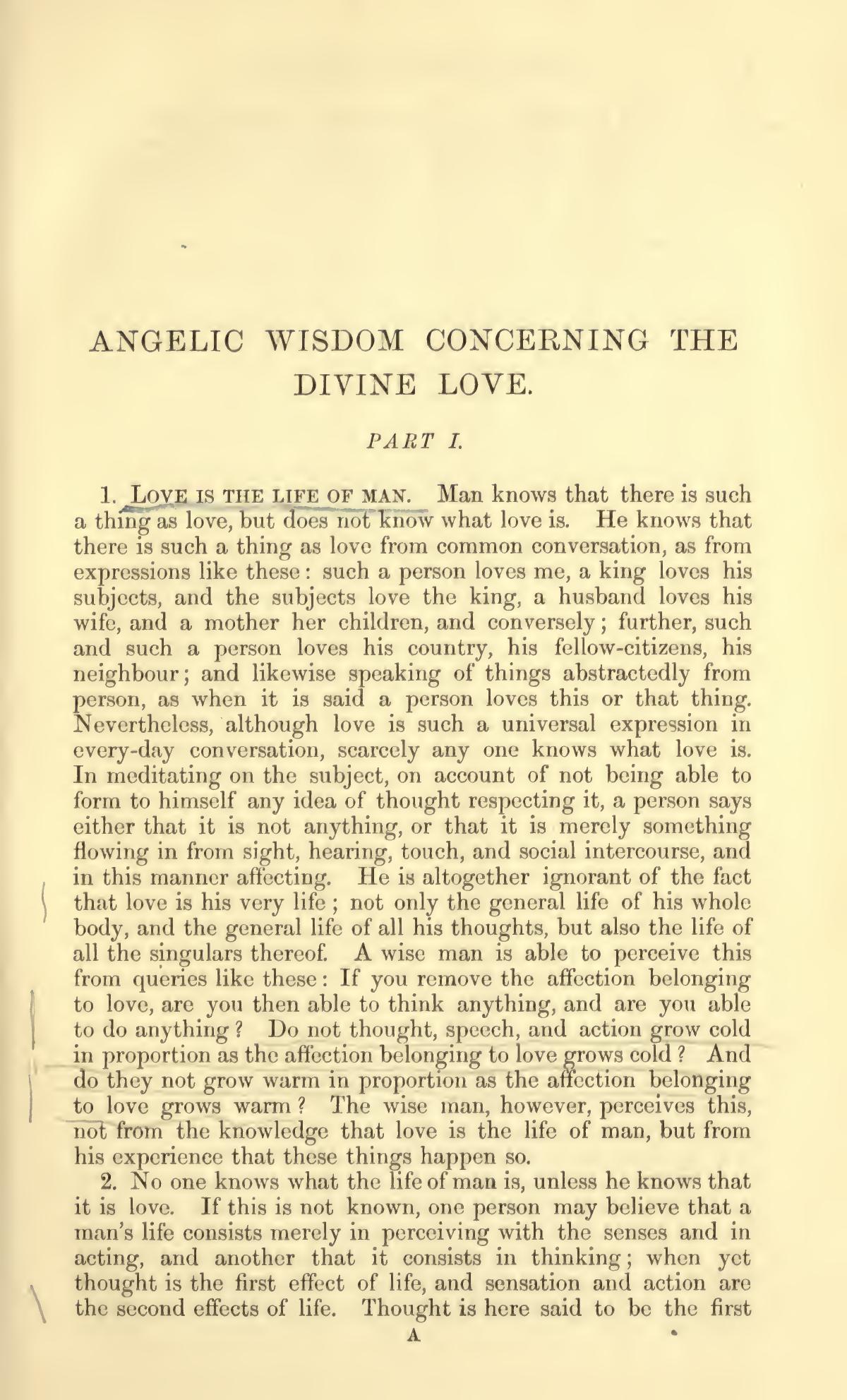
ANGELIC WISDOM CONCERNING THE DIVINE LOVE.
PART I.
1. LOVE IS THE LIFE OF MAN. Man knows that there is such a thing as love, but does not know what love is. He knows that there is such a thing as love from common conversation, as from expressions like these: such a person loves me, a king loves his subjects, and the subjects love the king, a husband loves his wife, and a mother her children, and conversely; further, such and such a person loves his country, his fellow-citizens, his neighbour; and likewise speaking of things abstractedly from person, as when it is said a person loves this or that thing. Nevertheless, although love is such a universal expression in every-day conversation, scarcely any one knows what love is. In meditating on the subject, on account of not being able to form to himself any idea of thought respecting it, a person says either that it is not anything, or that it is merely something flowing in from sight, hearing, touch, and social intercourse, and in this manner affecting. He is altogether ignorant of the fact that love is his very life; not only the general life of his whole body, and the general life of all his thoughts, but also the life of all the singulars thereof. A wise man is able to perceive this from queries like these: If you remove the affection belonging to love, are you then able to think anything, and are you able to do anything? Do not thought, speech, and action grow cold in proportion as the affection belonging to love grows cold? And do they not grow warm in proportion as the affection belonging to love grows warm? The wise man, however, perceives this, not from the knowledge that love is the life of man, but from his experience that these things happen so.
2. No one knows what the life of man is, unless he knows that it is love. If this is not known, one person may believe that a man's life consists merely in perceiving with the senses and in acting, and another that it consists in thinking; when yet thought is the first effect of life, and sensation and action are the second effects of life. Thought is here said to be the first effect of life, yet there is thought which is interior, and again interior; and thought which is exterior, and again exterior. Inmost thought, which is the perception of ends, is actually the first effect of life. But of these things hereafter, when the degrees of life are considered.
3. Some idea of love, as being the life of man, may be obtained from the heat of the sun in the world. It is well known that this heat is a kind of common life to all the vegetations of the earth. For when this heat arises, as is the case in spring time, plants of every kind spring from the soil; they deck themselves with leaves, afterwards with blossoms, and at last with fruits, and thus live in a certain sense. But when the heat retires, as is the case in the time of autumn and winter, the plants are stripped of these signs of their life, and they wither. The case of love with man is like this; for heat and love mutually correspond to each other; wherefore also love is warm.
4. GOD ALONE, CONSEQUENTLY THE LORD, IS VERY LOVE, BECAUSE HE IS VERY LIFE; AND ANGELS AND MEN ARE RECIPIENTS OF LIFE. In the treatises on "Divine Providence" and on "Life" this will be abundantly illustrated; here we shall only state that the Lord who is the God of the universe, is uncreate and infinite, whereas man and angel are created and finite. The Lord also, because he is uncreate and infinite, is very Esse which is called Jehovah, and He is Very Life or Life in itself. No man can be created immediately from the Uncreate, the Infinite, from very Esse and very Life, because the Divine is one and indivisible; but man must be created from created and finited things which have been so formed that the Divine can be in them. Since men and angels are such, they are recipients of life. If any man therefore allows himself to be so far led astray in thought as to believe that he is not a recipient of life, but life, he cannot be withheld from the thought that he is God. The fact that a man does feel as if he were life, and thence believes that he is, arises from fallacy; for the principal cause is not perceived otherwise in the instrumental cause than as one with it. That the Lord is life in Himself, He Himself teaches in John, "As the Father hath life in Himself, so also hath He given to the Son to have life in Himself" (v. 26). He declares also that he is "Life itself" (John xi. 25; xiv. 6). Now since life and love are one, as appears from what has been said above, nos. 1, 2, it follows that the Lord because He is life itself, is love itself.
5. But in order that this may strike the understanding, be it known absolutely, that the Lord, because He is love in its own very essence, that is, Divine love, appears before the angels in heaven as a sun, and that from that sun proceed heat and light, and that the heat thence proceeding in its essence is love, and the light thence proceeding in its essence is wisdom; and that the angels in proportion as they are recipients of that spiritual heat and of that spiritual light, are loves and wisdoms; not loves and wisdoms from themselves, but from the Lord. That spiritual heat and that spiritual light not only flow in with the angels and affect them; but they also flow in with men and affect them altogether in proportion as they become recipients; and they become recipients according to their love of the Lord, and their love towards the neighbour. This sun itself, this Divine love, cannot create any one immediately from itself by its heat and by its light; for in that case he would be love in its essence, which is the Lord Himself: but it can create from substances and matters so formed that they are able to receive heat itself and light itself: comparatively as the sun of the world by its heat and light cannot produce germinations in the earth immediately, but from the matters of the soil in which it can be present by its heat and light, and cause vegetation. In the work on "Heaven and Hell," nos. 116 to 140, it may be seen that the Divine love of the Lord appears in the spiritual world as a sun, and that the spiritual heat and the spiritual light from which the angels derive love and wisdom, proceed from it.
6. Since then man is not life, but a recipient of life, it follows that the conception of a man from his father is not a conception of life, but only a conception of the first and purest form receptible of life; to which form, as a stamen or initiament, are successively added in the womb substances and matters in forms adapted to the reception of life in its order and in its degree.
7. THE DIVINE IS NOT IN SPACE. That the Divine, namely, God, is not in space, although the Divine is omnipresent and with every man in the world, and with every angel in heaven, and with every spirit under heaven, cannot be comprehended by a merely natural idea, but may by a spiritual idea. It cannot be comprehended by a natural idea, because there is space in that idea; for it is formed out of such things as are in the world; and in each and all of these things, which strike the eye, there is space. Everything great and small there is of space; everything long, broad, and high there is of space; in short every measure, figure and form there is of space. It has therefore been said that by a merely natural idea it cannot be comprehended that the Divine is not in space, when it is said that it is everywhere. A man, nevertheless, may comprehend this by natural thought, provided he admits into it something of spiritual light. We shall therefore first of all say something concerning the spiritual idea, and the thought therefrom. A spiritual idea does not derive anything from space, but it derives its all from state.
Bu metin neden önemli
Eser Swedenborg'un öğretisinin merkezindeki iddiayı ortaya koyar. İnsanın hayatı sevgidir, düşünce ve eylem sevgiye bağlı olarak canlıdır. Bu bölümde Swedenborg sevgiyi gündelik bir söz olarak herkesin bildiğini, ama ne olduğunu çoğu kişinin düşünmediğini söyler. Metin Swedenborg'un ruhsal fikir anlayışını ve sevgi ile bilgeliğin ilişkisini ilk paragraflardan itibaren görmek için uygun bir başlangıçtır.
Bu eser Mistik Teoloji Koleksiyonu'nun parçasıdır →
- Kaynak eser
- Emanuel Swedenborg, Angelic Wisdom concerning the Divine Love and the Divine Wisdom, Swedenborg Society çevirisi, Londra
- Neşir
- 1763 / Swedenborg Society çevirisi
- Konum
- Birinci Bölüm, 1. paragraftan başlayarak
- Çeviren
- Şira Nur Uysal
- Dijital nüsha
- Internet Archive
Uysal, Ş. N. (Çev.). (2026). Swedenborg, İlahi Sevgi ve Hikmet: Sevgi İnsanın Hayatıdır. Kadim Kütüphane. https://kadimkutuphane.com/swedenborg-ilahi-sevgi-ve-hikmet-sevgi-insanin-hayatidir@misc{kk_swedenborg_ilahi_sevgi_ve_hikmet_sevgi_i,
author = {Uysal, Şira Nur},
title = {{Swedenborg, İlahi Sevgi ve Hikmet: Sevgi İnsanın Hayatıdır}},
year = {2026},
publisher = {Kadim Kütüphane},
url = {https://kadimkutuphane.com/swedenborg-ilahi-sevgi-ve-hikmet-sevgi-insanin-hayatidir},
note = {Türkçe çeviri, özgün eser: Emanuel Swedenborg},
}Yeni metinlerden ilk sen haberdar ol
Tam çeviriler, PDF'ler ve yeni eklenen kaynaklar hazırlandıkça e-postana düşsün.