Jacob Böhme (1575-1624), Görlitz'de yaşamış Alman ayakkabıcı ve mistiktir. Beschreibung der drei Prinzipien göttlichen Wesens'i 1619'da yazdı. Eser, Tanrı'nın özünün, doğanın ve insanın üç ilke üzerinden anlatıldığı bir kozmolojidir. Bu bölüm John Sparrow'un 17. yüzyıl çevirisinin 1910'daki yeniden baskısından aktarılmıştır.
İKİNCİ BÖLÜM
Tanrı'nın ve İlahi Tabiatın ne olduğuna dair birinci ve ikinci İlkeler hakkında; burada Kükürt ve Merkür'ün daha ayrıntılı bir tanımı sunulmaktadır.
1. Bunun bilinmesi ve kavranması ilahi bir ışık gerektirdiğinden ve ilahi ışık olmaksızın ilahi özün hiçbir şekilde kavranması mümkün olmadığından, Okuyucunun derinliğe inebilmesi için bu yüce gizli sırrı yaratılmışlara özgü bir tarzda bir nebze tasvir edeceğim. Çünkü ilahi öz dil ile bütünüyle ifade edilemez; onu yalnızca spiraculum vitae (yani ruhun ışığa bakan tini) kavrar. Zira her yaratık, aslen içinden çıktığı anasından daha ötesini ve daha derinini ne görür ne de anlar.
2. Tanrı'nın birinci İlkesinden doğan ve Tanrı tarafından insana, üçüncü İlkeye (yani yıldızsal ve elementsel doğuşa) üflenen ruh, özünden ve niteliğinden neşet ettiği Tanrı'nın birinci İlkesinin daha da derinini görür. Ve bu şaşılacak bir şey değildir, çünkü o yalnızca kendi doğuşunun yükselişinde kendini seyreder; ve böylece birinci İlkedeki Babanın tüm derinliğini görür.
3. Bunu şeytanlar da görür ve bilir; zira onlar da Tanrı'nın asli tabiatının kaynağı olan Tanrı'nın birinci İlkesindendir. Bunu görmemeyi ve hissetmemeyi de dilerler; fakat bundan sonra bahsedileceği üzere, özde bir ve kişisel ayrımda üçlü olan, Tanrı olarak adlandırılan ve Tanrı olan ikinci İlkenin kendilerine kapalı olması kendi suçlarıdır.
4. Fakat Tanrı'nın Kutsal Ruhu ile aydınlanmış olan insan ruhu (ki bu Ruh, ikinci İlkede kutsal cennetteki, yani Tanrı olarak adlandırılan gerçek ilahi tabiattaki Baba ve Oğul'dan çıkar), bu ruh doğrudan Tanrı'nın ışığına, kutsal ilahi doğuşun aynı ikinci İlkesine, semavi öze doğru bakar: Ancak ruhun büründüğü yıldızsal tin ve ayrıca kanın kaynağını yahut fışkırışını ve itkisini yöneten elementsel [tin], kendilerinden çıktıkları ve içinde yaşadıkları analarının ötesini göremezler.
5. Bu nedenle, tamamen semavi olanı ve bütünüyle saf Uluhiyete ait olanı konuşup yazacak olsaydım, bilgiye ve yeteneğe sahip olmayan Okuyucuya karşı dilsiz gibi olurdum. Yine de, herhangi bir kimseyi yüce şeyleri tefekkür etmeye arzu ve iştiyak duymaya sevk edebilmek için ilahi ve aynı zamanda yaratılmışlara özgü bir tarzda yazacağım: Ve şayet bir kimse bunu yapamayacağını fark ederse, en azından arzusu içinde arayıp kapıyı çalsın ve Tanrı'ya, ikinci İlkenin kapısının kendilerine açılması için Kutsal Ruhunu dileyerek dua etsin; zira Mesih bize dua etmemizi, aramamızı ve kapıyı çalmamızı buyurur ve o vakit bize açılacaktır. Çünkü şöyle der: Babamdan benim adımla dileyeceğiniz her şeyi O size verecektir: Dileyin, alacaksınız; arayın, bulacaksınız; kapıyı çalın, size açılacaktır.
6. Bilgim aramak ve kapıyı çalmak suretiyle elde edildiğine göre, bunu bir Yadigar olarak yazıya geçiriyorum ki herhangi bir kimsede bunları arama arzusu uyandırabileyim ve böylece yeteneğim toprağa gömülmeyip değerlendirilebilsin. Ancak bunu peşinen bilge olan, her şeyi bildiğini sanıp yine de hiçbir şeyi bilmeyen ve kavramayanlar için yazmadım, çünkü onlar zaten fazlasıyla doymuş ve zengindirler; bilakis bunu, kendim gibi olanlarla birlikte ferahlayabileyim diye benim gibi saf ve sade olanlar için yazdım.
Kükürt, Merkür ve Tuz hakkında daha fazlası.
7. S U L kelimesi bir şeyin ruhu anlamına gelir ve odur; zira kelimede, P H U R hecesinden türeyen yağ yahut ışıktır; ve bir şeyin güzelliği yahut esenliğidir, onun içindeki sevimli ve en değerli olan şeydir: Bir yaratıkta, yaratığın gördüğü ışıktır: ve akıl ile duyular onda bulunur ve o, P H U R'dan türeyen tindir. P H U R kelimesi veya hecesi, prima materia'dır ve üçüncü İlkede, elementsel hakimiyetin, bölgenin yahut özün kendisinden türediği makrokozmosu kendi içinde barındırır: Fakat birinci İlkede, Tanrı'nın ezelden beri Oğlunu kendisinden doğurduğu yahut meydana getirdiği ve Kutsal Ruh'un da kendisinden çıktığı en içteki doğuşun özüdür; S U L'dan ve P H U R'dan çıktığını anlayın. Ve insanda da mikrokozmosun ikinci merkezindeki yıldızsal tinden türeyen ışıktır; fakat spiraculum'da ve ruhun tininde, en içteki merkezde, yalnızca Tanrı sevgisi içinde olan ruhun sahip olduğu Tanrı ışığıdır, çünkü yalnızca Kutsal Ruh'tan tutuşturulur ve alevlendirilir.
Özgün metin (İngilizce)
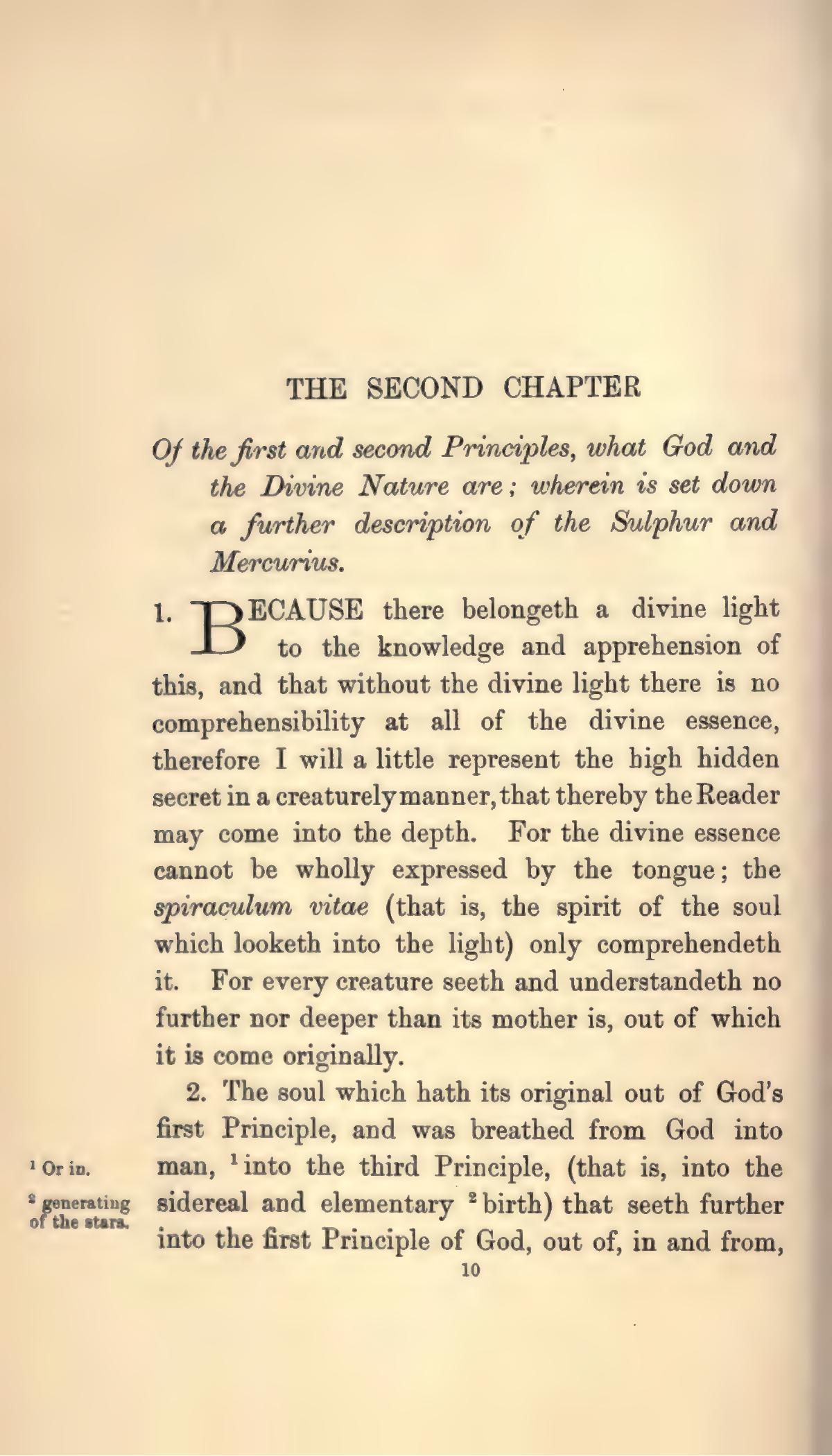
THE SECOND CHAPTER
Of the first and second Principles, what God and the Divine Nature are; wherein is set down a further description of the Sulphur and Mercurius.
1. BECAUSE there belongeth a divine light to the knowledge and apprehension of this, and that without the divine light there is no comprehensibility at all of the divine essence, therefore I will a little represent the high hidden secret in a creaturely manner, that thereby the Reader may come into the depth. For the divine essence cannot be wholly expressed by the tongue; the spiraculum vitae (that is, the spirit of the soul which looketh into the light) only comprehendeth it. For every creature seeth and understandeth no further nor deeper than its mother is, out of which it is come originally.
2. The soul which hath its original out of God's first Principle, and was breathed from God into man, into the third Principle, (that is, into the sidereal and elementary birth) that seeth further into the first Principle of God, out of, in and from, the essence and property of which it is proceeded. And this is not marvellous, for it doth but behold itself only in the rising of its birth; and thus it seeth the whole depth of the Father in the first Principle.
3. This the devils also see and know; for they also are out of the first Principle of God, which is the source of God's original nature. They wish also that they might not see nor feel it; but it is their own fault that the second Principle is shut up to them, which is called and is God, one in essence, and threefold in personal distinction, as shall be mentioned hereafter.
4. But the soul of man, which is enlightened with the Holy Spirit of God, (which in the second Principle proceedeth from the Father and the Son in the holy heaven, that is, in the true divine nature which is called God), this soul seeth even into the light of God, into the same second Principle of the holy divine birth, into the heavenly essence: But the sidereal spirit wherewith the soul is clothed, and also the elementary which ruleth the source, or springing and impulsion of the blood, they see no further than into their mother, whence they are, and wherein they live.
5. Therefore if I should speak and write that which is purely heavenly, and altogether of the clear Deity, I should be as dumb to the Reader, who hath not the knowledge and the gift. Yet I will so write in a divine, and also in a creaturely way, that I might stir up any one to desire and long after the consideration of the high things: And if any shall perceive that they cannot do it, that at least they might seek and knock in their desire, and pray to God for his Holy Spirit, that the door of the second Principle might be opened to them; for Christ biddeth us to pray, seek, and knock, and then it shall be opened unto us. For he saith, All that you shall ask the Father in my name, he will give it you: Ask and you shall receive; seek, and you shall find; knock, and it shall be opened unto you.
6. Seeing then that my knowledge hath been received by seeking and knocking, I therefore write it down for a Memorial, that I might occasion a desire in any to seek after them, and thereby my talent might be improved, and not be hidden in the earth. But I have not written this for those that are wise aforehand, that know all things, and yet know and comprehend nothing, for they are fully satisfied already, and rich; but I have written it for the simple, as I am, that I may be refreshed with those that are like myself.
Further of the Sulphur, Mercurius, and Sal.
7. The word S U L, signifieth and is the soul of a thing; for in the word it is the oil or light that is generated out of the syllable P H U R; and it is the beauty or the welfare of a thing, that which is lovely and dearest in it: In a creature it is the light by which the creature seeth: and therein reason and the senses consist, and it is the spirit which is generated out of the P H U R. The word or syllable P H U R, is the prima materia, and containeth in itself in the third Principle the macrocosm, from which the elementary dominion, or region, or essence is generated: But in the first Principle it is the essence of the most inward birth, out of which God generateth or begetteth his Son from eternity, and thereout the Holy Ghost proceedeth; understand out of the S U L and out of the P H U R. And in man also it is the light which is generated out of the sidereal spirit, in the second centre of the microcosm; but in the spiraculum and spirit of the soul, in the most inward centre, it is the light of God, which that soul only hath which is in the love of God, for it is only kindled and blown up from the Holy Ghost.
Bu metin neden önemli
Bu bölümde Böhme, ilahi özün nasıl kavranabileceğini sorar ve cevabı ilahi ışığın kendisinde bulur. Ruhun yaratılmış bir varlık olarak neyi görüp neyi göremediğini anlatır. Kükürt ve Merkür gibi simya terimleri burada doğanın ilahi kaynağını anlatan bir dil olarak kullanılır. Metin, Böhme'nin simya ile mistik teolojiyi nasıl birleştirdiğini gösterir.
Bu eser Mistik Teoloji Koleksiyonu'nun parçasıdır →
- Kaynak eser
- Jacob Boehme, Concerning the Three Principles of the Divine Essence, John Sparrow çevirisi, Londra, John M. Watkins, 1910
- Neşir
- 1619 / 1910 yeniden baskı
- Konum
- İkinci Bölüm, ilk paragraflar
- Çeviren
- Şira Nur Uysal
- Dijital nüsha
- Internet Archive
Uysal, Ş. N. (Çev.). (2026). Böhme, Üç İlke: Tanrı ve İlahi Doğa Nedir. Kadim Kütüphane. https://kadimkutuphane.com/bohme-uc-ilke-tanri-ve-ilahi-dogada@misc{kk_bohme_uc_ilke_tanri_ve_ilahi_dogada,
author = {Uysal, Şira Nur},
title = {{Böhme, Üç İlke: Tanrı ve İlahi Doğa Nedir}},
year = {2026},
publisher = {Kadim Kütüphane},
url = {https://kadimkutuphane.com/bohme-uc-ilke-tanri-ve-ilahi-dogada},
note = {Türkçe çeviri, özgün eser: Jacob Böhme},
}Yeni metinlerden ilk sen haberdar ol
Tam çeviriler, PDF'ler ve yeni eklenen kaynaklar hazırlandıkça e-postana düşsün.