Jacob Böhme (1575-1624), Görlitz'de yaşamış Alman ayakkabıcı ve mistiktir. Clavis, yani Anahtar, 1624'te yazdığı ve kendi eserlerinde geçen başlıca kavramları açıkladığı kısa bir kılavuzdur. Aktarılan bölüm John Sparrow'un İngilizce çevirisinden alınmıştır.
CLAVIS YA DA ANAHTAR;
VEYA,
BAZI BAŞLICA KELİMELERİN VE MESELELERİN BİR AÇIKLAMASI.
Tanrı'nın Doğa ve Yaratılmış Olan Olmaksızın Nasıl Düşünülmesi Gerektiği Üzerine.
14. Musa şöyle der: Efendimiz Tanrımız yalnızca tek bir Tanrı'dır. Bir başka yerde şöyle denir: Her şey O'ndandır, O'nun aracılığıyladır ve O'ndadır. Bir diğerinde: Her şeyi dolduran ben değil miyim? Ve bir başkasında: Yapılmış olan her şey O'nun Kelamı ile yapılmıştır. Bu nedenle O'nun her şeyin kökeni olduğunu söyleyebiliriz: O, ezeli ve ebedi, ölçülemez Birliktir.
15. Örneğin, dört unsur ve yıldızlı gökkubbe ve dahi doğanın kendisi yok olup var olmaktan çıksa, öyle ki artık hiçbir doğa ya da yaratılmış bulunmasa, bu dünyanın yerinde ne kalacağını düşündüğümde; doğanın ve yaratılmışın kökenini kendisinden aldığı bu ezeli ve ebedi Birliğin baki kalacağını görürüm.
16. Aynı şekilde, kendi kendime yıldızlı gökkubbenin yüz binlerce mil yukarısında ne olduğunu ya da hiçbir yaratılmışın bulunmadığı o yerde ne olduğunu düşündüğümde, orada ezeli, ebedi ve değişmez Birliğin bulunduğunu görürüm; bu Birlik, kendisinden önce veya sonra kendisine bir şey katabilecek ya da kendisinden bir şey eksiltebilecek yahut bu Birliğin kendisinden türemiş olabileceği hiçbir şey bulunmayan o yegane İyidir: Ne bir zemin, ne zaman, ne de mekan vardır; yalnızca insanın tarif edemeyeceği o ezeli ve ebedi tek Tanrı, yani o yegane İyi vardır.
Bu Tek Tanrı'nın Nasıl Üçlü Olduğuna Dair Daha İleri Bir İnceleme.
17. Kutsal Yazı bize bu tek Tanrı'nın üçlü olduğunu, yani üç türlü işleyişe sahip tek bir üçlü öz olduğunu, yine de yalnızca tek bir öz olduğunu gösterir; bu durum, dikkatle bakılacak olursa her şeyin içinde bulunan ve dışarı taşan güç ve erdemde de görülebilir: fakat bize özellikle tek bir zemin ve töz içinde üç ayrı işleyiş türü olan ateş, ışık ve havada temsil edilmektedir.
18. Ateş, ışık ve havanın bir mumdan doğduğunu gördüğümüz gibi (gerçi mum bu üçünden hiçbiri değil, fakat onların sebebidir), ezeli ve ebedi Birlik de ezeli ve ebedi Üçlüğün sebebi ve zeminidir; bu Üçlük kendini Birlikten tezahür ettirir ve kendini ortaya çıkarır: İlkin, arzu ya da iradede; İkincisi, haz ya da sevinçte; Üçüncüsü, ilerleyiş ya da dışa çıkışta.
19. Arzu ya da irade Baba'dır; yani Birliğin harekete geçişi veya tezahürüdür ki bununla Birlik kendini ister ya da arzular.
20. Haz ya da sevinç Oğul'dur; ve iradenin dilediği ve arzuladığı şeydir, yani O'nun sevgisi ve hazzıdır; nitekim Rabbimiz İsa Mesih'in vaftizinde Baba'nın tanıklık ederek şöyle dediği görülebilir: Bu benim sevgili Oğlumdur, O'ndan hoşnudum; O'nu dinleyin.
21. Sevinç, irade içindeki sıkışmadır; bununla Birlik içindeki irade kendini bir mekana ve işleyişe kavuşturur, irade bununla diler ve iş görür; ve bu, iradenin duyarlılığı ve erdemidir.
22. İrade Baba'dır, yani harekete geçirici arzudur; sevinç Oğul'dur, yani iradenin içindeki erdem ve işleyiştir ki irade bununla iş görür; ve Kutsal Ruh da erdemin sevinci aracılığıyla ilerleyen iradedir, yani iradenin, erdemin ve sevincin bir yaşamıdır.
23. Böylece ezeli ve ebedi Birlikte üç türlü işleyiş vardır: Birlik, kendisinin iradesi ve arzusudur; sevinç, iradenin iş gören tözü ve iradedeki algılanabilirliğin ezeli ve ebedi bir kıvancıdır; ve Kutsal Ruh da kudretin ilerleyişidir: bunun benzerliği bir bitkide görülebilir.
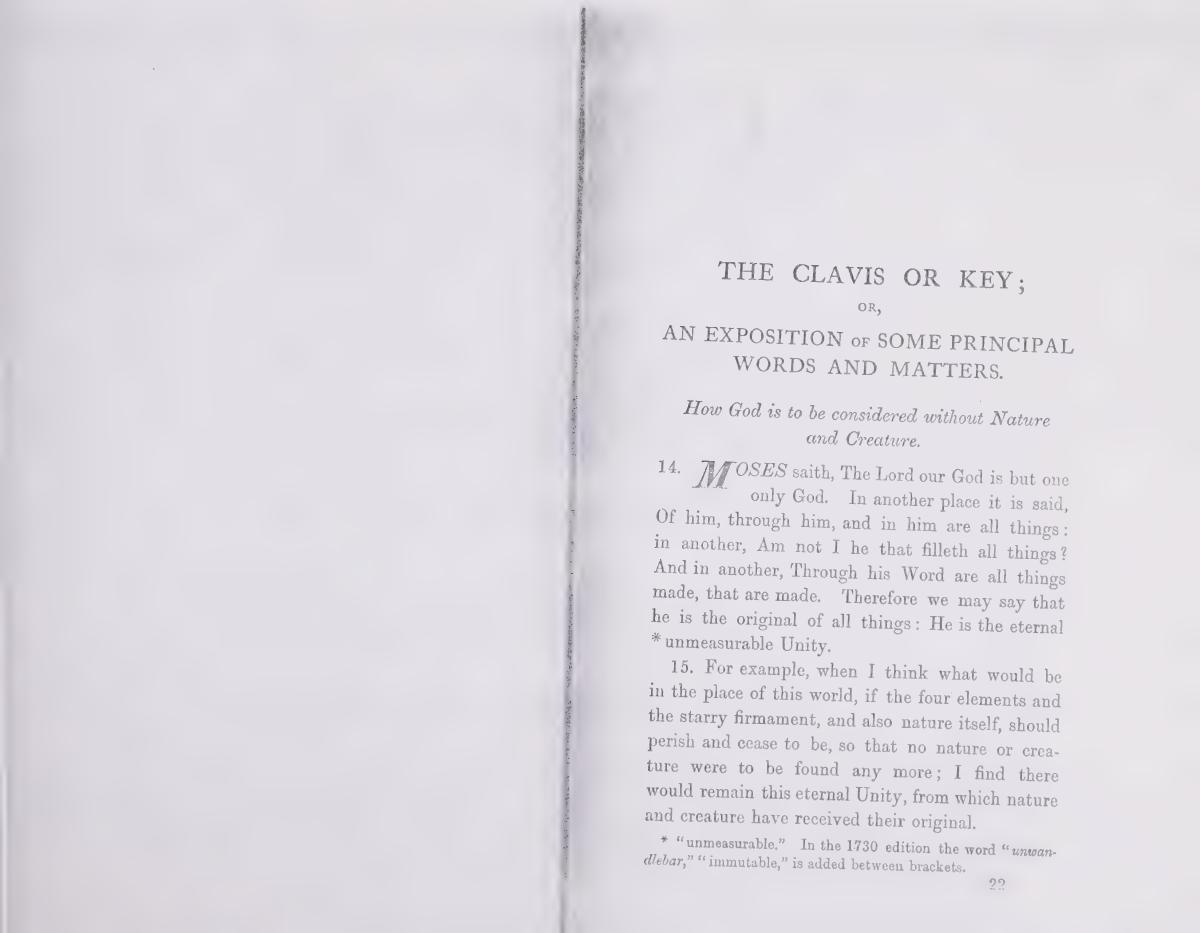
Özgün metin (İngilizce)
THE CLAVIS OR KEY;
OR,
AN EXPOSITION OF SOME PRINCIPAL WORDS AND MATTERS.
How God is to be considered without Nature and Creature.
14. MOSES saith, The Lord our God is but one only God. In another place it is said, Of him, through him, and in him are all things: in another, Am not I he that filleth all things? And in another, Through his Word are all things made, that are made. Therefore we may say that he is the original of all things: He is the eternal unmeasurable Unity.
15. For example, when I think what would be in the place of this world, if the four elements and the starry firmament, and also nature itself, should perish and cease to be, so that no nature or creature were to be found any more; I find there would remain this eternal Unity, from which nature and creature have received their original.
16. So likewise, when I think with myself what is many hundred thousand miles above the starry firmament, or what is in that place where no creature is, I find the eternal unchangeable Unity is there, which is that only Good, which hath nothing either before or after it, that can add anything to it, or take anything away from it, or from which this Unity could have its original: There is neither ground, time, nor place, but there is the only eternal God, or that only Good, which a man cannot express.
A further Consideration, How this one God is Threefold.
17. The Holy Scripture sheweth us that this only God is threefold, viz. one only threefold essence, having three manners of workings, and yet is but one only essence, as may be seen in the outflown power and virtue which is in all things, if any do but observe it: but it is especially represented to us in fire, light, and air; which are three several sorts of workings, and yet but in one only ground and substance.
18. And as we see that fire, light, and air, arise from a candle (though the candle is none of the three, but a cause of them), so likewise the eternal Unity is the cause and ground of the eternal Trinity, which manifesteth itself from the Unity, and bringeth forth itself, First, in desire, or will; Secondly, pleasure, or delight; Thirdly, proceeding, or outgoing.
19. The desire, or will is the Father; that is, the stirring or manifestation of the Unity, whereby the Unity willeth or desireth itself.
20. The pleasure, or delight is the Son; and is that which the will willeth and desireth, viz. his love and pleasure, as may be seen at the baptism of our Lord Jesus Christ, when the Father witnessed, saying, This is my beloved Son, in whom I am well pleased; hear ye him.
21. The delight is the compressure in the will, whereby the will in the Unity bringeth itself into a place and working, wherewith the will willeth and worketh; and it is the feelingness and virtue of the will.
22. The will is the Father, that is, the stirring desire; and the delight is the Son, that is, the virtue and the working in the will, with which the will worketh; and the Holy Ghost is the proceeding will, through the delight of the virtue, that is, a life of the will and of the virtue and delight.
23. Thus there are three sorts of workings in the eternal Unity, viz. the Unity is the will and desire of itself: the delight is the working substance of the will, and an eternal joy of perceptibility in the will; and the Holy Ghost is the proceeding of the power: the similitude of which may be seen in a plant.
Bu metin neden önemli
Böhme bu bölümde Tanrı'nın doğa ve yaratılmış olan olmaksızın nasıl düşünülebileceğini sorar. Dört unsur, gökkubbe ve doğa ortadan kalksa geriye kalanın ezeli ve ebedi Birlik olacağını söyler. Sonra bu tek Tanrı'daki üçlü işleyişi irade, sevinç ve ilerleyiş olarak anlatır. Metin, Böhme'nin yoğun terimler dünyasına en kısa girişlerden biridir.
Bu eser Mistik Teoloji Koleksiyonu'nun parçasıdır →
- Kaynak eser
- Jacob Boehme, The Clavis or Key, The Forty Questions of the Soul and the Clavis içinde, John Sparrow çevirisi, Londra 1911
- Neşir
- 1624 / 1911 baskı
- Konum
- Clavis'in ilk bölümü, 14-23. paragraflar
- Çeviren
- Şira Nur Uysal
- Dijital nüsha
- Internet Archive
Uysal, Ş. N. (Çev.). (2026). Böhme, Clavis: Tanrı Doğadan Önce Nasıl Düşünülür. Kadim Kütüphane. https://kadimkutuphane.com/bohme-clavis-yazilarinin-anahtari-tanri-ucluk@misc{kk_bohme_clavis_yazilarinin_anahtari_tanri_,
author = {Uysal, Şira Nur},
title = {{Böhme, Clavis: Tanrı Doğadan Önce Nasıl Düşünülür}},
year = {2026},
publisher = {Kadim Kütüphane},
url = {https://kadimkutuphane.com/bohme-clavis-yazilarinin-anahtari-tanri-ucluk},
note = {Türkçe çeviri, özgün eser: Jacob Böhme},
}Yeni metinlerden ilk sen haberdar ol
Tam çeviriler, PDF'ler ve yeni eklenen kaynaklar hazırlandıkça e-postana düşsün.