Stobili Yuhanna, MS 5. yüzyılda oğlu için Yunan şairlerinden ve filozoflarından seçmeler içeren büyük bir antoloji derledi. Bu antoloji, Corpus Hermeticum'da yer almayan çok sayıda Hermetik metni korumuştur; Kore Kosmou bunların en uzunudur. G. R. S. Mead, 1906'da yayımladığı Thrice-Greatest Hermes'in üçüncü cildinde bu parçaları İngilizceye çevirdi. Bu bölüm o çeviriden aktarılmıştır.
PARÇA II.
[TANRI'NIN ANLATILAMAZLIĞI ÜZERİNE]
[Her.] Tanrı'yı anlamak zordur, [O'ndan] bahsetmek ise imkânsızdır.
Çünkü Bedensiz olan asla bedende ifade edilemez, Kusursuz olan kusurlu olan tarafından asla kavranamaz ve Ebedî olanın geçici olanla bir arada bulunması zordur.
Biri ebedidir, diğeri gelip geçicidir; biri Hakikatin [aydınlığında], diğeri ise görünüşün gölgesindedir.
Ölümlü olan İlahi olandan ne kadar uzaksa, daha zayıf olan daha güçlü olandan, daha küçük olan daha büyük olandan o denli uzaktır.
İşte bu ikisi arasındaki mesafe, Güzel'in Görünüşü'nü karartır.
Zira bedenler gözlerle görülebilir, görülen şeyler dille anlatılabilir; fakat bedeni olmayan, tezahür etmemiş, suretsiz olan ve maddeden [bizim için] nesnelleşmemiş olan Şey, duyumuzla kavranamaz.
Aklımdadır ey Tat, aklımdadır ki, sözle ifade edilemeyen şey Tanrı'dır.
PARÇA III.
HAKİKÂT ÜZERİNE
1. [Her.] Hakikat hakkında, ey Tat, insanın konuşmaya cüret etmesi mümkün değildir; çünkü insan kusurlu bir hayvandır, kusurlu uzuvlardan meydana gelmiştir, çadırı [kendisine] yabancı birçok bedenden yamalanmıştır.
Lakin neyin mümkün ve doğru olduğunu söylüyorum, Hakikat yalnızca ebedî bedenlerde [bulunur], bedenleri kendi içlerinde hakiki olan [şeylerde]; ateş tam ateştir ve başka bir şey değildir, toprak tam topraktır ve başka bir şey değildir, hava tam havadır ve başka bir şey değildir, su da tam sudur ve başka hiçbir şey değildir.
Oysa bizim bedenlerimiz bütün bunların bir bileşimidir. Zira [içlerinde] ateş vardır, toprak da vardır, su da vardır, hava da; fakat onlar ne ateştir, ne toprak, ne su, ne hava, ne de hakiki olan herhangi bir [unsurdur].
Eğer bizim bileşimimizin başlangıcı Hakikat olmamışsa, Hakikati nasıl görebilir ya da nasıl söyleyebilir?
Hayır, yalnızca Tanrı dilerse onun hakkında bir fikre sahip olabilir.
2. Dolayısıyla yeryüzündeki hiçbir şey, ey Tat, Hakikat değildir; onlar Hakiki olanın [yalnızca] kopyalarıdır.
Ve bunlar her şey de değildir, pek azıdır; geri kalanı ise ey Tat, sahtelikten, hatadan ve suretlere benzeyen görünüşlerden ibarettir.
Görünüş yukarıdan gelen tesiri aldığında Hakikatin bir kopyasına dönüşür; yukarıdan gelen bu tesir olmaksızın ise sahte kalır.
Tıpkı bir portrenin tablodaki bedeni göstermesi, fakat görülen şeyin görünüşüne rağmen kendisinin bir beden olmaması gibi.
Gözleri varmış gibi görünür; fakat hiçbir şey görmez, hiçbir şey duymaz.
Tablo diğer her şeye de sahiptir, fakat bunlar sahtedir; görenlerin bakışını aldatır, onlar hakiki olanı gördüklerini sanırlar, oysa gördükleri gerçekten sahtedir.
O halde sahte olanı görmeyen herkes hakikati görür.
Eğer bunlardan her birini gerçekten olduğu gibi kavrar ya da görürsek, gerçekten kavramış ve görmüş oluruz.
Fakat var olana aykırı [olan şeyleri kavrar ya da görürsek], ne kavrayabiliriz ne de hakiki olan bir şeyi bilebiliriz.
3. [Tat.] O halde baba, yeryüzünde bile Hakikat var mıdır?
[Her.] Azımsanmayacak derecede yanılıyorsun, ey oğul.
Hakikat hiçbir surette yeryüzünde değildir, olamaz da.
Fakat Tanrı onlara ilahi rüyet kudretini bahşederse, bazı insanlar onun hakkında bir fikre sahip olabilir.
Böylece yeryüzünde hakiki hiçbir şey yoktur, bildiğim ve söylediğim [budur]. Hepsi görünüş ve gösteriştir; doğru [şeyleri] biliyor ve söylüyorum. Yine de doğru şeyleri bilmeye ve söylemeye Hakikat dememeliyiz, değil mi?
4. [Tat.] Yeryüzünde hakiki hiçbir şey yokken, nasıl olur da şeylerin doğru olduğunu bilebilir ve söyleyebiliriz?
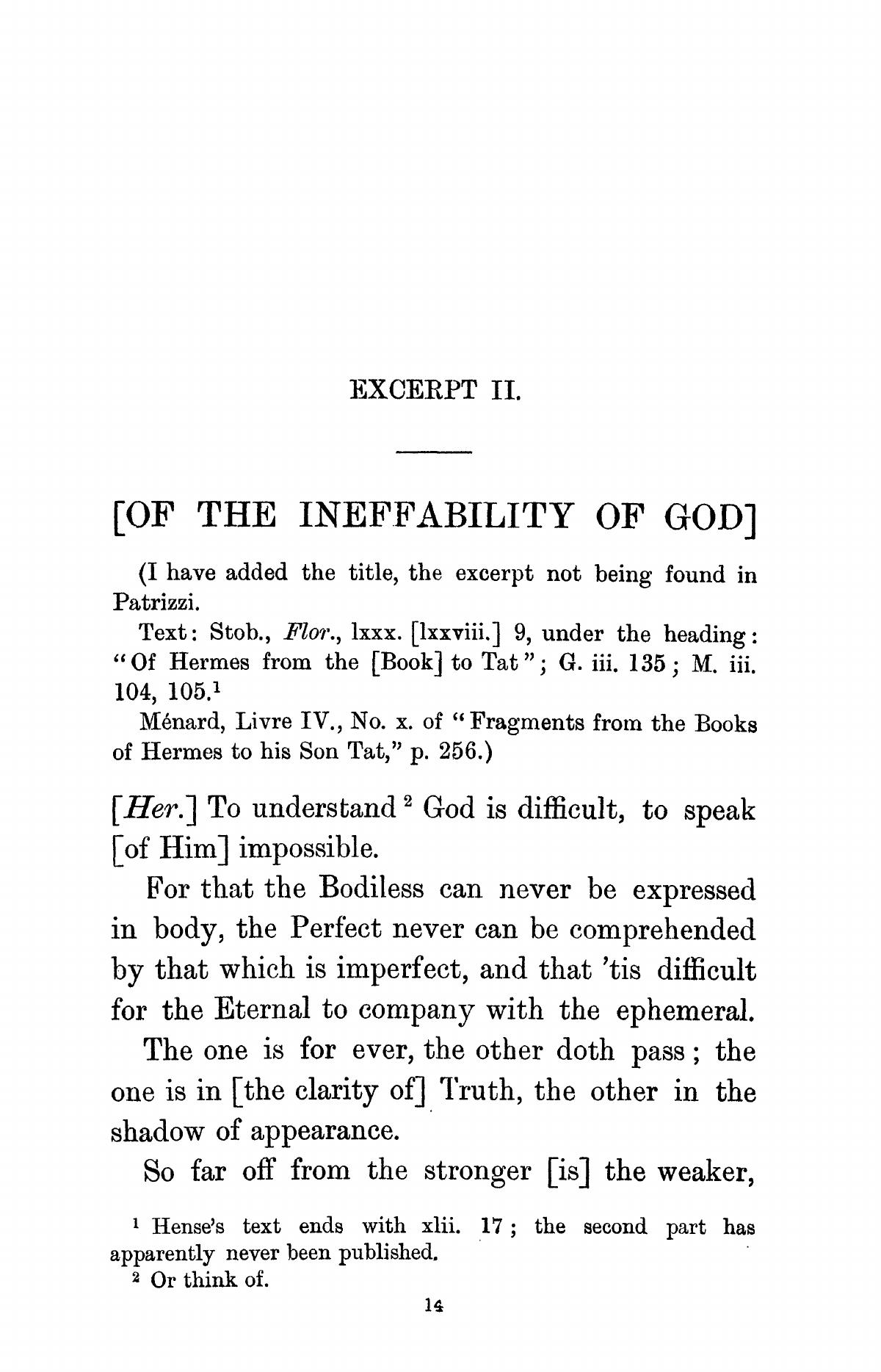
Özgün metin (İngilizce)
EXCERPT II.
[OF THE INEFFABILITY OF GOD]
[Her.] To understand God is difficult, to speak [of Him] impossible.
For that the Bodiless can never be expressed in body, the Perfect never can be comprehended by that which is imperfect, and that 'tis difficult for the Eternal to company with the ephemeral.
The one is for ever, the other doth pass; the one is in [the clarity of] Truth, the other in the shadow of appearance.
So far off from the stronger [is] the weaker, the lesser from the greater [is so far], as [is] the mortal [far] from the Divine.
It is the distance, then, between the two that dims the Vision of the Beautiful.
For 'tis with eyes that bodies can be seen, with tongue that things seen can be spoken of; but That which hath no body, that is unmanifest, and figureless, and is not made objective [to us] out of matter, cannot be comprehended by our sense.
I have it in my mind, O Tat, I have it in my mind, that what cannot be spoken of, is God.
EXCERPT III.
OF TRUTH
1. [Her.] Concerning Truth, O Tat, it is not possible that man should dare to speak, for man's an animal imperfect, composed out of imperfect members, his tabernacle patched together from many bodies strange [to him].
But what is possible and right, this do I say, that Truth is [to be found] in the eternal bodies only, [those things] of which the bodies in themselves are true, fire very fire and nothing else, earth very earth and nothing else, air very air and nothing else, and water very water and naught else.
Our frames, however, are a compound of all these. For they have [in them] fire, and they have also earth, they've water, too, and air; but they are neither fire, nor earth, nor water, nor air, nor any [element that's] true.
And if our composition has not had Truth for its beginning, how can it either see or speak the Truth?
Nay, it can only have a notion of it, [and that too] if God will.
2. All things, accordingly, that are on earth, O Tat, are not the Truth; they're copies [only] of the True.
And these are not all things, but few [of them]; the rest consist of falsity and error, Tat, and shows of seeming like unto images.
Whenever the appearance doth receive the influx from above, it turns into a copy of the Truth; without its energizing from above, it is left false.
Just as the portrait also indicates the body in the picture, but in itself is not a body, in spite of the appearance of the thing that's seen.
'Tis seen as having eyes; but it sees naught, hears naught at all.
The picture, too, has all the other things, but they are false, tricking the sight of the beholders, these thinking that they see what's true, while what they see is really false.
All, then, who do not see what's false see truth.
If, then, we thus do comprehend, or see, each one of these just as it really is, we really comprehend and see.
But if [we comprehend, or see, things] contrary to that which is, we shall not comprehend, nor shall we know aught true.
3. [Tat.] There is, then, father, Truth e'en on the earth?
[Her.] Not inconsiderably, O son, art thou at fault.
Truth is in no wise, Tat, upon the earth, nor can it be.
But some men can, [I say,] have an idea of it, should God grant them the power of godly vision.
Thus there is nothing true on earth, [so much] I know and say. All are appearances and shows, I know and speak true [things]. We ought not, surely, though, to call the knowing and the speaking of true things the Truth?
4. [Tat.] Why, how on earth ought we to know and speak of things being true, yet nothing's true on earth?
Bu metin neden önemli
Stobaeus parçaları, Hermes'in oğlu Tat'a öğrettiği dersler biçimindedir ve Tanrı'yı kavramanın güçlüğünü, hakikatin bedende tam olarak bulunamayacağını, ruhun ve kaderin doğasını işler. Corpus Hermeticum'un tamamlayıcısı olarak Hermetik öğretinin kayıp bütününe dair elimizdeki en önemli tanıklıklardandır. Mead'in çevirisi 20. yüzyıl ezoterik çevrelerinde Hermetizmin yeniden okunmasında belirleyici olmuştur.
Bu eser Hermetizm Koleksiyonu'nun parçasıdır →
- Kaynak eser
- Thrice-Greatest Hermes: Studies in Hellenistic Theosophy and Gnosis, cilt III, G. R. S. Mead, Londra, Theosophical Publishing Society, 1906
- Neşir
- MS 2-3. yüzyıl (yazım), 5. yüzyıl (derleme) / 1906 (G. R. S. Mead çevirisi)
- Konum
- II. Alıntı: Tanrı'nın dile gelmezliği üzerine
- Çeviren
- Şira Nur Uysal
- Dijital nüsha
- Internet Archive
Uysal, Ş. N. (Çev.). (2026). Stobaeus'un Hermetik Parçaları: Tanrı'yı Kavramak. Kadim Kütüphane. https://kadimkutuphane.com/stobaeus-hermetik-parcalar-tanriyi-kavramak@misc{kk_stobaeus_hermetik_parcalar_tanriyi_kavra,
author = {Uysal, Şira Nur},
title = {{Stobaeus'un Hermetik Parçaları: Tanrı'yı Kavramak}},
year = {2026},
publisher = {Kadim Kütüphane},
url = {https://kadimkutuphane.com/stobaeus-hermetik-parcalar-tanriyi-kavramak},
note = {Türkçe çeviri, özgün eser: Hermes Trismegistos (Stobaeus'un aktarımıyla)},
}Yeni metinlerden ilk sen haberdar ol
Tam çeviriler, PDF'ler ve yeni eklenen kaynaklar hazırlandıkça e-postana düşsün.