Ptahhotep'in Öğütleri, V. Hanedan firavunu Djedkare İsesi'nin veziri Ptahhotep'e atfedilen ve yaşlı bir babanın oğluna yaşam bilgeliğini aktardığı biçimde kurulmuş bir öğüt metnidir. En eksiksiz nüshası Orta Krallık'tan kalma ve bugün Paris'te bulunan Prisse Papirüsü'ndedir. Dünya edebiyatının günümüze ulaşmış en eski bilgelik metinleri arasında sayılır. Bu bölüm Battiscombe Gunn'ın çevirisinden aktarılmıştır.
PTAH-HOTEP'UN ÖĞRETİSİ
Yukarı ve Aşağı Mısır Kralı, sonsuza dek, Zamanın sonuna kadar yaşayan İsôsi'nin Hükümdarlığında, Şehrinin Valisi, Vezir Ptah-hotep'in Öğretisi.
A. Şehrinin Valisi, Vezir Ptah-hotep şöyle dedi: “Ey Hükümdar, Efendim, hayatın sonu yaklaştı; yaşlılık [üzerime] çöküyor; takatsizlik geliyor ve çocukluk hali yenileniyor. [Yaşlı olan kişi] her gün ıstırap içinde yatar. Gözler küçüldü, kulaklar sağırdır. Takat azaldı, yürekte huzur kalmadı. Ağız sessizdir ve tek kelime etmez; kalp durur ve dünü hatırlamaz. Bedendeki tüm kemikler ağrır; iyi olan kötüye döner. Bütün tatlar yok olur. Yaşlılık, her bakımdan fena olarak insanlığa bunları yapar. Burun tıkanmıştır ve ister ayakta olsun ister otururken, dermansızlıktan (?) nefes alamaz.
‘Bu yüzden kuluna, emirlik yetkimi [oğluma] devretmeyi buyur. Eski zaman insanlarının, bir vakitler tanrılara kulak vermiş olanların öğütlerini dinleyenlerin sözlerini ona söyleyeyim. Yalvarırım sana, bu iş yapılsın ki basiretli kimseler arasından günah sürülsün ve sen de diyarları aydınlatasın.’
Bu Tanrı'nın Haşmeti şöyle buyurdu: ‘Ona öyleyse eski zamanın sözlerini öğret; emirlerin evlatları için bir hayranlık vesilesi olsun ki onunla birlikte içeri girip dinlesinler. Onların bütün yüreklerini doğrult ve usanç vermeden onunla hasbihal et.’
B. Miras Yoluyla Geçen Reis, Mukaddes Peder, Tanrı'nın Sevgilisi, Kralın Bedeninden Olan En Büyük Oğlu, Şehrinin Valisi, Vezir Ptah-hotep'in, cahillere güzel konuşmadaki kusursuzluğun bilgisini öğretirken söylediği güzel sözler darbımeselleri burada başlar; bunlara itaat edenin şerefi, bunlara karşı gelenin utancı.
Oğluna şöyle dedi:
1. Bilgili olduğun için kibirlenme; fakat bilgeyle olduğu gibi cahil adamla da konuş. Zira ustalığa bir sınır çizilemez, her türlü avantaja sahip hiçbir zanaatkar da yoktur. Güzel söz, cariyelerin çakıl taşları arasında bulduğu zümrütten daha nadirdir.
2. Eğer tartışan, iyi niyetli ve senden daha bilge birini konuşurken bulursan, kollarını indir, sırtını bük; seninle aynı fikirde olmazsa (?) ona öfkelenme. Fena söz söylemekten sakın; konuştuğu hiçbir anda ona karşı çıkma. Seni konudan habersiz biri olarak muhatap alsa dahi, senin alçakgönüllülüğün onun iddialarını bertaraf edecektir.
3. Eğer tartışan, senin dengin, senin seviyendeki birini konuşurken bulursan, fena bir şey söylediğinde sessiz kalma; böylece ondan daha bilge olursun. Dinleyenlerin alkışı büyük olacak ve adın emirlerin nezdinde iyi bilinecektir.
4. Eğer tartışan, yoksul bir adam, yani senin dengin olmayan birini konuşurken bulursan, o hakir olduğu için onu hor görme. Kendi haline bırak; o zaman kendi kendini mahcup edecektir. Kendi gönlünü hoş etmek için onu sorgulama, karşında duranın üzerine gazabını akıtma; aşağı seviyedeki bir zihnin kafasını karıştırmak utanç vericidir. Eğer yüreğindeki şeyi yapmak üzereysen, emirlerce reddedilmiş bir şey olarak onu yen.
5. Eğer bir lider olursan, halkın gidişatını yönlendiren biri olarak, kendi hal ve hareketin kusursuz olsun diye daima lütufkar olmaya gayret et. Doğruluk büyüktür, dosdoğru bir yol belirler; Osiris'in hükümranlığından bu yana asla yıkılmamıştır. Yasaları çiğneyen cezalandırılacaktır. Haddi aşmak açgözlü adamın işidir; fakat düşüşler (?) onun zenginliklerini alıp götürür. Kötülük yapmak girişimini hiçbir zaman limana sağ salim ulaştırmamıştır. Çünkü o, ‘Bana izin verildiği için elde edeceğim’ demez, ‘Kendi başıma, kendim için elde edeceğim’ der. Fakat adaletin sınırları sabittir; bu, insanın babasından devralıp tekrarladığı şeydir.
6. İnsanlar arasına korku salma; çünkü Tanrı da [bunu] aynı şekilde cezalandırır. Zira ‘Hayat bundadır’ diyen bir adam vardır; oysa ağzındaki ekmekten mahrum kalır. ‘Kudret [bundadır]’ diyen bir adam vardır ve ‘Gördüğüm şeyi kendime alırım’ der. İnsan böyle konuşur ve yere serilir. Sahip olmayana vererek muradına eren ise bir başkasıdır. İnsanların hazırlık yaptığı şeyler asla gerçekleşmemiştir; zira Tanrı neyi emrettiyse işte o vuku bulur. Bu yüzden iyilik evinde yaşa, o zaman insanlar gelip kendiliklerinden hediyeler verecektir.
Özgün metin (İngilizce)
THE INSTRUCTION OF PTAH-HOTEP
THE Instruction of the Governor of his City, the Vizier, Ptah-hotep, in the Reign of the King of Upper and Lower Egypt, Isôsi, living for ever, to the end of Time.
A. The Governor of his City, the Vizier, Ptah-hotep, he said : ‘O Prince, my Lord, the end of life is at hand ; old age descendeth [upon me] ; feebleness cometh, and childishness is renewed. He [that is old] lieth down in misery every day. The eyes are small ; the ears are deaf. Energy is diminished, the heart hath no rest. The mouth is silent, and he speaketh no word ; the heart stoppeth, and he remembereth not yesterday. The bones are painful throughout the body ; good turneth unto evil. All taste departeth. These things doeth old age for mankind, being evil in all things. The nose is stopped, and he breatheth not for weakness (?), whether standing or sitting.
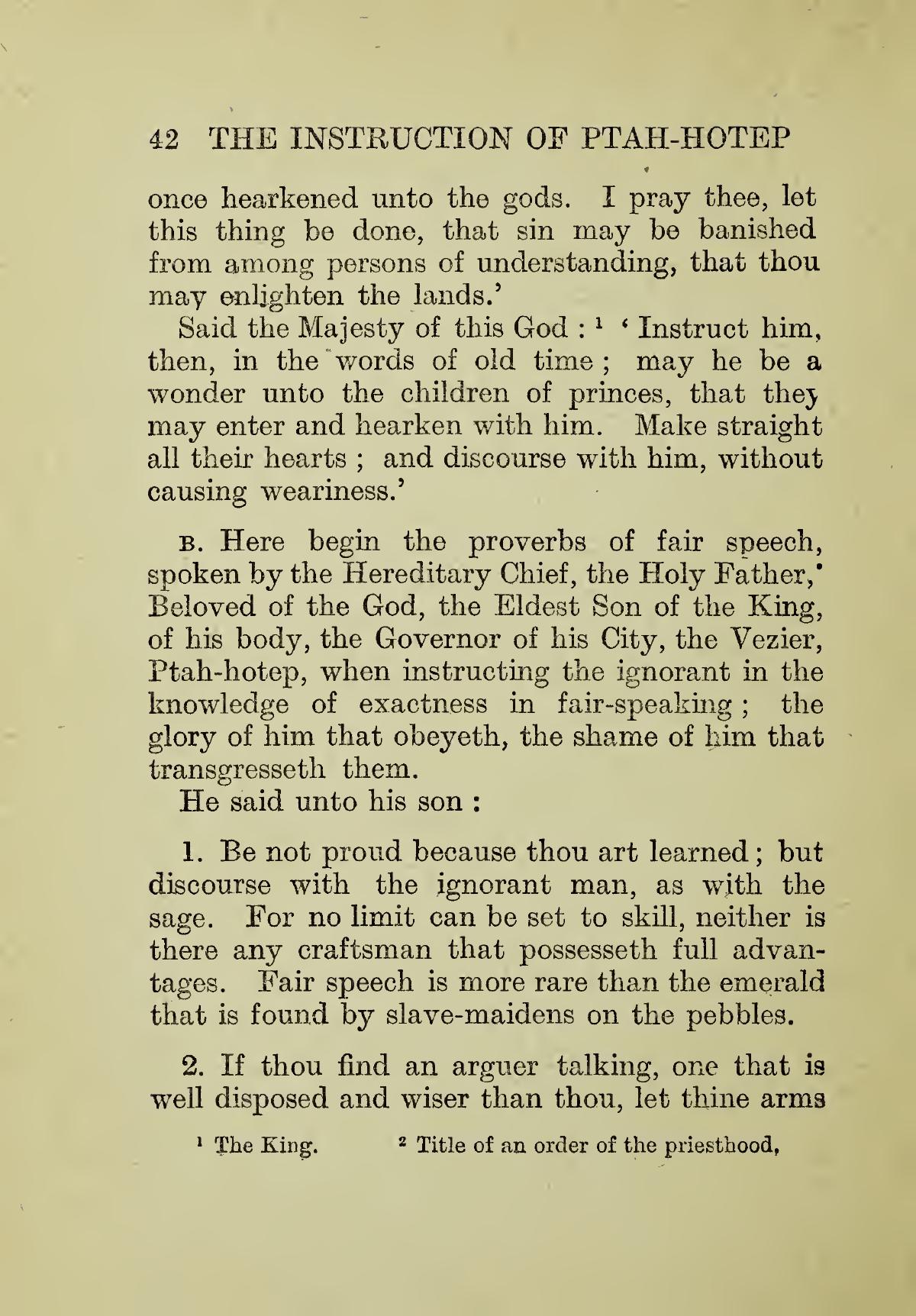
‘Command me, thy servant, therefore, to make over my princely authority [to my son]. Let me speak unto him the words of them that hearken to the counsel of the men of old time ; those that once hearkened unto the gods. I pray thee, let this thing be done, that sin may be banished from among persons of understanding, that thou may enlighten the lands.’
Said the Majesty of this God : ‘Instruct him, then, in the words of old time ; may he be a wonder unto the children of princes, that they may enter and hearken with him. Make straight all their hearts ; and discourse with him, without causing weariness.’
B. Here begin the proverbs of fair speech, spoken by the Hereditary Chief, the Holy Father, Beloved of the God, the Eldest Son of the King, of his body, the Governor of his City, the Vezier, Ptah-hotep, when instructing the ignorant in the knowledge of exactness in fair-speaking ; the glory of him that obeyeth, the shame of him that transgresseth them.
He said unto his son :
1. Be not proud because thou art learned ; but discourse with the ignorant man, as with the sage. For no limit can be set to skill, neither is there any craftsman that possesseth full advantages. Fair speech is more rare than the emerald that is found by slave-maidens on the pebbles.
2. If thou find an arguer talking, one that is well disposed and wiser than thou, let thine arms fall, bend thy back, be not angry with him if he agree (?) not with thee. Refrain from speaking evilly ; oppose him not at any time when he speaketh. If he address thee as one ignorant of the matter, thine humbleness shall bear away his contentions.
3. If thou find an arguer talking, thy fellow, one that is within thy reach, keep not silence when he saith aught that is evil ; so shalt thou be wiser than he. Great will be the applause on the part of the listeners, and thy name shall be good in the knowledge of princes.
4. If thou find an arguer talking, a poor man, that is to say not thine equal, be not scornful toward him because he is lowly. Let him alone ; then shall he confound himself. Question him not to please thine heart, neither pour out thy wrath upon him that is before thee ; it is shameful to confuse a mean mind. If thou be about to do that which is in thine heart, overcome it as a thing rejected of princes.
5. If thou be a leader, as one directing the conduct of the multitude, endeavour always to be gracious, that thine own conduct be without defect. Great is Truth, appointing a straight path ; never hath it been overthrown since the reign of Osiris. One that oversteppeth the laws shall be punished. Overstepping is by the covetous man ; but degradations (?) bear off his riches. Never hath evil-doing brought its venture safe to port. For he saith, ‘I will obtain by myself for myself,’ and saith not, ‘I will obtain because I am allowed.’ But the limits of justice are steadfast ; it is that which a man repeateth from his father.
6. Cause not fear among men ; for [this] the God punisheth likewise. For there is a man that saith, ‘Therein is life’ ; and he is bereft of the bread of his mouth. There is a man that saith, ‘Power [is therein]’ ; and he saith, ‘I seize for myself that which I perceive.’ Thus a man speaketh, and he is smitten down. It is another that attaineth by giving unto him that hath not. Never hath that which men have prepared for come to pass ; for what the God hath commanded, even that thing cometh to pass. Live, therefore, in the house of kindliness, and men shall come and give gifts of themselves.
Bu metin neden önemli
Ptahhotep, doğru sözü, ölçülülüğü, dinlemeyi ve Ma'at'a, yani evrensel düzen ve hakikate uygun yaşamayı öğütler. Mısır'ın Ma'at kavramı, insanın davranışını kozmik düzenle uyumlu kılma düşüncesinin en eski ifadelerinden biridir. Metin, sonraki öğüt edebiyatına, İbrani hikmet kitaplarına ve Hermetik geleneğin Mısır bilgeliğine dair imgesine arka plan sağlar.
Bu eser Mısır Koleksiyonu'nun parçasıdır →
- Kaynak eser
- The Instruction of Ptah-hotep and the Instruction of Ke'gemni, Battiscombe Gunn çevirisi, Londra, John Murray, Wisdom of the East dizisi
- Neşir
- MÖ 3. binyıl sonu (atfedilen) / 1918 baskısı (Battiscombe Gunn çevirisi)
- Konum
- Öğütlerin başı
- Çeviren
- Şira Nur Uysal
- Dijital nüsha
- Internet Archive
Uysal, Ş. N. (Çev.). (2026). Ptahhotep'in Öğütleri: Bilgeliğin Yolu. Kadim Kütüphane. https://kadimkutuphane.com/ptahhotepin-ogutleri-bilgeligin-yolu@misc{kk_ptahhotepin_ogutleri_bilgeligin_yolu,
author = {Uysal, Şira Nur},
title = {{Ptahhotep'in Öğütleri: Bilgeliğin Yolu}},
year = {2026},
publisher = {Kadim Kütüphane},
url = {https://kadimkutuphane.com/ptahhotepin-ogutleri-bilgeligin-yolu},
note = {Türkçe çeviri, özgün eser: Ptahhotep (atfedilen)},
}Yeni metinlerden ilk sen haberdar ol
Tam çeviriler, PDF'ler ve yeni eklenen kaynaklar hazırlandıkça e-postana düşsün.