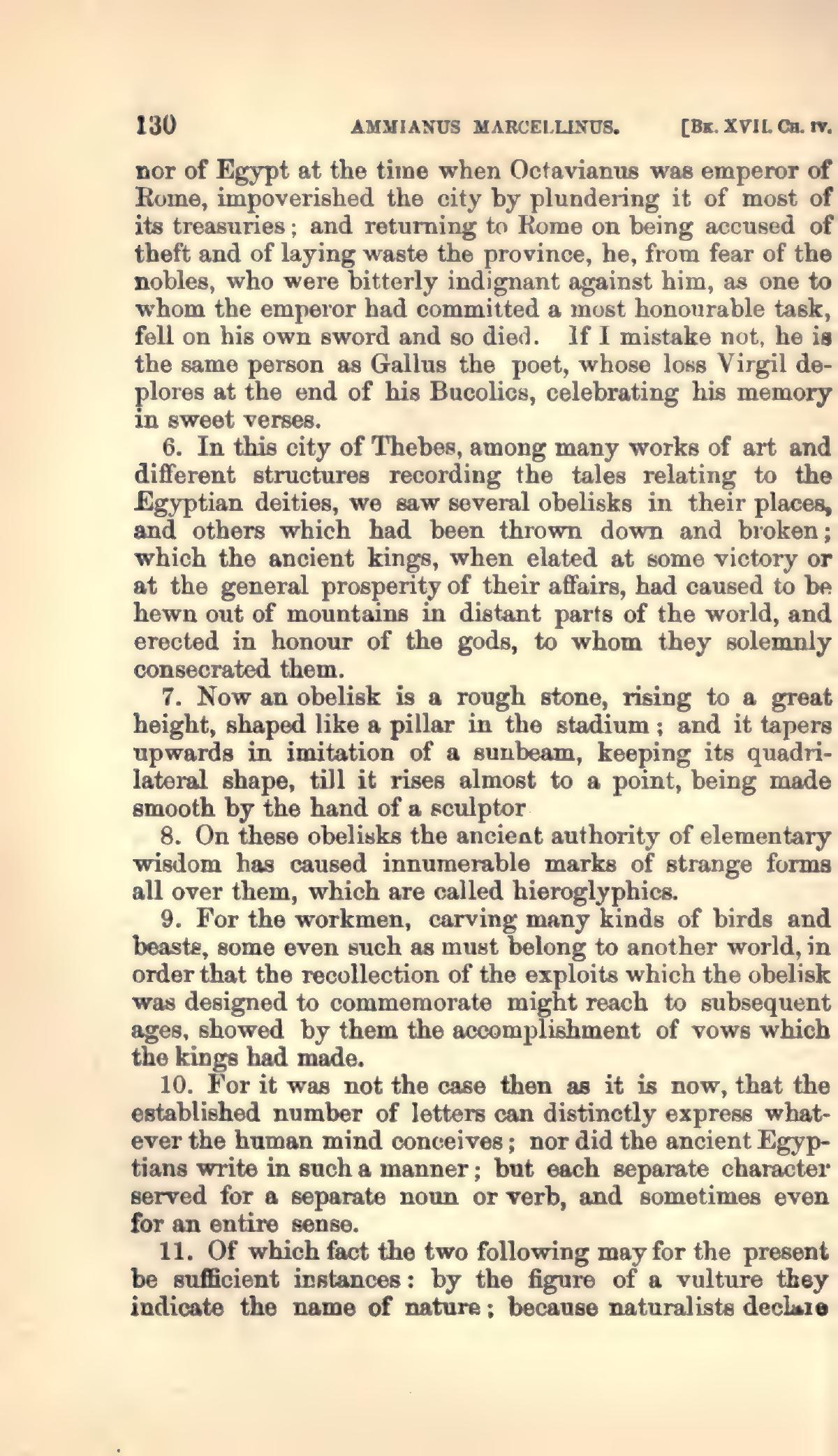
Ammianus Marcellinus (yaklaşık 330-395), Romalı asker ve tarihçidir. Roma Tarihi'ni Latince yazdı ve eserin günümüze ulaşan bölümü MS 353 sonrasını anlatır. XVII. Kitap'ın bir bölümü, İmparator Konstantius'un Mısır'dan Roma'ya getirdiği dikilitaşa ve üzerindeki yazıtlara ayrılmıştır. Aktarılan bölüm C. D. Yonge'un çevirisinden alınmıştır.
Bu Thebai şehrinde, Mısır tanrılarına dair efsaneleri kaydeden birçok sanat eseri ve muhtelif yapılar arasında, yerlerinde duran birkaç dikilitaş ve devrilip kırılmış olan başkalarını gördük; eski krallar, bir zaferden veya işlerinin genel refahından gururlandıklarında, bunları dünyanın uzak bölgelerindeki dağlardan yontturmuş ve kendilerine törenle adadıkları tanrıların onuruna diktirmişlerdi.
Bir dikilitaş, stadyumdaki bir sütun gibi şekillendirilmiş, büyük bir yüksekliğe ulaşan kaba bir taştır; dört kenarlı şeklini koruyarak neredeyse bir noktaya ulaşana dek güneş ışınını taklit ederek yukarıya doğru incelir ve bir heykeltıraşın eliyle pürüzsüz hale getirilir.
Bu dikilitaşların üzerine ilkel bilgeliğin kadim otoritesi, hiyeroglif adı verilen tuhaf biçimli sayısız işaretler işletmiştir.
Zira işçiler, dikilitaşın anısını yaşatmak için tasarlandığı kahramanlıkların sonraki çağlara ulaşabilmesi amacıyla, birçoğu başka bir dünyaya ait olması gereken çok sayıda kuş ve hayvan türünü oyarak kralların adadıkları adakların gerçekleştiğini bunlarla göstermişlerdir.
Çünkü o zamanlar, belirlenmiş harf sayısının insan zihninin tasarladığı her şeyi açıkça ifade edebildiği şimdiki gibi bir durum yoktu; ne de eski Mısırlılar bu şekilde yazarlardı; bilakis her bir müstakil karakter ayrı bir isim veya fiil, hatta bazen bütün bir anlam için kullanılırdı.
Bu duruma şimdilik şu iki örnek yeterli olabilir: bir akbaba figürüyle tabiatın adını belirtirler; çünkü doğa bilimciler bu kuş sınıfında hiçbir erkeğin bulunmadığını bildirirler. Bal yapan bir arı figürüyle de bir kralı belirtirler; böyle bir işaretle tatlılığın yanı sıra iğnelerin de bir hükümdarın özellikleri olduğunu gösterirler; ve buna benzer birçok simge vardır.
Constantius'un kulağına sürekli fısıldayan dalkavuklar, Augustus Octavianus'un Mısır'ın Heliopolis şehrinden getirdiği iki dikilitaştan birini Circus Maximus'a, diğerini ise Campus Martius'a yerleştirdiğinde, böyle büyük bir işin azametinden ürkerek Roma'ya henüz getirilmiş olan bu taşa dokunmaya veya onu yerinden oynatmaya cesaret edemediğini durmadan iddia ettiklerinden; gerçeği bilmeyenlerin şunu öğrenmesini isterim ki, eski imparator birkaç dikilitaşı taşımış olmasına rağmen, hürmetsizlik etmenin günah sayılacağı ve en göz alıcı süsü olduğu muhteşem tapınağının sınırları içine dikilmiş, özellikle Güneş tanrısına adanmış olduğu için bu taşa dokunmamıştı.
Fakat Konstantin bu düşünceyi önemsiz sayarak onu yerinden söktürdü ve tüm dünyanın tapınağı olan Roma'daki tanrılara adamak üzere başka bir tapınaktan görkemli bir eseri alıp götürmekle dine herhangi bir hakarette bulunmayacağını doğru bir şekilde düşünerek, taşınması için hazırlıklar yapılırken bir süre yerde yatmasına izin verdi. Nil'den aşağı taşınıp İskenderiye'ye indirildiğinde, onu taşımak için şimdiye kadar eşi benzeri görülmemiş, yürütülmesi için üç yüz kürekçi gerektiren bir gemi inşa edildi.
Bu hazırlıklar tamamlandığında ve adı geçen imparator öldükten sonra girişim soğumaya başladı. Bununla birlikte, bir süre sonra nihayet gemiye yüklendi; deniz yoluyla ve neredeyse bilinmeyen Nil'den gelen bir hediyeyi bizzat bağrında beslediği surlara ulaştırmaya kendi kıvrımlı sularının güç yetiremeyeceğinden adeta korkmuş gibi görünen Tiber nehrinin akıntısına karşı taşındı. Nihayet dikilitaş, şehre üç mil mesafedeki İskenderiye köyüne ulaştı; ardından bir kızağa yerleştirilerek yavaşça çekildi ve Ostra kapısından ve umumi balık pazarından geçirilerek Circus Maximus'a getirildi.
Geriye kalan tek iş onu dikmekti ki bunun neredeyse hiç mümkün olmadığına inanılıyordu. Devasa kirişler tehlikeli bir biçimde dikilmiş, adeta bir makineler korusu gibi görünmekteydi; üzerlerine kalın ipler bağlanmış, sayısız iplikten bir ağ oluşturarak yoğunluklarıyla gökyüzünü karartmıştı; yazı unsurlarıyla kaplı olan o büyük taşın kendisi bunlara bağlandı, boşluğa doğru yavaş yavaş yükseltildi ve binlerce adam bir değirmen taşı gibi onu döndürüp dururken uzun süre asılı kaldı; nihayet meydanın ortasına yerleştirildi ve üzerine altın levhalarla daha parlak hale getirilmiş tunç bir küre kondu. Bu küre hemen ardından yıldırım çarpması sonucu tahrip olunca, üzerine meşale tamamen yanıyormuş gibi görünmesi için yine altın kaplamalı, meşale benzeri tunç bir figür yerleştirildi.
Sonraki çağlarda başka dikilitaşlar da taşındı; bunlardan biri Vatikan'da, ikincisi Sallustius'un bahçesinde, ikisi de Augustus'un anıtındadır.
Fakat Circus'taki eski dikilitaşın üzerine kazınmış olan yazıyı, Hermapion'un eserine uyarak aşağıda Grek harfleriyle belirttik:
Güney tarafından başlayan birinci satır şu anlamı taşır: "Güneşten Kral Ramestes'e: Bütün yeryüzünde sevinçle hüküm sürmeyi sana verdim; Güneş'in ve Apollon'un sevdiği sana, Heron'un hakikati seven kudretli oğluna, meskun dünyanın tanrı soyundan gelen hükümdarına; Güneş'in bütün insanların arasından seçtiği yiğit, cengaver Kral Ramestes'e. Onun kudreti altında, cesareti ve gücüyle bütün dünya yer almaktadır. Kral Ramestes, Güneş'in ölümsüz oğlu."
İkinci satır şöyledir: "Hakikat üzerine kurulu olan kudretli Apollon, tacın efendisi, Mısır'ın efendisi olarak onu onurlandıran, Heliopolis'i bezeyen ve dünyanın geri kalanını yaratan, Güneş şehrinde mabetleri bulunan tanrıları büyük ölçüde yücelten; oğlunun sevdiği."
Üçüncü satır: "Kudretli Apollon, Güneş'in pek parlak oğlu; Güneş onu diğerlerinin üzerinde seçti ve yiğit Mars ona armağanlar verdi. Sen ki iyi talihin sonsuza dek sürer. Sen ki Ammon seni sever. Sen ki Feniks tapınağını güzel şeylerle doldurdun. Sen ki tanrılar sana uzun bir ömür verdi. Apollon, Heron'un kudretli oğlu, dünyanın kralı Ramestes. Mısır'ı yabancı düşmanı boyunduruk altına alarak savunan. Güneş'in sevdiği. Tanrıların kendisine uzun bir ömür verdiği, dünyanın efendisi, ölümsüz Ramestes."
Diğer bir ikinci satır: "Güneş, büyük Tanrı, göklerin efendisi. Sana doyumsuzluktan uzak bir hayat verdim. Apollon, tacın kudretli efendisi; hiçbir şey onunla kıyaslanamaz. Mısır'ın efendisi bu krallıkta onun için birçok heykel dikti. Ve Heliopolis şehrini göklerin efendisi olan Güneş'in kendisi kadar parlak kıldı. Güneş'in oğlu, sonsuza dek yaşayan kral, bu eserin tamamlanmasında iş birliği yaptı."
Üçüncü bir satır: "Ben, Güneş, tanrı, göklerin efendisi; Kral Ramestes'e herkesin üzerinde kudret ve yetki verdim. Hakikati seven Apollon, zamanın efendisi ve tanrıların babası Vulcanus, cesaretinden ötürü onu diğerlerinin arasından seçti. Herkesi sevindiren kral, Güneş'in oğlu ve Güneş'in sevgilisi."
Doğuya bakan birinci satır: "Heliopolis'in ulu Tanrısı, Göklerde ikamet eden kudretli Apollon, Güneş'in yol gösterdiği Heron oğlu. Tanrıların onurlandırdığı kişi. Bütün yeryüzüne hükmeden: Güneş'in diğer herkesin önünde seçtiği kişi. Mars'ın lütfuyla yiğit olan kral. Ammon'un ve kendisini sonsuza dek kral olarak seçen her yanı parıldayan tanrının sevdiği." Ve bu şekilde devam eder.
Özgün metin (İngilizce)
In this city of Thebes, among many works of art and different structures recording the tales relating to the Egyptian deities, we saw several obelisks in their places, and others which had been thrown down and broken; which the ancient kings, when elated at some victory or at the general prosperity of their affairs, had caused to be hewn out of mountains in distant parts of the world, and erected in honour of the gods, to whom they solemnly consecrated them.
Now an obelisk is a rough stone, rising to a great height, shaped like a pillar in the stadium; and it tapers upwards in imitation of a sunbeam, keeping its quadrilateral shape, till it rises almost to a point, being made smooth by the hand of a sculptor.
On these obelisks the ancient authority of elementary wisdom has caused innumerable marks of strange forms all over them, which are called hieroglyphics.
For the workmen, carving many kinds of birds and beasts, some even such as must belong to another world, in order that the recollection of the exploits which the obelisk was designed to commemorate might reach to subsequent ages, showed by them the accomplishment of vows which the kings had made.
For it was not the case then as it is now, that the established number of letters can distinctly express whatever the human mind conceives; nor did the ancient Egyptians write in such a manner; but each separate character served for a separate noun or verb, and sometimes even for an entire sense.
Of which fact the two following may for the present be sufficient instances: by the figure of a vulture they indicate the name of nature; because naturalists declare that no males are found in this class of bird. And by the figure of a bee making honey they indicate a king; showing by such a sign that stings as well as sweetness are the characteristics of a ruler; and there are many similar emblems.
And because the flatterers, who were continually whispering into the ear of Constantius, kept always affirming that when Augustus Octavianus had brought two obelisks from Heliopolis, a city of Egypt, one of which was placed in the Circus Maximus, and the other in the Campus Martius, he yet did not venture to touch or move this one which has just been brought to Rome, being alarmed at the greatness of such a task; I would have those, who do not know the truth, learn that the ancient emperor, though he moved several obelisks, left this one untouched, because it was especially dedicated to the Sun-god, and was set up within the precincts of his magnificent temple, which it was impious to profane; and of which it was the most conspicuous ornament.
But Constantine deeming that a consideration of no importance, had it torn up from its place, and thinking rightly that he should not be offering any insult to religion if he removed a splendid work from some other temple to dedicate it to the gods at Rome, which is the temple of the whole world, let it lie on the ground for some time while arrangements for its removal were being prepared. And when it had been carried down the Nile, and landed at Alexandria, a ship of a burden hitherto unexampled, requiring three hundred rowers to propel it, was built to receive it.
And when these preparations were made, and after the aforenamed emperor had died, the enterprise began to cool. However, after a time it was at last put on board ship, and conveyed over sea, and up the stream of the Tiber, which seemed as it were frightened, lest its own winding waters should hardly be equal to conveying a present from the almost unknown Nile to the walls which itself cherished. At last the obelisk reached the village of Alexandria, three miles from the city; and then it was placed in a cradle, and drawn slowly on, and brought through the Ostran gate and the public fish-market to the Circus Maximus.
The only work remaining to be done was to raise it, which was generally believed to be hardly, if at all, practicable. And vast beams having been raised on end in a most dangerous manner, so that they looked like a grove of machines, long ropes of huge size were fastened to them, darkening the very sky with their density, as they formed a web of innumerable threads; and into them the great stone itself, covered over as it was with elements of writing, was bound, and gradually raised into the empty air, and long suspended, many thousands of men turning it round and round like a millstone, till it was at last placed in the middle of the square; and on it was placed a brazen sphere, made brighter with plates of gold: and as that was immediately afterwards struck by lightning, and destroyed, a brazen figure like a torch was placed on it, also plated with gold—to look as if the torch were fully alight.
Subsequent ages also removed other obelisks; one of which is in the Vatican, a second in the garden of Sallust: and two in the monument of Augustus.
But the writing which is engraven on the old obelisk in the Circus, we have set forth below in Greek characters, following in this the work of Hermapion:
The first line, beginning on the south side, bears this interpretation: "The Sun to Ramestes the king: I have given to thee to reign with joy over the whole earth; to thee whom the Sun and Apollo love—to thee, the mighty truth-loving son of Heron—the god-born ruler of the habitable earth; whom the Sun has chosen above all men, the valiant warlike King Ramestes. Under whose power, by his valour and might, the whole world is placed. The King Ramestes, the immortal son of the Sun."
The second line is: "The mighty Apollo, who takes his stand upon truth, the lord of the diadem, he who has honoured Egypt by becoming its master, adorning Heliopolis, and having created the rest of the world, and having greatly honoured the gods who have their shrines in the city of the Sun; whom the son loves."
The third line: "The mighty Apollo, the all-brilliant son of the Sun, whom the Sun chose above all others, and to whom the valiant Mars gave gifts. Thou whose good fortune abideth for ever. Thou whom Ammon loves. Thou who hast filled the temple of the Phoenix with good things. Thou to whom the gods have given long life. Apollo the mighty son of Heron, Ramestes the king of the world. Who has defended Egypt, having subdued the foreign enemy. Whom the Sun loves. To whom the gods have given long life—the master of the world—the immortal Ramestes."
Another second line: "The Sun, the great God, the master of heaven. I have given unto thee a life free from satiety. Apollo, the mighty master of the diadem; to whom nothing is comparable. To whom the lord of Egypt has erected many statues in this kingdom. And has made the city of Heliopolis as brilliant as the Sun himself, the master of heaven. The son of the Sun, the king living for ever, has co-operated in the completion of this work."
A third line: "I, the Sun, the god, the master of heaven, have given to Ramestes the king might and authority over all. Whom Apollo the truth-lover, the master of time, and Vulcan the father of the gods hath chosen above others by reason of his courage. The all-rejoicing king, the son of the Sun, and beloved by the Sun."
The first line, looking towards the east: "The great God of Heliopolis, the mighty Apollo who dwelleth in Heaven, the son of Heron whom the Sun hath guided. Whom the gods have honoured. He who ruleth over all the earth: whom the Sun has chosen before all others. The king valiant by the favour of Mars. Whom Ammon loveth, and the all-shining god, who hath chosen him as a king for everlasting." And so on.
Bu metin neden önemli
Ammianus bu bölümde dikilitaşı güneş ışınını taklit eden dört kenarlı bir taş olarak tanımlar ve eski krallarca tanrılara adandığını söyler. Ardından yazıtlardaki hiyerogliflerin çevirisinden örnekler verir. Metin, Roma dünyasında Mısır yazısının nasıl algılandığını ve hiyeroglif yazıtların antik bir yazar tarafından nasıl aktarıldığını gösterir.
Bu eser Mısır Koleksiyonu'nun parçasıdır →
- Kaynak eser
- Ammianus Marcellinus, Roman History, XVII. Kitap, C. D. Yonge çevirisi, Londra, Bohn, 1894
- Neşir
- MS 4. yüzyıl / 1894 çeviri
- Konum
- XVII. Kitap, 4. bölüm
- Çeviren
- Şira Nur Uysal
- Dijital nüsha
- Internet Archive
Uysal, Ş. N. (Çev.). (2026). Ammianus Marcellinus, Dikilitaşlar ve Hiyeroglifler. Kadim Kütüphane. https://kadimkutuphane.com/ammianus-dikilitaslar-ve-hiyeroglifler-konstantius@misc{kk_ammianus_dikilitaslar_ve_hiyeroglifler_k,
author = {Uysal, Şira Nur},
title = {{Ammianus Marcellinus, Dikilitaşlar ve Hiyeroglifler}},
year = {2026},
publisher = {Kadim Kütüphane},
url = {https://kadimkutuphane.com/ammianus-dikilitaslar-ve-hiyeroglifler-konstantius},
note = {Türkçe çeviri, özgün eser: Ammianus Marcellinus},
}Yeni metinlerden ilk sen haberdar ol
Tam çeviriler, PDF'ler ve yeni eklenen kaynaklar hazırlandıkça e-postana düşsün.