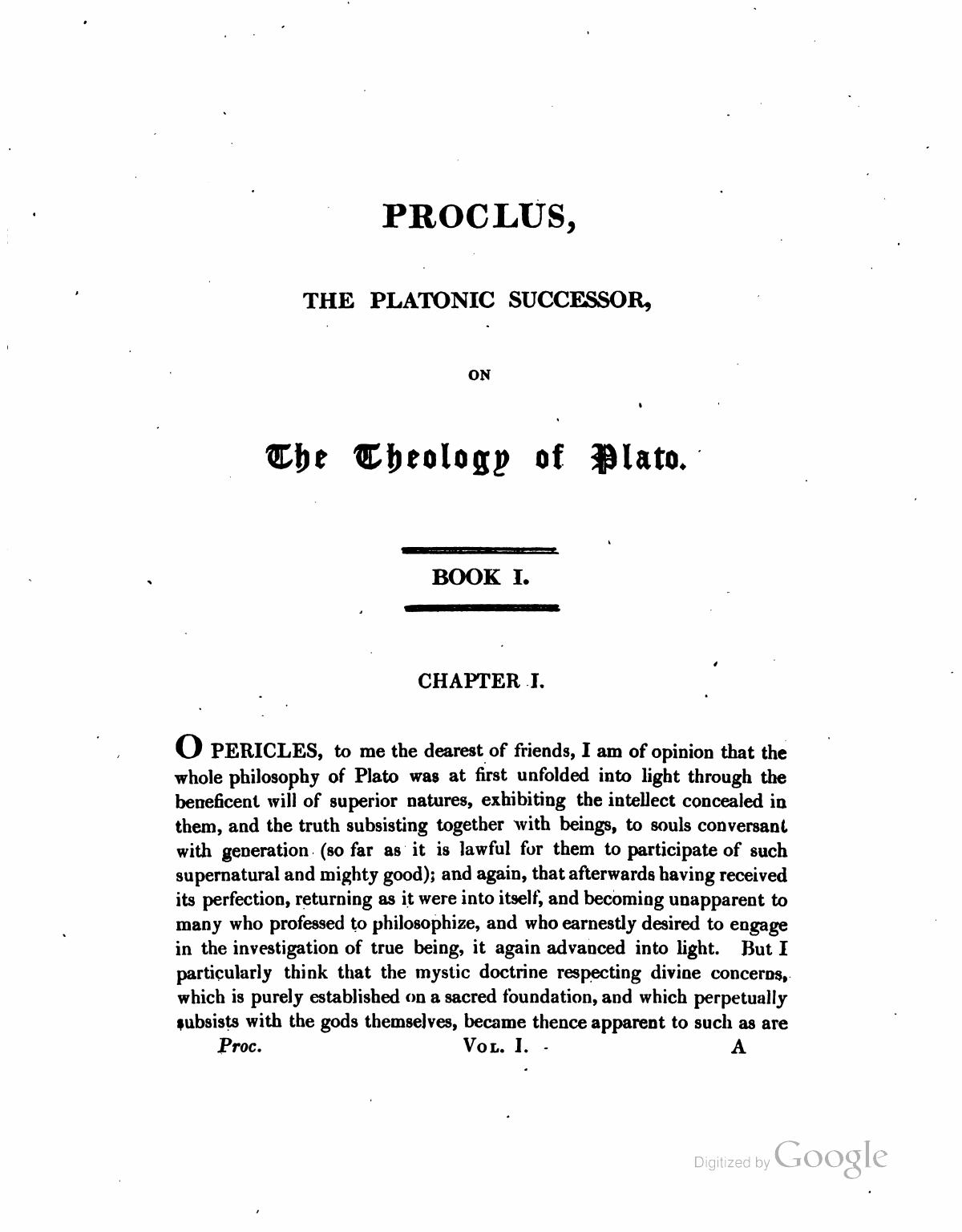
Proklos (412-485), Atina'daki Platoncu Akademi'nin başkanlığını yapmış Yeni Platoncu filozoftur. Platon'un Teolojisi Üzerine adlı altı kitaplık eseri onun en kapsamlı metafizik eseridir ve Platon'un diyaloglarından ilahi mertebelerin düzenini çıkarır. Aktarılan bölüm Thomas Taylor'un 1816 çevirisinde birinci kitabın ilk bölümüdür.
I. KİTAP
I. BÖLÜM
Ey dostların bana en sevgilisi Perikles, Platon'un bütün felsefesinin ilk olarak üstün tabiatların hayırhah iradesiyle ışığa çıkarıldığına, onlarda gizli olan aklı ve varlıklarla birlikte var olan hakikati oluşla meşgul olan ruhlara (böyle doğaüstü ve ulu bir iyilikten pay almalarına izin verildiği ölçüde) sergilediğine ve ardından yetkinliğine ulaşıp adeta kendi içine dönerek, felsefe yaptığını iddia eden ve gerçek varlığın araştırılmasına canıgönülden girişmek isteyen birçok kimse için görünmez hale geldikten sonra yeniden ışığa doğru ilerlediğine inanıyorum. Fakat özellikle kutsal bir temel üzerine safça kurulmuş ve tanrıların kendileriyle birlikte ebediyen var olan ilahi meselelere dair gizemli öğretinin, yeryüzünden ayrılan ruhların inisiye edildiği o gerçek gizemlerin ve mutlu, kutlu bir hayatı samimiyetle benimseyenlerin pay aldığı o eksiksiz ve sarsılmaz görülerin baş önderi ve hierofantı demekte yanılmayacağım tek bir insan aracılığıyla, ondan bir süreliğine nasiplenebilecek olanlara görünür hale geldiğini düşünüyorum. Ancak bu felsefe başlangıçta ondan öyle hürmete layık ve gizemli bir biçimde parıldadı ki, sanki kutsal tapınaklarda ve onların en iç odalarında kurulmuş gibiydi ve bu kutsal yerlere girmiş olan birçok kimse tarafından bilinmeyerek, belirli düzenli zaman dilimleri içinde, böylesi gizemli meselelerin geleneğine uygun bir yaşam sürmüş olan hakiki rahipler vasıtasıyla elinden geldiğince ışığa çıktı. Bana öyle geliyor ki, bütün o mekan da görkemli hale geldi ve ilahi temaşaların aydınlanmaları her yerde nazarımıza serildi.
Platon'un epopteia'sının (yani mistik tefekkürlerinin) ilahi meselelere dair tümüyle kutsal anlatıları bizlere açan ve önderlerine benzer bir tabiata nail olan bu yorumcularının Mısırlı Plotinos ile bu nazariyeyi ondan devralanlar, yani Amelios ve Porphyrios olduğunu; üçüncü sırada ise bunlardan adeta kudretli heykeller gibi neşet edenler, yani Iamblikhos ve Theodoros ile bunlardan sonra bu ilahi koroyu takip ederek ilahi ilhamla dolu bir zihinle Platon'un doktrinleri üzerine mesai harcayan diğer kimseler olduğunu kabul ederim. Tanrılardan sonra güzel ve iyi olan her şeye önderimiz olan o zat, ruhunun bağrında hakikatin en hakiki ve saf ışığını lekesiz bir biçimde kabul ederek, bizi Platon felsefesinin geri kalanının tamamına ortak etti; kendisinden daha kadim olanlardan almış olduğu o gizli bilgiyi bize aktardı ve kendiyle birlikte ilahi meselelerin mistik hakikati hususunda ilahi bir vecde kapılmamızı sağladı.
Dolayısıyla bu zata kendisinden gördüğümüz faydalara layık bir şükran sunmaya girişecek olsak, bütün zaman bile buna yetmezdi. Fakat Platon felsefesinin eşsiz iyiliğini yalnızca başkalarından almış olmakla kalmayıp, şimdiki zamanın en yetkini olan ve felsefenin zirvesine ulaşmış bulunan bir önderin rehberliğinde seyircisi ve elimizden geldiğince taklitçisi olduğumuz o kutlu temaşaların anıtlarını gelecek nesillere bırakmamız da icap ediyorsa, belki de tanrılara ruhumuzdaki hakikat ışığını tutuştursunlar diye yakarmakla ve daha üstün tabiatların hizmetkarları ile memurlarına aklımızı yönlendirip onu Platonik nazariyenin tastamam, ilahi ve yüce nihayetine iletsinler diye niyazda bulunmakla doğru davranmış oluruz. Zira zekadan en ufak bir nasibi olan herkesin girişimlerine Tanrılardan ve bilhassa Tanrılara dair izahlarda başlayacağını düşünüyorum; çünkü ilahi bir tabiatı, ancak Tanrıların ışığıyla yetkinleşerek anlamamız ve onlar tarafından yönetilmedikçe, çok biçimli kanaatlerden ve sözlerde var olan çeşitlilikten muaf olmadıkça, aynı zamanda ilahi isimlerin yorumunu muhafaza etmedikçe başkalarına ifşa etmemiz mümkün değildir. Bu sebeple bunu bilerek ve Platon'un Timaios'unun teşvikine uyarak, öncelikle Tanrıları kendilerine dair öğretinin önderleri kılıyoruz. Niyazlarımızı işitmeleri neticesinde bize lütufkar davransınlar ve merhametle yaklaşarak ruhumuzun aklına rehberlik edip onu Platon'un Vesta'sının çevresinde ve bu tefekkürün çetin yüceliklerine doğru yönlendirsinler; oraya ulaştığımızda, onlara dair bütün hakikati kabul edeceğiz ve ilahi meselelere dair sancılı tasavvurlarımızın en hayırlı neticesini elde edeceğiz; zira onlara dair bir şeyler bilmeyi arzuluyor, onları başkalarından soruşturuyor ve aynı zamanda elimizden geldiğince bizzat kendimiz araştırıyoruz.
Özgün metin (İngilizce)
BOOK I.
CHAPTER I.
O PERICLES, to me the dearest of friends, I am of opinion that the whole philosophy of Plato was at first unfolded into light through the beneficent will of superior natures, exhibiting the intellect concealed in them, and the truth subsisting together with beings, to souls conversant with generation (so far as it is lawful for them to participate of such supernatural and mighty good); and again, that afterwards having received its perfection, returning as it were into itself, and becoming unapparent to many who professed to philosophize, and who earnestly desired to engage in the investigation of true being, it again advanced into light. But I particularly think that the mystic doctrine respecting divine concerns, which is purely established on a sacred foundation, and which perpetually subsists with the gods themselves, became thence apparent to such as are capable of enjoying it for a time, through one man, whom I should not err in calling the primary leader and hierophant of those true mysteries, into which souls separated from terrestrial places are initiated, and of those entire and stable visions, which those participate who genuinely embrace a happy and blessed life. But this philosophy shone forth at first from him so venerably and arcanely, as if established in sacred temples, and within their adyta, and being unknown to many who have entered into these holy places, in certain orderly periods of time, proceeded as much as was possible for it into light, through certain true priests, and who embraced a life corresponding to the tradition of such mystic concerns. It appears likewise to me, that the whole place became splendid, and that illuminations of divine spectacles every where presented themselves to the view.
These interpreters of the epopteia (or mystic speculations) of Plato, who have unfolded to us all-sacred narrations of divine concerns, and who were allotted a nature similar to their leader, I should determine to be the Egyptian Plotinus, and those who received the theory from him, I mean Amelius and Porphyry, together with those in the third place who were produced like virile statues from these, viz.: Jamblichus and Theodorus, and any others, who after these, following this divine choir, have energized about the doctrines of Plato with a divinely-inspired mind. From these, he who, after the gods, has been our leader to every thing beautiful and good, receiving in an undefiled manner the most genuine and pure light of truth in the bosom of his soul, made us a partaker of all the rest of Plato's philosophy, communicated to us that arcane information which he had received from those more ancient than himself, and caused us, in conjunction with him, to be divinely agitated about the mystic truth of divine concerns.
To this man, therefore, should we undertake to return thanks adequate to the benefits which we have received from him; the whole of time would not be sufficient. But if it is necessary, not only that we should have received from others the transcendant good of the Platonic philosophy, but that we should leave to posterity monuments of those blessed spectacles of which we have been spectators, and emulators to the utmost of our ability, under a leader the most perfect of the present time, and who arrived at the summit of philosophy; perhaps we shall act properly in invoking the gods, that they will enkindle the light of truth in our soul, and in supplicating the attendants and ministers of better natures to direct our intellect and lead it to the all-perfect, divine, and elevated, end of the Platonic theory. For I think that every where he who participates in the least degree of intelligence, will begin his undertakings from the Gods, and especially in explications respecting the Gods: for we can no otherwise be able to understand a divine nature than by being perfected through the light of the Gods; nor divulge it to others unless governed by them, and exempt from multiform opinions, and the variety which subsists in words, preserving at the same time the interpretation of divine names. Knowing therefore this, and complying with the exhortation of the Platonic Timæus, we in the first place establish the Gods as leaders of the doctrine respecting themselves. But may they in consequence of hearing our prayers be propitious to us, and benignantly approaching, guide the intellect of our soul, and lead it about the Vesta of Plato, and to the arduous sublimities of this speculation; where, when arrived, we shall receive all the truth concerning them, and shall obtain the best end of our parturient conceptions of divine concerns, desiring to know something respecting them, inquiring about them of others, and, at the same time, as far as we are able, exploring them ourselves.
Bu metin neden önemli
Proklos eserin girişinde dostu Perikles'e seslenir ve Platon felsefesinin tanrısal bir lütufla ortaya çıkarıldığını anlatır. Platon'u tanrısal gizemlerin hierofantı, yani yorumcusu olarak niteler. Ardından bu eserin planını ve yöntemini açıklar. Metin, Proklos'un Platon'u nasıl bir dinî ve felsefi öğretmen olarak gördüğünü doğrudan gösterir.
Bu eser Neoplatonizm Koleksiyonu'nun parçasıdır →
- Kaynak eser
- Proclus, On the Theology of Plato, Thomas Taylor çevirisi, Londra, 1816
- Neşir
- MS 5. yüzyıl / 1816 çeviri
- Konum
- I. Kitap, I. Bölüm
- Çeviren
- Şira Nur Uysal
- Dijital nüsha
- Internet Archive
Uysal, Ş. N. (Çev.). (2026). Proklos, Platon'un Teolojisi: Perikles'e Giriş. Kadim Kütüphane. https://kadimkutuphane.com/proklos-platon-teolojisi-birinci-kitap-periklese-giris@misc{kk_proklos_platon_teolojisi_birinci_kitap_p,
author = {Uysal, Şira Nur},
title = {{Proklos, Platon'un Teolojisi: Perikles'e Giriş}},
year = {2026},
publisher = {Kadim Kütüphane},
url = {https://kadimkutuphane.com/proklos-platon-teolojisi-birinci-kitap-periklese-giris},
note = {Türkçe çeviri, özgün eser: Proklos},
}Yeni metinlerden ilk sen haberdar ol
Tam çeviriler, PDF'ler ve yeni eklenen kaynaklar hazırlandıkça e-postana düşsün.