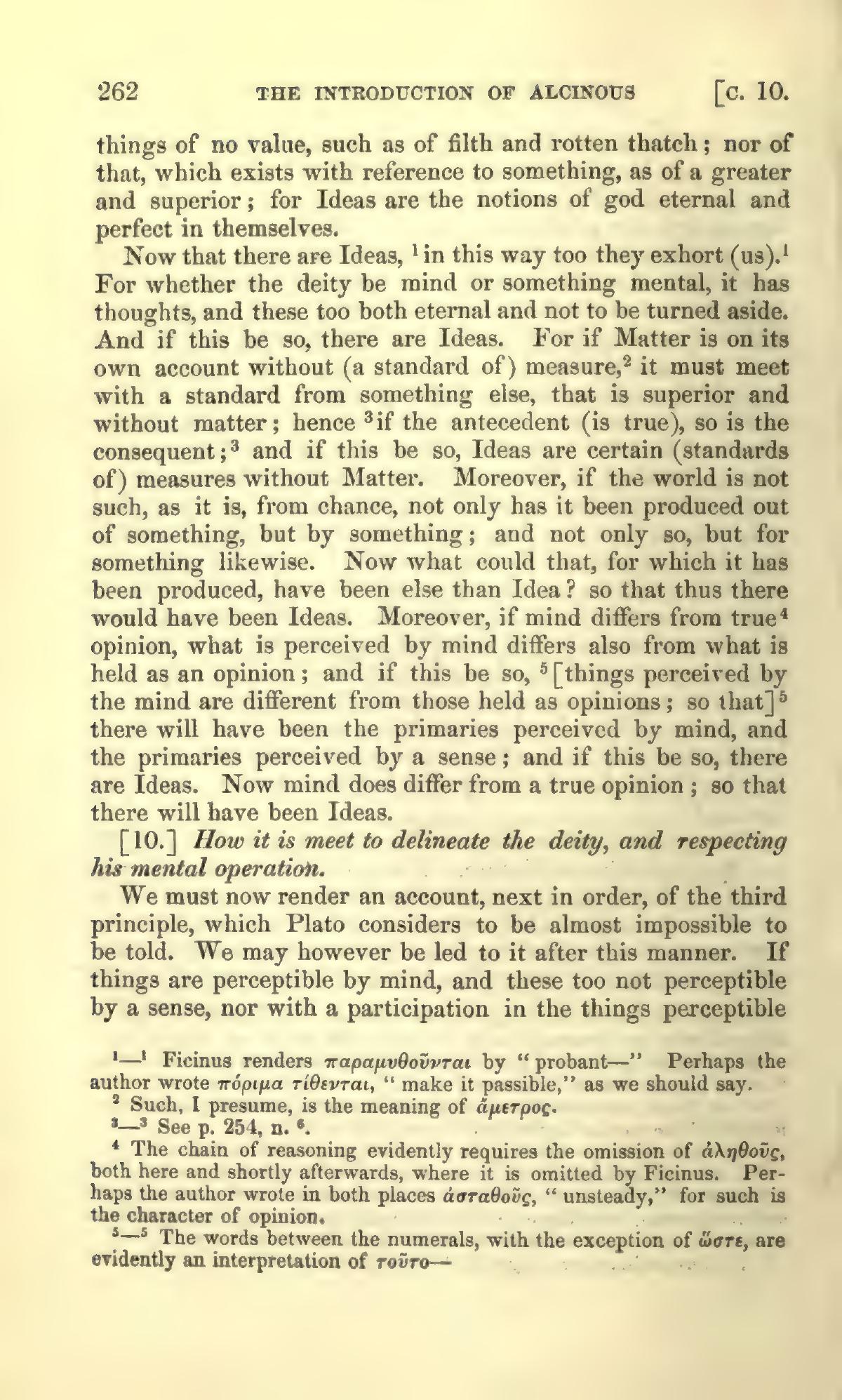
Alkinoos, yaklaşık MS 2. yüzyılda yaşamış Orta Platoncu bir filozoftur. Didaskalikos adıyla da bilinen Platon Öğretilerine Giriş, Platon'un felsefesini kısa bir ders kitabı halinde sunar. Aktarılan bölüm George Burges'in İngilizce çevirisinin onuncu bölümüdür.
[10.] Tanrının nasıl tasvir edilmesi gerektiği ve onun zihinsel işleyişine dair.
Şimdi sırasıyla, Platon'un anlatılmasını neredeyse imkansız gördüğü üçüncü ilkenin bir açıklamasını sunmalıyız. Yine de ona şu şekilde ulaştırılabiliriz. Eğer zihinle algılanabilen şeyler varsa ve bunlar duyuyla algılanamıyorsa, duyuyla algılanabilen şeylerden pay almıyorsa, bilakis zihinle algılanabilen bazı birincil varlıklara aitse, duyuyla algılanabilen birinciller olduğu gibi, zihinle algılanabilen yalın birinciller de vardır. O halde öncül (doğru) ise, vargı da öyledir. İnsanlar, duyumdan kaynaklanan etkilenimle lekelenmiş olduklarından, zihinle algılanabilir bir şey üzerine düşünmeye karar verdiklerinde, zihinle algılanabilir şeyler üzerinde sıklıkla açık seçik düşünemezler; öyle ki aynı anda büyüklük, biçim ve rengi de düşünecek şekilde hayallerinde duyuyla algılanabilir olanı tutarlar. Oysa tanrılar, duyuyla algılanabilir şeylerden kurtulmuş olarak, açık seçik ve (hayallerin) karışımı olmaksızın (düşünürler). Zihin, canlılık ilkesinden üstün olduğuna ve kendi işleyişine göre bütün şeyleri aynı anda ve ebediyen düşünen Zihin, bilkuvve bir zihinden üstün olduğuna; bunun nedeni de şundan daha iyi olduğuna ve var olan bunların da üzerinde bulunduğuna göre, bütün göğün zihninin daima işlemesinin nedeni olarak bu, birincil tanrı olacaktır. Kendisi hareketsiz olduğu halde, güneşin kendisine baktığında görme duyusu için yaptığı gibi ve arzu yetisine sahip olan şey, kendisi hareketsiz kalarak arzuyu uyandırdığı gibi, o (zihin) için de iş görmektedir. En azından bu yolla bu Zihin de bütün göğün zihnini harekete geçirecektir. Şimdi, birincil Zihin en güzel olduğuna göre, şüphesiz onun altına konulan şeyin de en güzel olması gerekir. Oysa hiçbir şey onun kendisinden daha güzel değildir. Bu nedenle o, ebediyen kendi üzerine ve kendi düşünceleri üzerine düşünüyor olmalıdır; ve onun bu zihinsel etkinliği İdeadır. Dahası, birincil tanrı ebedidir, dile gelmezdir, kendi içinde yetkindir, yani hiçbir eksiği yoktur; daima yetkindir, yani ebediyen yetkindir; her bakımdan yetkindir, yani her yönden yetkindir; tanrısallıktır, kutsallıktır, hakikattir, simetridir, iyidir. Ve ben bunu bir tanım veriyormuş gibi değil, her şeye göre zihinde tutulan birine dair söyler gibi söylüyorum. O bir iyidir, çünkü her iyinin nedeni olarak, gücü ölçüsünde her şeye iyilik bahşeder; ve güzel bir şeydir, çünkü kendiliğinden, doğaca olandan daha fazlasıdır ve simetriktir; ve hakikattir, çünkü Güneş'in bütün ışığın başlangıcı olması gibi o da bütün hakikatin başlangıcıdır; ve babadır, çünkü her şeyin nedenidir ve göksel zihni ve evrenin ruhunu kendisine ve kendi düşüncelerine göre düzene sokar. Çünkü evrenin ruhunu yükseltip kendine yönelttikten sonra, baba tarafından düzene sokularak bu dünyadaki bütün doğayı düzene sokan o zihnin nedeni olarak, kendi iradesine göre her şeyi kendisiyle doldurmuştur. Dahası, belirtildiği üzere, dile gelmezdir ve yalnızca zihinle kavranabilir; zira o ne cinstir, ne türdür, ne de ayrımdır; ne de ona kötü herhangi bir şey gelmiştir, çünkü bunu belirtmek caiz değildir; ne de iyi herhangi bir şey gelmiştir, çünkü o zaman bir şeyden, bilhassa iyilikten pay alarak böyle olurdu; ne ayrımdır, çünkü onun kavramına göre bu (olamaz); ne eşitlikle var olandır, çünkü o bir nitelik kılınmamıştır ve bir nitelikle yetkinleşmemiştir; ne de niteliksizdir, çünkü üzerine gelen herhangi bir nitelikten yoksun bırakılmamıştır; ne herhangi bir şeyin parçasıdır, ne de parçalara sahip bir bütün gibidir; ne aynı ne de farklı herhangi bir şey olacak şekildedir, çünkü şeylerin geri kalanından ayrılabileceği hiçbir durum başına gelmemiştir; ne hareket eder ne de hareket ettirilir.
Şimdi ona dair ilk kavrayış, bütün bu şeylerden soyutlamaya göre olan kavrayış olacaktır; tıpkı bir yüzeyi, ardından bir çizgiyi ve son olarak bir noktayı düşünerek, duyuyla algılanabilir olandan yapılan bir soyutlamaya göre noktaya dair bir kavrayışa sahip olduğumuz gibi. İkinci kavrayış ise bir şekilde şu yolla analojiye göre olan kavrayış olacaktır.
Özgün metin (İngilizce)
[10.] How it is meet to delineate the deity, and respecting his mental operation.
We must now render an account, next in order, of the third principle, which Plato considers to be almost impossible to be told. We may however be led to it after this manner. If things are perceptible by mind, and these too not perceptible by a sense, nor with a participation in the things perceptible by a sense, but belonging to some primaries perceptible by mind, there are simple primaries perceptible by mind, as there are primaries likewise perceptible by a sense. If then the antecedent (is true), so is the consequent. Now men as being infected with the suffering from sensation, so that, when they determine to think upon something perceptible by mind, they keep in their fancy that, which is perceptible by a sense, so as to think at the same time of magnitude, and form, and colour do frequently think not clearly upon things perceptible by mind; whereas the gods, being freed from things perceptible by a sense, (do think) clearly and without a mixture (of fancies). Now since Mind is superior to the living principle, and as the Mind, which is, according to its working, thinking upon all things simultaneously and for ever, is superior to a mind in posse; and as the cause of that is better than this, and what exists is still above these, this would be the primary god, as being the cause of perpetually operating for the mind of the whole heaven. Now he is operating, although unmoved himself, for that (mind), as the sun does for vision, when it looks for him, and as that, which has the faculty of desire, excites desire, itself being unmoved. At least in this way will this Mind likewise excite the mind of the whole heaven. Now, since the primary Mind is the most beautiful, there must needs be the most beautiful thing placed under it. But nothing is more beautiful than itself. It would therefore be thinking for ever upon itself and its own cogitations; and this its mental energy is Idea. Moreover the primary god is eternal, ineffable, perfect in itself, that is, not wanting in any thing, ever-perfect, that is, for ever perfect, all-perfect, that is, perfect in every way, a divinity, holiness, truth, symmetry, good. And I say not this, as if giving a definition, but as of one had in mind according to all. He is a good, because, being the cause of all good, he bestows kindness on all things according to his power; and a beautiful thing, because he is (so) by himself more than that by nature and symmetrical; and truth, because he is the beginning of all truth, as the Sun is of all light; and he is the father, by being the cause of all things, and by putting into order the heavenly mind, and the soul of the world, with reference to himself and his own cogitations. For according to his own will he has filled all things with himself, after having raised up the soul of the world and turned it to himself, being the cause of that mind, which, being put into order by the father, puts into order the whole of nature in this world. He is moreover ineffable, and to be comprehended by mind alone, as has been stated; since he is neither genus nor species, nor difference; nor has there happened to him any thing either evil for it is not lawful to state this; or good for he would be such according to the participation of something, especially goodness; nor difference for this (cannot be) according to the notion of him; nor being with equality for he has not been made a quality, nor perfected by quality; nor without quality for he has not been deprived of any quality, coming upon him; nor a part of any thing; nor as a whole, possessing any parts; nor so as to be any thing the same or different for nothing has happened to him, according to which he is able to be separated from the rest of things; nor does he move, nor is he moved.
Now (the) first notion of him will be that, which is according to the abstraction from (all) these things; as we have had a notion of a point according to an abstraction from what is perceptible by a sense, by thinking upon a superficies, then a line, and lastly a point. The second notion will be that, which is according to analogy somehow in this way.
Bu metin neden önemli
Alkinoos bu bölümde Platon'un anlatılmasını neredeyse imkânsız gördüğü üçüncü ilkeyi, yani Tanrı'yı, nasıl düşünebileceğimizi sorar. Zihinle algılanabilen şeylerin varlığından yola çıkar ve duyulardan arınmış bir düşünme biçimini Tanrı'ya yaklaşmanın yolu olarak anlatır. Metin, Orta Platonculuğun Tanrı konusunda kullandığı yöntemlerden birini doğrudan gösterir. Çeviri teknik terimler bakımından zor bir metindir ve bu sayfa bir önizlemedir.
Bu eser Neoplatonizm Koleksiyonu'nun parçasıdır →
- Kaynak eser
- Alcinous, The Introduction to the Doctrines of Plato, George Burges çevirisi, The Works of Plato cilt VI, Londra, Bohn
- Neşir
- MS 2. yüzyıl / 19. yüzyıl çeviri
- Konum
- 10. bölüm
- Çeviren
- Şira Nur Uysal
- Dijital nüsha
- Internet Archive
Uysal, Ş. N. (Çev.). (2026). Alkinoos, Platon'un Öğretileri Elkitabı: Tanrı Nasıl Düşünülür. Kadim Kütüphane. https://kadimkutuphane.com/alkinoos-platonun-ogretileri-elkitabi-tanri-ve-idealar@misc{kk_alkinoos_platonun_ogretileri_elkitabi_ta,
author = {Uysal, Şira Nur},
title = {{Alkinoos, Platon'un Öğretileri Elkitabı: Tanrı Nasıl Düşünülür}},
year = {2026},
publisher = {Kadim Kütüphane},
url = {https://kadimkutuphane.com/alkinoos-platonun-ogretileri-elkitabi-tanri-ve-idealar},
note = {Türkçe çeviri, özgün eser: Alkinoos},
}Yeni metinlerden ilk sen haberdar ol
Tam çeviriler, PDF'ler ve yeni eklenen kaynaklar hazırlandıkça e-postana düşsün.