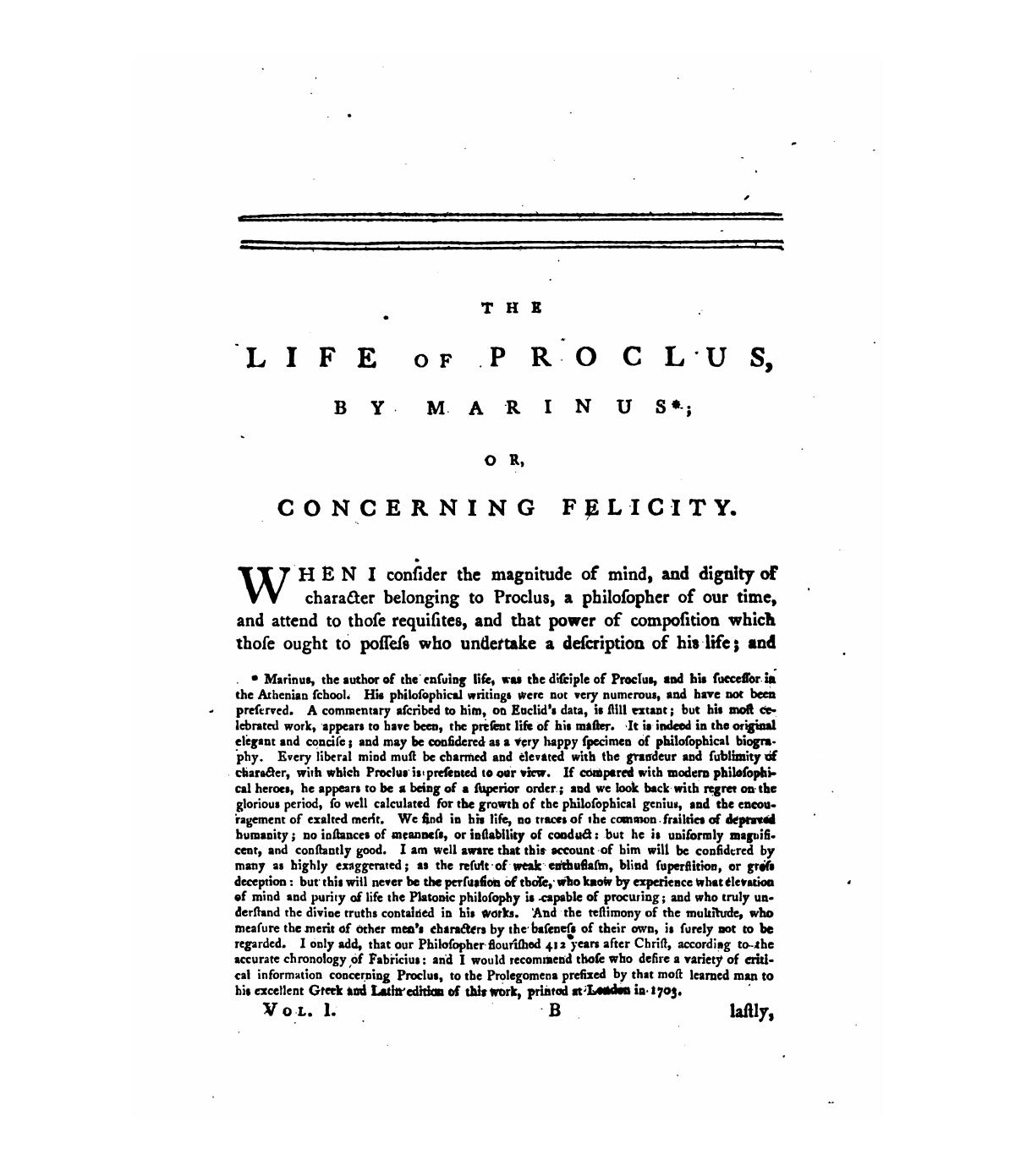
Marinos, Proklos'un öğrencisi ve Atina Akademisi'ndeki halefidir. Hocasının ölümünden kısa süre sonra, MS 485 dolayında, ona Proklos'un Hayatı ya da Mutluluk Üzerine adlı övgü niteliğinde bir biyografi yazdı. Aktarılan bölüm Thomas Taylor'un 1788-1789 İngilizce çevirisinden alınmıştır.
MARINUS TARAFINDAN PROKLOS'UN HAYATI VEYA MUTLULUK ÜZERİNE.
Çağımızın bir filozofu olan Proklos'un zihin büyüklüğünü ve karakterinin yüceliğini düşündüğümde ve onun hayatını anlatmaya girişenlerin sahip olması gereken nitelikleri ve ifade gücünü göz önüne aldığımda; son olarak da kendi söz dağarcığımın yoksulluğuna baktığımda, böyle bir girişimden kaçınmanın, atasözüne göre hendeğin üzerinden atlamamanın ve böylesine büyük bir güçlük ve tehlike barındıran bir söylemden vazgeçmenin daha doğru olduğuna inanma eğilimine giriyorum. Fakat diğer yandan mabetlerde bile sunaklara yaklaşan herkesin aynı şekilde kurban kesmediğini düşündüğümde tereddütlerim biraz azalmaktadır; zira kimileri o sunakların ait olduğu tanrıların lütfuna layık olacak biçimde boğalar, keçiler ve benzeri şeyleri özenle hazırlamakla meşgul olur, aynı şekilde kimileri bazısı manzum olarak daha zarif, bazısı ise mensur ilahiler besteler; buna karşılık bütün bu bağışlardan yoksun olan ve belki de bir çörek ile az miktarda ekmek ve günnükten başka bir şey kurban etmeyen, yakarışlarını da taptıkları tanrıya kısa bir hitapla tamamlayan kimseler ise diğerlerinden daha az işitilmezler. Kendi kendime böyle düşünürken İbykos'un sözleriyle, tanrılara değil (çünkü onun sözleri böyledir) bilge bir insana karşı kusur işlemekten ve böylece insanların övgüsünü kazanmaktan korkuyorum.
Çünkü onun yakın dostlarından biri olan benim, hayatı konusunda sessiz kalmam ve elimden gelen en üstün gayretle, onun hakkında doğru olan ve belki de diğerlerine nispetle öncelikle yayımlanması gereken ayrıntıları aktarmamam helal değildir. Gerçekten de böyle bir ihmal yüzünden, belki de insanlığın saygı ve takdirini kazanamam; zira onlar benim bu davranışımı tamamen gösterişten kaçınma arzusuna bağlamayacak, böyle bir niyetten tembellik ya da ruhun daha da korkunç bir hastalığı yüzünden kaçındığımı varsayacaklardır. Dolayısıyla bütün bu mülahazalarla harekete geçerek, bu filozofun neredeyse sayısız olan ve şüphe götürmez gerçekliklerine güvenilebilecek bazı şanlı yönlerini anlatmayı üzerime almış bulunuyorum.
Bu nedenle, sözlerini bölümlere ayırmaya alışkın olan yazarların mutat yöntemine göre başlamayacağım; bilakis bu mübarek insanın saadetinin, en büyük hakkaniyetle bu risalenin temeli yapılması gerektiği kanaatindeyim. Zira ben onu, geçmiş çağlarda methedilmiş insanların en mutlusu olarak görmekteyim; onun sadece hikmetin saadetinden ötürü mutlu olduğunu söylemiyorum, her ne kadar bütün insanların en üst derecesinde buna sahip olmuş olsa da; hayvani bir hayatın nimetlerinden bolca yararlandığı için yahut yine talihi sebebiyle de böyle söylemiyorum, her ne kadar harici mallar olarak adlandırılan tüm bu şeylerin büyük bir bolluğuna sahip olmak bakımından talih ona en üstün derecede ait olmuş olsa da; fakat onun mutluluğu mükemmel, her parçasıyla eksiksiz ve yukarıda sayılan unsurların her birinden meydana gelmiş olduğu için onu mutlu olarak adlandırıyorum. O halde ilk olarak faziletleri türlerine göre tabii, ahlaki ve siyasi olarak, ayrıca tamamen arınma ve temaşa ile meşgul olan ve bu yüzden Katartik ve Teoretik olarak adlandırılan daha yüce derecedeki faziletlere ve yine belirli bir tanrı ile benzerlik kazandığımız Teürjik olarak adlandırılan faziletlere ayırdıktan sonra; insanın erişiminin ötesinde kaldığı için bunlardan üstün olanları bir yana bırakıp, eşyanın tabiatında ilk olmasa bile insan ruhunun ilerleyişinde ilk olan ve daha tabii olanlardan başlayacağız.
O halde, övgüsü bu risalenin konusu olan bu kutlu insan, insan soyunun payına düşen bütün o bedeni faziletlere doğduğu andan itibaren tabiatı gereği sahipti; bunların izleri ömrünün son döneminde dahi açıkça görülmekteydi ve sağlam bir kabuk gibi bedenini çevreleyip kuşattığı müşahede edilmekteydi. İlk olarak, bedensel basiret olarak adlandırılan fevkalade bir duyu mükemmelliği ile donatılmıştı; bu durum özellikle felsefe yapmak ve hayvani hayatın daha büyük kolaylığı için tanrılar tarafından insanlara bahşedilmiş olan daha soylu görme ve işitme duyularında belirgindi ve bunlar bu ilahi insanda ömrü boyunca tastamam kaldı. İkinci olarak, soğuktan etkilenmeyen, herhangi bir bozuk veya ihmalkar beslenmeyle ya da meşakkatlere katlanmakla zayıflamayan yahut bozulmayan bir beden kuvvetine sahipti; gerçi gece gündüz dua etmekle, başkalarının eserlerini incelemekle, bizzat kitaplar yazmakla ve dostlarıyla sohbet etmekle meşgul olurken bu kuvvet tükenirdi; bütün bunları öylesine bir süratle icra ederdi ki yalnızca tek bir konuyu çalışıyor gibi görünürdü. Ancak bu tür bir güç, bu gibi gayretlerde sarf edilen benzersiz kuvvetten ötürü, haklı olarak beden metaneti olarak adlandırılabilir.
Donatılmış olduğu üçüncü bedensel fazilet güzellikti; bu kavramları ortaya koyanlar, itidal ile karşılaştırıldığında bunun çok yerinde bir biçimde tabiat benzerliğine sahip olduğunu düşünmüşlerdir. Zira nasıl ki itidalin, ruhun güçlerinin belirli bir ahenk ve mutabakatından meydana geldiğini düşünüyorsak, bedensel güzelliğin de uzvi parçaların belirli bir uyumundan oluştuğu kabul edilir. Kendisi gerçekten de sadece bu mükemmel beden orantısıyla donatıldığı için değil, aynı zamanda ruhunun gümrah hali yaşayan bir ışık gibi bedensel çerçevesinden dilin açıklayamayacağı kadar harikulade parıltılarla parıldadığı için son derece hoş bir görünüme sahipti. Hakikaten o denli güzeldi ki hiçbir ressam onun benzerini tam olarak tasvir edemezdi; onun elden ele dolaşan bütün resimleri, her ne kadar çok güzel olsalar da aslındaki gerçek güzelliğin çok gerisindeydi. Sahip olduğu dördüncü bedensel fazilet ise sıhhatti; bunun ruhtaki adalete tekabül ettiğini ve diğerinin ruhun parçalarında olduğu gibi bunun da bedensel parçaların düzenindeki bir tür adalet olduğunu teyit ederler. Zira adalet, ruhun parçalarını kendi vazifelerinde tutan belirli bir melekeden başka bir şey değildir. Bu yüzden hekimler tarafından, bedenin birbiriyle çelişen unsurlarını birlik ve mutabakata kavuşturan şeye sıhhat denir; Proklos da buna öylesine bir mükemmellikte sahipti ki yetmiş beş yıllık uzun ömrü boyunca iki ya da üç kereden fazla hastalanmadığını ifade etmiştir. Bunun yeterli bir kanıtı da şuradan bellidir ki son hastalığında, uğradıkları akınların son derece seyrek olmasından ötürü, bedenini istila eden rahatsızlıkların neler olduğunu tamamen bilmemekteydi.
İşte Proklos'un sahip olduğu ve mükemmel fazileti taksim ettiğimiz o suretlerin öncüleri ve adeta habercileri sayılabilecek bedensel nimetler bunlardı. Fakat eğitimden önce, tabiatı gereği sahip olduğu ruhunun ilk güçleri ve mahsulleri ile donandığı ve Platon'un felsefi bir tabiatın unsurları saydığı o fazilet parçaları, onların mükemmel niteliğini düşünen herkesin hayranlığını celbetmelidir.
Özgün metin (İngilizce)
THE LIFE OF PROCLUS, BY MARINUS; OR, CONCERNING FELICITY.
WHEN I consider the magnitude of mind, and dignity of character belonging to Proclus, a philosopher of our time, and attend to those requisites, and that power of composition which those ought to possess who undertake a description of his life; and lastly, when I regard my own poverty of diction, I am inclined to believe it more proper to refrain from such an undertaking, not to leap over the fosse (according to the proverb), and to decline a discourse involved in so much difficulty and danger. But my scruples are something diminished when I consider, on the other hand, that even in temples, those who approach to the altars do not all sacrifice alike; but that some are solicitously employed in preparing bulls, goats, and other things of a similar kind, as not unworthy the beneficence of the Gods to whom those altars belong: likewise that they compose hymns, some of which are more elegant in verse, but others in prose; while some, who are destitute of all such gifts, and sacrifice with nothing more perhaps than a cake and a small quantity of bread, with frankincense, and who finish their invocations with a short address to the particular divinity they adore, are not less heard than others. While I thus think with myself, I am afraid, according to Ibycus, lest I should not offend against the Gods (for these are his words) but against a wise man, and thus obtain the praise of men.
For I do not think it lawful, that I who was one of his familiars, should be silent concerning his life; and should not, according to my utmost ability, relate such particulars concerning him as are true, and which perhaps ought to be published in preference to others. And indeed by such a neglect I shall not perhaps obtain the esteem and honour of mankind, who will not entirely ascribe my conduct to the desire of avoiding ostentation, but will suppose I avoided such a design from indolence, or some more dreadful disease of the soul. Incited, therefore, by all these considerations, I have taken upon me to relate some illustrious particulars of this philosopher, since they are almost infinite, and may be depended on for their undoubted reality.
I shall begin therefore not according to the usual manner of writers, who are accustomed to distribute their discourse into chapters; but I consider that the felicity of this blessed man ought, with the greatest propriety, to be placed as the foundation of this treatise. For I regard him as the most happy of those men who were celebrated in former ages; I do not say happy only from the felicity of wisdom, though he possessed this in the highest degree of all men; nor because he abundantly enjoyed the goods of an animal life; nor again on account of his fortune, though this belonged to him in a most eminent degree, for he was supplied with a great abundance of all such things as are called external goods: but I call him happy, because his felicity was perfect, complete in all parts, and composed from each of the preceding particulars. Having then in the first place distributed virtues according to their kinds into natural, moral, and political, and also into those of a sublimer rank, which are wholly conversant with purification and contemplation, and are therefore called Cathartic and Theoretic, and also such as are denominated Theurgic, by which we acquire a similitude with some particular divinity; but omitting such as are superior to these, as beyond the reach of man, we shall begin from such as are more natural, and which are first in the progressions of the human soul, though not first in the nature of things.
This blessed man, then, whose praise is the subject of this treatise, naturally possessed, from the hour of his birth, all those physical virtues which fall to the lot of mankind; the traces of which were manifest in the latest period of his life, and appeared to surround and invest his body after the manner of a tenacious shell. In the first place, he was endued with a singular perfection of sensation, which they denominate corporeal prudence; and this was particularly evident in the nobler senses of seeing and hearing, which are indeed given by the gods to men for the purpose of philosophizing, and for the greater convenience of the animal life; and which remained entire to this divine man through the whole of his life. Secondly, he possessed a strength of body which was not affected by cold, and which was neither weakened nor disturbed by any vicious or negligent diet, nor by any endurance of labours, though it was exhausted day and night, while he was employed in prayer, in perusing the works of others, in writing books himself, and in conversing with his familiars; all which he performed with such expedition, that he appeared to study but one thing alone. But a power of this kind may with propriety be called fortitude of body, from the singular strength employed in such exertions.
The third corporeal virtue with which he was endued was beauty, which, when compared with temperance, the authors of these appellations have very properly considered as possessing a similitude of nature. For as we consider temperance as consisting in a certain symphony and consent of the powers of the soul, so corporeal beauty is understood to consist in a certain agreement of the organical parts. He was indeed of a most pleasing aspect, not only because he was endued with this excellent proportion of body, but because the flourishing condition of his soul beamed through his corporeal frame like a living light, with splendors too wonderful for language to explain. And indeed he was so beautiful that no painter could accurately describe his resemblance; and all the pictures of him which were circulated, although very beautiful, were far short of the true beauty of the original. But the fourth corporeal virtue which he possessed was health, which they affirm corresponds to justice in the soul; and that this is a certain justice in the disposition of the corporeal parts, as the other in those of the soul. For justice is nothing more than a certain habit, containing the parts of the soul in their proper duty. Hence, that is called health by physicians, which conciliates the jarring elements of the body into union and consent; and which Proclus possessed in such perfection, that he affirmed he was not ill above twice or thrice, in the course of so long a life as seventy-five years. But a sufficient proof of this is evident from hence, that, in his last illness, he was entirely ignorant what the disorders were which invaded his body, on account of the great rarity of their incursions.
Such then were the corporeal goods which Proclus possessed, and which may be called the forerunners, and as it were messengers, of those forms into which we have distributed perfect virtue. But the first powers and progeny of his soul, which he naturally possessed, previous to instruction, and those parts of virtue with which he was adorned, and which Plato reckons the elements of a philosophic nature, must excite the wonder of any one who considers their excellent quality. For he was remarkable for his memory and ingenuity; he was of a disposition magnificent, gentle, and friendly; and a companion,
Bu metin neden önemli
Marinos girişte böyle bir hayat anlatısına girişmekteki çekincesini anlatır. Ardından Proklos'un sahip olduğu erdemleri sıralar. Bedensel erdemleri, güzelliği ve ruhunun doğuştan gelen niteliklerini bir filozofun mutluluğunun parçaları olarak tanımlar. Metin, Atina Akademisi'nin son büyük başkanının çağdaş bir öğrencisi tarafından nasıl görüldüğünü doğrudan gösterir.
Bu eser Neoplatonizm Koleksiyonu'nun parçasıdır →
- Kaynak eser
- Marinus, The Life of Proclus, Thomas Taylor çevirisi, The Philosophical and Mathematical Commentaries of Proclus içinde, Londra, 1788-1789
- Neşir
- MS 485 dolayı / 1788 çeviri
- Konum
- Giriş ve ilk bölümler
- Çeviren
- Şira Nur Uysal
- Dijital nüsha
- Internet Archive
Uysal, Ş. N. (Çev.). (2026). Marinos, Proklos'un Hayatı: Mutluluk Üzerine. Kadim Kütüphane. https://kadimkutuphane.com/marinos-proklosun-hayati-mutluluk-uzerine@misc{kk_marinos_proklosun_hayati_mutluluk_uzerin,
author = {Uysal, Şira Nur},
title = {{Marinos, Proklos'un Hayatı: Mutluluk Üzerine}},
year = {2026},
publisher = {Kadim Kütüphane},
url = {https://kadimkutuphane.com/marinos-proklosun-hayati-mutluluk-uzerine},
note = {Türkçe çeviri, özgün eser: Marinos},
}Yeni metinlerden ilk sen haberdar ol
Tam çeviriler, PDF'ler ve yeni eklenen kaynaklar hazırlandıkça e-postana düşsün.