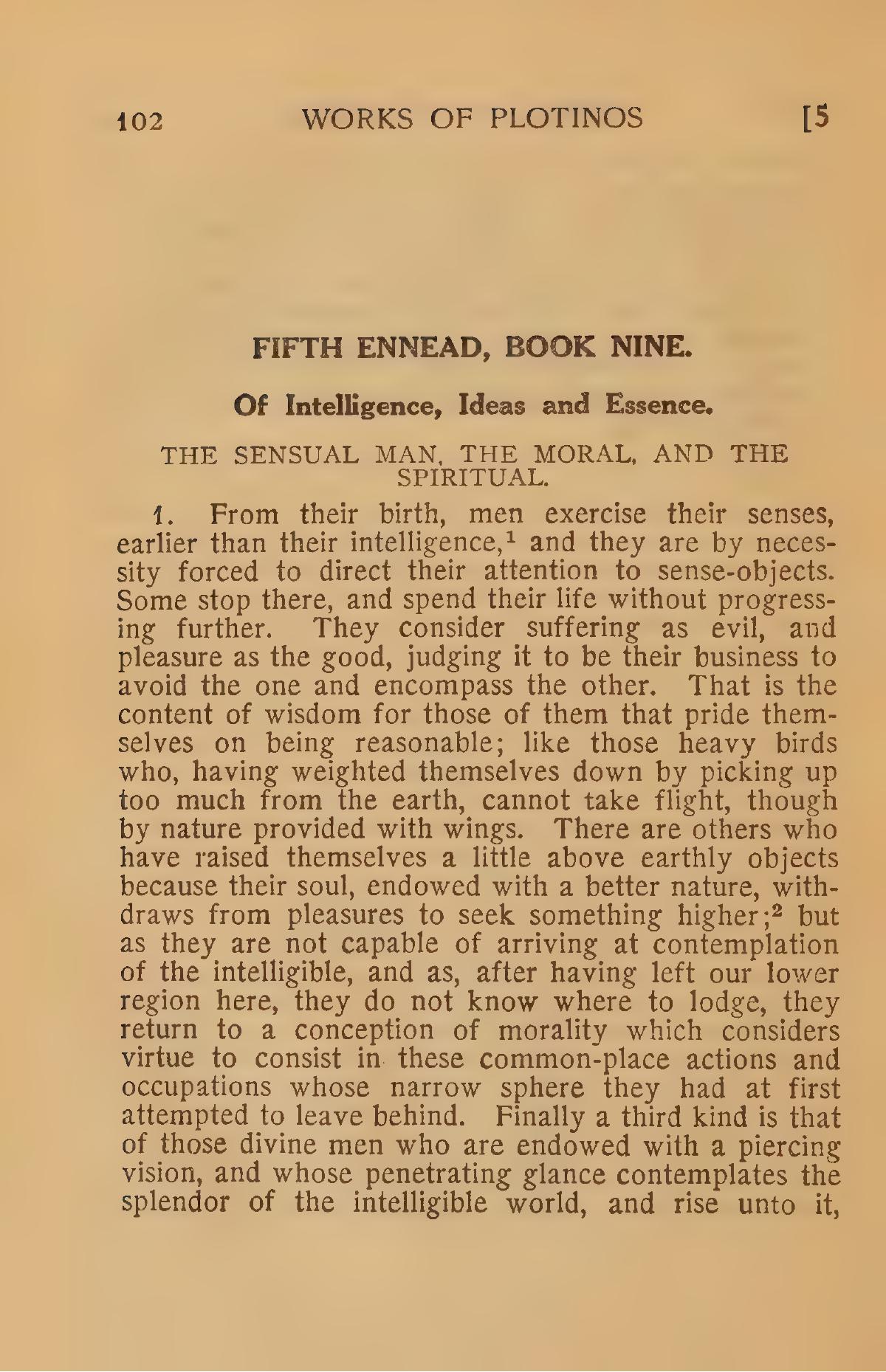
Plotinos (204/205-270), Yeni Platonculuğun kurucusudur. Yazdığı elli dört inceleme, öğrencisi Porphyrios tarafından dokuzarlı altı gruba, yani Enneadlar'a ayrılmıştır. Zekâ, İdealar ve Varlık Üzerine başlıklı V.9, Porphyrios'un verdiği yazılış sırasına göre Plotinos'un ilk incelemelerindendir. Bu bölüm Kenneth Sylvan Guthrie'nin incelemeleri yazılış sırasıyla veren 1918 çevirisinden aktarılmıştır.
BEŞİNCİ ENNEAD, DOKUZUNCU KİTAP.
Zeka, İdealar ve Öz Üzerine.
DUYUSAL, AHLAKİ VE RUHANİ İNSAN.
1. İnsanlar doğumlarından itibaren duyularını zekalarından daha önce kullanırlar ve zorunlu olarak dikkatlerini duyu nesnelerine yöneltmek durumunda kalırlar. Bazıları orada durur ve daha ileri gitmeden yaşamlarını geçirirler. Acı çekmeyi kötülük, hazzı ise iyilik olarak görürler; birinden kaçınmayı ve diğerini elde etmeyi kendi işleri sayarlar. Makul olmakla övünenlerin bilgelik içeriği budur; tıpkı doğaları gereği kanatlarla donatılmış olmalarına rağmen, yerden çok fazla şey toplayarak kendilerini ağırlaştırdıkları için uçamayan o ağır kuşlar gibidirler. Daha iyi bir doğayla donatılmış olan ruhları daha yüksek bir şey aramak için hazlardan geri çekildiğinden, kendilerini dünyevi nesnelerin biraz üzerine çıkarmış olan başkaları da vardır; ancak akledilir olanın temaşasına ulaşacak kudrette olmadıklarından ve buradaki alt bölgemizi terk ettikten sonra nereye yerleşeceklerini bilemediklerinden, erdemin ilk başta geride bırakmaya çalıştıkları dar alanına ait bu sıradan eylem ve uğraşlardan ibaret olduğunu düşünen bir ahlak anlayışına geri dönerler. Son olarak üçüncü bir tür, keskin bir görüşle donatılmış olan ve nüfuz edici bakışları akledilir dünyanın ihtişamını temaşa eden ve bu dünyanın bulutlarının ve karanlığının üzerinde uçarak ona doğru yükselen o ilahi insanların türüdür. Ardından, dünyevi şeylere karşı küçümsemeyle dolu olarak orada, yukarıda kalırlar ve uzun yolculuklardan sonra nihayet yurduna kavuşan bir adamın tarif edilmez mutluluğuyla gerçek anavatanlarında ikamet ederler.
YÜKSEK BÖLGEYE YALNIZCA DOĞUŞTAN FİLOZOF OLANLAR ULAŞIR.
2. Bu daha yüksek bölge neresidir? Ona ulaşmak için ne yapılmalıdır? Kişi doğası gereği sevmeye yatkın olmalı ve gerçekten doğuştan bir filozof olmalıdır. Güzelliğin huzurunda aşık, doğum sancılarına benzer bir şey hisseder; fakat bedensel güzellikte duraklamaktan uzak durarak, erdem, ödevler, bilim ve yasalar tarafından ruhta uyandırılan güzelliğe yükselir. Sonra onları güzelliklerinin nedenine kadar takip eder ve bu yükseliş sürecinde, ancak ilk sırada yer alan İlkeye, kendi içinde güzel olana ulaştığında durur. Ancak o zaman doğum sancılarına benzettiğimiz bu ızdırap tarafından sürüklenmekten kurtulur.
SEVGİ GİDEREK DAHA YÜKSEK AŞAMALARA DÖNÜŞÜR.
Peki oraya nasıl yükselir? Bunu yapma gücünü nereden bulur? Sevmeyi nasıl öğrenir? İşte böyledir. Bedenlerde görülen güzellik arızidir; bedenlerin maddesini oluşturduğu şekillerden ibarettir. Dolayısıyla töz değişir ve güzellikten çirkinliğe doğru değiştiği görülür. Beden yalnızca ödünç alınmış bir güzelliğe sahiptir. Bedene bu güzelliği kim vermiştir? Bir yandan güzelliğin varlığı; diğer yandan bedeni biçimlendiren ve ona sahip olduğu şekli veren ruhun etkinliği. Peki ruh, kendi başına mutlak güzellik midir? Hayır, çünkü bazı ruhlar bilge ve güzelken, diğer bazıları akılsız ve çirkindir. Öyleyse ruh yalnızca bilgelik sayesinde güzeldir. Ama onun bilgeliği nereden türemiştir? Zorunlu olarak zekadan; bazen akıllı olup bazen olmayan zekadan değil, tam da bu nedenden ötürü güzel olan hakiki Zekadan. İlk ilke olarak Zekada duracak mıyız? Yoksa aksine onun da mı üzerine çıkacağız? Kesinlikle öyle, çünkü Zeka bize ilk İlkeden önce kendini gösterir, zira tabiri caizse İyinin giriş holünde yer alır. Her şeyi kendi içinde taşır ve onları tezahür ettirir; öyle ki İyinin kendisi mutlak ve basit bir birlik içinde kalırken, o İyinin imgesini çokluk içinde sergiler.
ZEKANIN VARLIĞI VE DOĞASI İÇİN KANITLAR.
3. Şimdi aklın bize mutlak öz ve hakiki "varlık" olduğunu söylediği ve varlığını daha önce farklı bir biçimde ortaya koyduğumuz Zekayı ele alalım. Zekanın varlıklar silsilesinin bir parçasını oluşturup oluşturmadığını sorgulamak gülünç görünebilir; ancak bundan şüphe duyan ya da en azından Zekanın ona atfettiğimiz doğaya sahip olduğunun, (maddeden) ayrı olduğunun, özlerle özdeş olduğunun ve ideaları içerdiğinin kanıtlanmasını istemeye meyilli insanlar vardır. Bizim görevimiz budur.
İNSAN DÜNYASINDA HER ŞEY FORM VE MADDENİN BİR BİLEŞİMİDİR.
Öz olarak kabul ettiğimiz her şey bileşiktir; ne sanat eserlerinde ne de doğanın ürünlerinde basit veya tek olan hiçbir şey yoktur. Gerçekten de sanat eserleri metal, ahşap, taş içerir ve bu maddelerden yalnızca maddeye formunu vererek ondan bir heykel, yatak ya da ev yapan sanatçının emeğiyle türetilirler. Doğanın ürünleri arasında bileşik veya karışım olanlar, bileşiğin unsurları üzerine basılmış olan forma kadar çözümlenebilirler; örneğin bir insanda bir ruh ve beden, bedende ise dört unsur ayırt edebiliriz. Unsurların bizzat maddesi, kendi içinde ele alındığında hiçbir forma sahip olmadığından, her nesne maddeden ve ona form sağlayan bir ilkeden oluşmuş görünür. Böylece maddenin formunu nereden aldığını sormaya ve ruhun basit mi olduğunu, yoksa biri madde, diğeri form rolünü oynayan iki kısım mı içerdiğini araştırmaya yöneliriz; öyle ki ilk kısım bir heykelin metalinin aldığı forma, ikincisi ise bizzat formu üreten ilkeye benzer olacaktır.
DÜNYA RUHU DA FORM VE MADDENİN BİR BİLEŞİMİDİR.
Bu anlayışı evrene uyguladığımızda, Zekaya yükselir ve onda dünyanın demiurgik yaratıcısını tanırız. (Maddi) tözlerin su, hava, toprak ve ateş haline gelmesi, başka bir ilkenin, evrensel Ruhun aracılığıyla şekillerini ondan almasıyla gerçekleşmiştir. Ruh bir yandan dünyanın dört unsurunu şekillendirir; diğer yandan, bizzat sanatçıların ruhlarının işledikleri nedenleri sanatlardan almaları gibi, o da Zekadan (tohumsal) nedenleri alır. Dolayısıyla Zekada, ruhun formu olan bir kısım vardır; bu, şekil olarak düşünülen zekadır. Bir de metale heykel şeklini veren heykeltıraş gibi şekil veren ve verdiği her şeye kendi içinde sahip olan bir başka kısım vardır. Şimdi Zekanın ruha verdiği (şekiller) hakikatle mümkün olduğunca yakından bağlantılıyken, ruhun bedene verdikleri yalnızca imgeler ve görünüşlerdir.
YÜKSELİŞİMİZİN NEDEN RUHTA DURAMAYACAĞI.
4. Ruha ulaştığımızda neden orada durup onu ilk ilke olarak kabul etmeyelim? Çünkü Zeka, Ruhtan farklı ve Ruhtan daha iyi bir güçtür; ve daha iyi olan, doğası gereği (en kötü olandan) önce gelmelidir. Stoacılar, yetkinliğine ulaştığında Zekayı doğuranın Ruh olduğunu düşünmekte yanılmaktadırlar. Bu geçişi gerçekleştiren bir ilke olmadıkça, gizil olan nasıl edimselliğe geçebilir? Eğer bu geçiş tesadüfe bağlı olsaydı, hiç gerçekleşemezdi. Dolayısıyla ilk sıra edimsellik halinde olana, hiçbir şeye ihtiyaç duymayana, yetkin olana verilmeli, yetkin olmayan şeyler ise ikinci sıraya konulmalıdır. Bunlar, kendilerini doğuran ilkeler tarafından yetkinleştirilebilir; bu ilkeler onlara kıyasla babalık rolü oynayarak, başlangıçta yetkin olmayacak şekilde ürettikleri şeyi yetkinleştirirler. Böylece üretilen şey, yaratıcı ilke açısından maddedir ve daha sonra ondan biçimini alarak yetkinleşir. Ayrıca Ruh (sıklıkla) etkilenime açıktır; bizim ise etkilenimsiz bir şey keşfetmemiz gerekir ki o olmadan her şey zamanla çözülüp dağılır; dolayısıyla ruhtan önce gelen bir ilkeye ihtiyaç vardır. Dahası, Ruh dünyadadır; oysa dünyanın dışında ikamet eden ve dolayısıyla Ruhtan üstün olacak bir şey bulunmalıdır; çünkü dünyada içkin olan şey bedenin ya da maddenin içinde ikamet ettiğinden, dünyanın dışında hiçbir şey var olmasaydı, hiçbir şey kalıcı olmazdı. Bu durumda insanın (tohumsal) akıl ilkesi ve diğer tüm akıl ilkeleri ne kalıcı ne de ezeli ve ebedi olabilirdi. Tüm bu değerlendirmelerin ve bunlara ekleyebileceğimiz diğer pek çok düşüncenin sonucu, Ruhun ötesinde Zekanın varlığının zorunlu olarak tasdik edilmesidir.
AKIL EDİMSELLİK HALİNDEDİR ÇÜNKÜ DÜŞÜNCESİ KENDİ ÖZÜ YA DA VAROLUŞU İLE ÖZDEŞTİR.
5. Gerçek anlamıyla ele alındığında Zeka, yalnızca gizil olup akılsız bir haldeyken sonradan akıllı hale gelen bir şey değildir (aksi takdirde daha da yüksek bir ilke aramak zorunda kalırdık); bilakis edimsellik halindedir ve ezeli ve ebedidir. Kendi başına akıllı olduğu için, düşündüğü şeyi kendi başına düşünür ve sahip olduğu şeye kendi başına sahip olur. Şimdi, kendisini ve kendi başına düşündüğüne göre, düşündüğü şey bizzat kendisidir. Eğer onun varoluşu ile düşüncesini birbirinden ayırabilseydik, onun "varlığı" akılsız olurdu; edimsellik halinde değil, gizil olurdu. Dolayısıyla düşünce kendi nesnesinden ayrılmamalıdır; her ne kadar duyu nesnelerinden ötürü, anlaşılır varlıkları birbirinden ayrı olarak tasavvur etmeye alışmış olsak da.
AKIL İLKELERİ, İLK ÖRNEKLER OLARAK, STOACI "YETİ", DOĞA YA DA RUHTAN ÖNCE VAR OLMUŞ OLMALIDIR.
Öyleyse eyleyen, düşünen ilke hangisidir ve Zekanın düşündüğü şey olduğu iddiasını haklı çıkarmak için gerekli olan edimselliği ve düşüncesi nedir? Açıkça görülüyor ki Zeka, salt gerçek varoluşuyla varlıkları düşünür ve onları var kılar; dolayısıyla o, varlıkların kendisidir. Nitekim varlıklar ya onun dışında ya da onun içinde var olacaktır; ikinci durumda onunla özdeş olmaları gerekir. Zekanın dışında var olmaları düşünülemez; çünkü nerede konumlanırlardı? Dolayısıyla onun içinde var olmaları ve onunla özdeş olmaları gerekir. Sıradan insanların düşündüğü gibi duyu nesnelerinde olamazlar, çünkü duyu nesneleri hiçbir cinste ilk olamaz. Maddelerinde içkin olan biçim, yalnızca varoluşun temsilidir; oysa kendisinden başka bir şeyde var olan bir biçim, oraya daha üstün bir ilke tarafından konulmuştur ve onun suretidir. Dahası, eğer Zeka evrenin yaratıcı gücü olmak zorundaysa, evreni yaratırken varlıkları henüz var olmayan bir şeyde var olanlar olarak düşünemezdi. Dolayısıyla anlaşılır varlıklar dünyadan önce var olmalıdır ve duyu nesnelerinin suretleri olamazlar; aksine onların ilk örnekleri olup Zekanın "varlığını" oluştururlar. (Tohumsal) akıl ilkelerinin yeterli olabileceği itirazında bulunulabilir. Bu akıl ilkeleri şüphesiz ezeli ve ebedidir; ve eğer ezeli, ebedi ve etkilenimsiz iseler, niteliklerini betimlediğimiz Zekanın içinde var olmalıdırlar; yani "yeti", doğa ve ruhtan önce gelen Zekanın içinde, çünkü bu sonuncularında söz konusu varlıklar gizildir.
AKIL, DÜNYANIN GENEL ZORUNLULUKLARI TARAFINDAN GEREKTİRİLİR.
Dolayısıyla Zeka, özü itibarıyla tüm varlıkları oluşturur; ve Zeka onları düşündüğünde, onlar Zekanın dışında değildir ve ne ondan önce gelir ne de onu takip ederler. Zeka ilk yasa koyucudur ya da daha doğrusu bizzat varoluşun yasasıdır. Bu nedenle Parmenides, "Düşünce varoluşla özdeştir" derken haklıydı. Dolayısıyla maddi olmayan şeylerin bilgisi, o şeylerin bizzat kendileriyle özdeştir. İşte bu yüzden kendimi bir varlık olarak tanıyorum ve anlaşılır varlıklara dair anımsamalarım var. Gerçekten de bu varlıkların hiçbiri Zekanın dışında değildir ve hiçbir mekânda barınmaz; hepsi kendi içlerinde değişmez ve yıkılmaz olarak varlıklarını sürdürürler. İşte bu yüzden onlar gerçekten varlıklardır. Eğer doğmuş olsalardı ya da yok olsalardı, varoluşa yalnızca ilineksel bir biçimde sahip olurlardı, artık varlık olmazlardı; öz olan, sahip oldukları varoluş olurdu. Duyu nesneleri ancak pay alma yoluyla oldukları söylenen şeylerdir; onların tözünü oluşturan doğa, tıpkı metalin biçimini heykeltıraştan ve ahşabın marangozdan alması gibi, şeklini başka bir yerden alır; sanatın sureti maddeye nüfuz ederken, sanatın kendisi kendi özdeşliği içinde kalır ve heykelin ya da yatağın gerçek varoluşuna kendi içinde sahip olur. İşte cisimlerin suretlerden pay alma konusundaki genel zorunluluğu, onların varlıklardan farklı olduğunu böylece gösterir; çünkü onlar değişirken, varlıklar değişmezdir, kendi temellerine kendi içlerinde sahiptirler ve hiçbir uzanımları olmadığından ve akılsal ve mutlak bir varoluş içinde varlıklarını sürdürdüklerinden herhangi bir mekânda var olma ihtiyaçları yoktur. Yine, cisimlerin varoluşunun başka bir ilke tarafından korunması gerekirken, kendi içlerinde yokluğa mahkûm nesnelere varoluş sağlayan akıl, varlığını sürdürmek için hiçbir şeye ihtiyaç duymaz.
AKIL TÜM VARLIKLARI ÜRETİCİ BİR BİÇİMDE İÇERİR.
6. Böylece Zeka edimsel olarak tüm varlıkları oluşturur; hepsini içerir, ancak mekânsal olarak değil; kendisine sahip olduğu gibi onları içerir; onlarla özdeştir. Tüm varlıklar eşzamanlı olarak onun içinde yer alır ve onun içinde birbirinden ayrı kalırlar, tıpkı sayıca çoklukları herhangi bir karışıklığa yol açmaksızın ruhun içinde pek çok bilgi türünün var olabilmesi gibi; her biri diğerlerini işin içine katmadan, ihtiyaç duyulduğunda ortaya çıkar. Eğer ruhta her bir düşünce diğer düşüncelerden bağımsız bir edimsellik ise, Zeka çok daha fazla bir biçimde eşzamanlı olarak her şey olmalıdır; ancak şu kısıtlamayla ki, onların her biri özel bir güçtür. Evrenselliği içinde ele alındığında Zeka, cinsin tüm türleri, bütünün tüm parçaları içermesi gibi tüm varlıkları içerir. Tohumsal güçler bile bu evrenselliğin izini taşır. Bütünlüğü içinde ele alındığında her biri, organizmanın tüm parçalarını bölünmemiş bir durumda içeren bir merkezdir; bununla birlikte onun içinde gözlerin akıl ilkesi ellerinkinden farklıdır ve bu çeşitlilik, (ondan) doğan organların çeşitliliğiyle kendini gösterir.
Bu nedenle, tohumun güçlerinden her biri, bu güç onda içerilen diğer güçlerle birleştiğinde, tohum-aklın tam birliğidir. Tohumda cismani olan şey madde içerir, örneğin nem gibi; fakat tohum-akıl bütün biçimdir; kendisi ruhun daha üstün bir gücünün imgesi olan üretici güçle özdeştir. Tohumlarda bulunan bu üretici güce genellikle “doğa” denir. Işığın ateşten yayılması gibi üstün güçlerden çıkarak maddeyi evcilleştirir ve biçimlendirir; onu itmeden ya da kaldıraçlarla olduğu gibi hareket ettirmeden ona tohum-aklı aktarır.
SONRADAN GELEN BİLİMSEL KAVRAMLAR OLDUĞU GİBİ ÖNCEDEN GELENLER DE VARDIR.
7. Ruhun duyu nesnelerine dair çıkarımsal akıl yoluyla oluşturduğu ve daha ziyade kanılar olarak adlandırılması gereken bilimsel kavramlar, (ele aldıkları) nesnelerden sonradır; ve dolayısıyla, onların imgelerinden başka bir şey değildir. Fakat çıkarımsal akıllar tarafından akıldan alınan gerçek bilimsel kavramlar hiçbir duyu-tasarımı içermez. Bilimsel kavramlar oldukları ölçüde, tasarımını oluşturdukları şeylerin ta kendileridir; akıl ile düşüncenin sıkı birliğini ortaya koyarlar. İlk (doğalardan) oluşan İçsel Zeka, kendisine içtenlikle sahiptir, bütün ezeliyetten beri kendi içinde ikamet eder ve bir edimselliktir. Bakışlarını kendisinin dışına yöneltmez, çünkü her şeye kendi içinde sahiptir; sonradan edinmez ve kendisinde mevcut olmayabilecek şeyleri keşfetmek için akıl yürütmez. Bunlar ruha özgü işlemlerdir. Kendi içinde sabit kalan Zeka, aynı anda bütün şeylerdir. Yine de, onlardan her birinin varlığını sürdürmesini sağlayan şey düşünce değildir; örneğin tanrısallığın ya da hareketin var olması, yalnızca aklın tanrısallığı ya da hareketi düşünmüş olmasındandır. Düşüncelerin biçimler olduğunu söylediğimizde, bununla anlaşılır olanın yalnızca Zeka onu düşündüğü için var olduğunu kastediyorsak yanılırız. Tam tersine, Zeka yalnızca anlaşılır olan var olduğu için düşünebilir. Aksi takdirde Zeka anlaşılır olanı düşünmeye nasıl erişebilirdi? Anlaşılır olanla tesadüfen karşılaşamaz, ne de kendisini sonuçsuz çabalarla tüketebilir.
DÜŞÜNCE BİÇİMDİR, ŞEKİL İSE VARLIĞIN EDİMSELLEŞMESİDİR.
8. Düşünce özü itibarıyla bir olan (?) bir şey olduğundan, düşüncenin nesnesi olan biçim ile idea bir ve aynı şeydir. Bu şey nedir? Zeka ve akılsal “varlık”tır; çünkü hiçbir idea akla yabancı değildir; her biçim akıldır ve bütün akıl bütün biçimlerdir; her tikel biçim tikel bir akıldır. Aynı şekilde, bütünüyle ele alındığında bilim, kapsadığı bütün kavramlardır; her kavram toplam bilimin bir parçasıdır; bilimden mekânsal olarak ayrılmış değildir ve bütün bilimde gizil olarak var olur. Zeka kendi içinde ikamet eder ve kendisine sakin bir biçimde sahip olarak, bütün şeylerin ezeli doluluğudur. Onu özden önce gelen bir şey olarak tasavvur etseydik, bütün varlıkları üreten ve doğuran şeyin Zekanın eylemi ve düşüncesi olduğunu söylememiz gerekirdi. Fakat tam tersine, özün Zekadan önce geldiği kesin olduğundan, düşünen ilke içinde önce varlıkları, sonra edimselleşmeyi ve düşünceyi tasavvur etmeliyiz; tıpkı ateşin (doğasına) ateşin edimselleşmesinin katılması gibi, öyle ki varlıklar kendi edimselleşmeleri olarak doğuştan gelen akla (?) sahiptir. Şimdi öz bir edimselleşmedir; dolayısıyla öz ve akıl tek bir edimselleşmeden ibarettir ya da daha ziyade ikisi kaynaşır. Sonuç olarak, varlıklar, özün edimselleşmesi ve akıl olarak tek bir doğa oluştururlar. Bu durumda düşünce biçimdir ve şekil varlığın edimselleşmesidir. Bununla birlikte, düşüncede özü Zekadan ayırdığımızda, bu ilkelerden birini diğerinden önce gelen olarak tasavvur etmeliyiz. Bu ayrımı gerçekleştiren Zeka, kendisinden ayırdığı özden gerçekten farklıdır; fakat özden ayrılamaz olan ve düşünceyi özden ayırmayan Zeka, bizzat özdür ve bütün şeylerdir.
AKIL EVRENSEL İLKÖRNEĞİ İÇERİR.
9. Öyleyse Zekanın birliği içinde içerilen ve haklarında düşünürken ayırdığımız şeyler nelerdir? Onlar, dinginlikleri bozulmadan ifade edilmelidir ve Zekanın içeriklerini bir şekilde birlik içinde kalan bir bilimle temaşa etmeliyiz. Bu duyu-dünyası bütün canlıları kapsayan bir canlı olduğundan, hem genel hem de özel varoluşunu kendisinden farklı bir ilkeden, sırasıyla akıldan türeyen bir ilkeden aldığından, akıl bizzat evrensel ilkörneği içermeli ve Platon'un (haklı olarak) hakkında şöyle dediği o anlaşılır dünya olmalıdır: “Zeka, var olan canlının içinde bulunan ideaları görür.” (Tohum) aklı onu almaya uygun maddeyle birlikte var olan bir canlının elbette doğurulması gerektiğinden, akılsal, her şeye gücü yeten ve hiçbir engelle kısıtlanmayan bir doğanın salt varoluşu da, onunla biçimi almaya muktedir olan (töz) arasına hiçbir şey giremeyeceğinden, zorunlu olarak akıl tarafından süslenmeli (ya da yaratılmalıdır); fakat aldığı biçimi yalnızca bölünmüş bir durumda açığa vurur; öyle ki, örneğin bize bir yanda bir insanı, diğer yanda güneşi gösterir, oysa akıl her şeye birlik içinde sahiptir.
DUYU-DÜNYASINDA YALNIZCA BİÇİM OLAN ŞEYLER AKILDAN İLERİ GELİR.
10. Dolayısıyla, duyu-dünyasında biçim olan bütün şeyler akıldan ileri gelir; biçim olmayanlar ise ondan ileri gelmez. Yani, sanatlara aykırı olan şeyleri bizzat sanatların kendisinde bulamadığımız gibi, anlaşılır dünyada da doğaya aykırı olan şeylerin hiçbirini bulamayız. Böylece tohum-akıl, bir bedendeki topallık gibi kusurları içermez. Doğuştan gelen topallık aklın maddeye egemen olamamasından kaynaklanırken, arızi topallık biçimin (ideanın?) bozulmasından kaynaklanır.
DOĞAL ÖZELLİKLER ANLAŞILIR DÜNYADAKİ KATEGORİLERDEN TÜRER.
Doğal olan nitelikler, nicelikler, sayılar, büyüklükler, durumlar, eylemler ve doğal deneyimler, genel ya da tikel olsun hareketler ve duraklamalar, zamanın yerini ezeliyetin ve mekânın yerini anlaşılır varlıkların (birbiri içinde olanların) “iç içe geçmesinin” aldığı anlaşılır dünyanın içerikleri arasındadır. Anlaşılır dünyada bütün varlıklar bir arada olduğundan, (kendi başına) seçtiğiniz herhangi bir varlık, akılsal ve yaşayan “varlık”tır, özdeşlik ve farklılıktır, hareket ve dinginliktir; hareket eden ve dinginlikte olan şeydir; “varlık” ve niteliktir; yani bütündür. Orada her öz, yalnızca gizillik halinde olmak yerine edimsellik halindedir; dolayısıyla nitelikten ayrılmış değildir.
ANLAŞILIR DÜNYA DÜNYEVİ KUSURLARI İÇERMEZ.
Anlaşılır dünya yalnızca duyu-dünyasında bulunan şeyleri mi içerir, yoksa fazladan bir şey de içerir mi? . . . . Bu bakımdan sanatları ele alalım.
Her şeyden önce, anlaşılır dünya hiçbir kusur barındırmaz. Burada, aşağıdaki kötülükler eksiklikten, yoksunluktan, ihmalden kaynaklanır; bu, tamamen özümsenememiş olan maddenin ya da maddeye benzer herhangi bir şeyin durumudur.
BAZI SANATLAR TAMAMEN DÜNYEVİDİR; MÜZİK GİBİ DİĞERLERİ İSE ANLAŞILIRDIR.
11. Öyleyse sanatları ve ürünlerini ele alalım. İnsan aklı içinde temsil edildikleri biçimleri dışında, resim, heykel, dans veya oyunculuk gibi taklit sanatlarını anlaşılır dünyaya bağlayamayız; çünkü bunlar burada, aşağıda doğarlar, duyu nesnelerini model alırlar ve onların biçimlerini, hareketlerini ve görünür orantılarını temsil ederler. Bununla birlikte, hayvanların simetrisinin sunduğu güzellikleri inceleyerek bu simetrinin genel özelliklerini ele alan bir yetiye sahipsek, bu yeti, yukarıda evrensel simetriyi temaşa eden entelektüel gücün bir parçasını oluşturmalıdır. Ancak ritim ve uyumu inceleyen müzik, bu şeylerdeki anlaşılır olanı incelediği ölçüde, anlaşılır ritimle ilgilenen müziğin imgesidir.
DOĞANIN İLERLEMESİNE YARDIMCI OLAN BİRÇOK YARDIMCI SANAT VARDIR.
Mimarlık ve marangozluk gibi duyu nesneleri üreten sanatların ilkeleri anlaşılır dünyadadır ve belirli orantıları kullandıkları ölçüde bilgelikten pay alırlar. Fakat bu orantıları duyu nesnelerine uyguladıkları için, insan aklı içinde yer aldıkları ölçü haricinde bütünüyle anlaşılır dünyaya bağlanamazlar. Bitkilerin büyümesine yardımcı olan tarım, sağlığı artıran tıp ve bedene zindeliğin yanı sıra güç de sağlayan (jimnastik) için de durum benzerdir; zira yukarıda başka bir Güç, tüm canlı organizmaların ihtiyaç duydukları zindeliği kendisinden aldıkları başka bir Sağlık vardır.
DİĞER SANATLAR ANLAŞILIR OLANA UYGULANDIKLARINDA ANLAŞILIRDIR.
Son olarak, retorik, strateji, özel ve kamusal maliye ile siyaset, eylemlerine güzellik dokudukları ve yukarıya bir göz attıkları her zaman, kendi bilimlerine anlaşılır bilimden bir katkı eklemiş olduklarını (keşfederler).
Bununla birlikte, (bütünüyle) anlaşılır varlıklarla ilgilenen geometri bilimi, anlaşılır dünyaya bağlanmalıdır. Özü incelediği için bilimler arasında ilk sırayı işgal eden felsefe için de durum böyledir. Sanatlar ve ürünleri hakkında söyleyeceklerimizin hepsi bundan ibarettir.
ANLAŞILIR DÜNYA YALNIZCA TÜMEL İDEALARI İÇERİR; TIKEL ÖZELLİKLER MADDEDEN TÜRER.
12. Eğer anlaşılır dünya İnsan ideasını içeriyorsa, akıllı insanın ve sanatçının ideasını da içermelidir; ve dolayısıyla Zeka tarafından doğurulan sanatların ideasını da içermelidir. Bu nedenle, anlaşılır dünyanın tümellerin idealarını, örneğin Sokrates'inkini değil de, bizatihi İnsan ideasını içerdiğinde ısrar etmeliyiz. Yine de anlaşılır dünyanın bireysel insanın ideasını, yani her bireyde farklılık gösteren şeylerle birlikte ele alınan insanın ideasını da içerip içermediğine karar vermemiz gerekecektir; zira birinin kemerli burnu, diğerinin ise basık burnu olabilir. Nitekim hayvan ideası içinde farklılıklar olduğu gibi, bu farklılıklar da insan ideası içinde örtük olarak bulunur. Ancak kemerli bir burun ile kalkık bir burun arasındaki farklılıklar maddeden türer. Aynı şekilde, renk çeşitlilikleri arasında bazıları tohumsu akıl içinde yer alırken, diğerleri madde ve mekândan türer.
BİREYSEL RUHLARIN VE AKLIN İDEALARININ YANI SIRA, ANLAŞILIR DÜNYA BİZATİHİ RUHU VE BİZATİHİ AKLI İÇERİR.
13. Geriye, anlaşılır dünyanın yalnızca duyu dünyasında olanı mı içerdiğini, yoksa yukarıda tikel insanı bizatihi İnsandan ayırdığımız gibi, bizatihi Ruhu bireysel ruhtan, bizatihi Zekayı tikel akıldan ayırmamız gerekip gerekmediğini incelemek kalıyor. Burada, aşağıdaki her şeyi arketiplerin imgeleri olarak, örneğin bir insanın ruhunu bizatihi Ruhun imgesi olarak görmemeliyiz. Ruhları yalnızca saygınlık dereceleri farklılaştırır; fakat bu ruhlar bizatihi Ruh değildir. Bizatihi Ruh gerçekten var olduğu için, duyu nesnelerinin anlaşılır varlıkların imgeleri olması gibi bilgelik, adalet ve anlaşılır bilimin imgeleri olmayan, aksine tamamen farklı varoluş koşulları içinde burada, aşağıda bulunan bizzat bu varlıkların kendileri olan belirli bir bilgelik, adalet ve bilimi de içermelidir; çünkü bunlar mekânsal olarak sınırlandırılmamıştır. Dolayısıyla ruh bedenden çıktığında, bu şeyleri kendi içinde muhafaza eder; zira duyu dünyası yalnızca belirli bir yerde var olurken, anlaşılır dünya her yerde var olur; bu nedenle ruhun burada, aşağıda içerdiği her şey aynı zamanda anlaşılır dünyadadır. Sonuç olarak, eğer "duyu nesneleri" ile gerçekten "görünür" şeyleri kastediyorsak, o zaman gerçekten de anlaşılır dünya bu duyu dünyasında mevcut olmayan varlıkları içerir. Aksine, eğer "duyu dünyası" içine ruhu ve onun içerdiği her şeyi dahil edersek, o zaman yukarıda olan tüm şeyler burada, aşağıda da mevcuttur.
BÜTÜNÜYLE BİR OLAN YÜCE VARLIK, ÇOKLUĞUN KÖKENİNİ AÇIKLAMAZ.
14. Tüm anlaşılırları içeren doğayı (Zekayı) yüce İlke ile özdeşleştirebilir miyiz? İmkânsız, çünkü yüce İlke özü itibarıyla bir ve basit olmalıdır, oysa özler bir çokluk oluşturur. Fakat bu özler bir çokluk oluşturduğundan, bu çokluğun ve tüm bu özlerin nasıl var olabileceğini açıklamak zorunda kalırız. (Tek olan) Zeka nasıl tüm bu şeyler olabilir? Nereden sadır olur? Bunu başka bir yerde incelememiz gerekecektir.
RUH İLİNTİLERİ MADDEDEN ALIR, FAKAT KUSURLAR ANLAŞILIR OLANDA DEĞİLDİR.
Ayrıca, anlaşılır dünyanın çürümeden türeyen, zararlı veya nahoş olan nesnelerin, örneğin çamur veya dışkı gibi şeylerin idealarını içerip içermediği sorulabilir. Evrensel Zekanın İlk'ten aldığı tüm şeylerin mükemmel olduğu yanıtını veririz. Bunların arasında yukarıda bahsedilen o kirli ve bayağı nesnelerin ideaları bulunmaz; Zeka bunları içermez. Fakat ruh, Zekadan ideaları almasına rağmen, maddeden başka şeyler alır ki bunların arasında yukarıda bahsedilen ilintiler bulunabilir. Bunun yanı sıra, bu soruya daha kapsamlı bir yanıt, "İdeaların Çokluğu Bir'den Nasıl Sadır Olur" konusunu açıkladığımız kitabımızda aranmalıdır.
TÜM DÜNYEVİ VARLIKLARIN KARŞILIK GELEN İDEALARI YOKTUR.
Sonuç olarak, Zekanın pay almadığı ve duyu nesnelerinin tesadüfi bir karmaşası tarafından oluşturulan ilintisel bileşiklerin, anlaşılır dünyada kendilerine karşılık gelen hiçbir ideası yoktur. Çürümeden ileri gelen şeyler, yalnızca Ruh bu durumda daha iyi bir şey üretemediği için üretilir; aksi takdirde doğaya daha uygun bir nesne üretmeyi tercih ederdi; dolayısıyla elinden geleni üretir.
SANATLAR DAHİ RUHA BAĞIMLIDIR.
İnsana doğal gelen şeylerle ilgili bütün sanatlar, bizzat İnsanın ideaları içinde yer alır. Evrensel olan Sanat diğer sanatlardan öncedir; fakat Sanat, bizzat Ruhun kendisinden, daha doğrusu ruh olmadan önce Zekada bulunan ve ruh olduğunda bizzat Ruhun kendisi diye adlandırılmayı hak eden yaşamdan sonradır.
Özgün metin (İngilizce)
FIFTH ENNEAD, BOOK NINE.
Of Intelligence, Ideas and Essence.
THE SENSUAL MAN, THE MORAL, AND THE SPIRITUAL.
1. From their birth, men exercise their senses, earlier than their intelligence, and they are by necessity forced to direct their attention to sense-objects. Some stop there, and spend their life without progressing further. They consider suffering as evil, and pleasure as the good, judging it to be their business to avoid the one and encompass the other. That is the content of wisdom for those of them that pride themselves on being reasonable; like those heavy birds who, having weighted themselves down by picking up too much from the earth, cannot take flight, though by nature provided with wings. There are others who have raised themselves a little above earthly objects because their soul, endowed with a better nature, withdraws from pleasures to seek something higher; but as they are not capable of arriving at contemplation of the intelligible, and as, after having left our lower region here, they do not know where to lodge, they return to a conception of morality which considers virtue to consist in these common-place actions and occupations whose narrow sphere they had at first attempted to leave behind. Finally a third kind is that of those divine men who are endowed with a piercing vision, and whose penetrating glance contemplates the splendor of the intelligible world, and rise unto it, taking their flight above the clouds and darkness of this world. Then, full of scorn for terrestrial things, they remain up there, and reside in their true fatherland with the unspeakable bliss of the man who, after long journeys, is at last repatriated.
THE HIGHER REGION REACHED ONLY BY THOSE WHO ARE BORN PHILOSOPHERS.
2. Which is this higher region? What must be done to reach it? One must be naturally disposed to love, and be really a born philosopher. In the presence of beauty, the lover feels something similar to the pains of childbirth; but far from halting at bodily beauty, he rises to that aroused in the soul by virtue, duties, science and laws. Then he follows them up to the cause of their beauty, and in this ascending progress stops only when he has reached the Principle that occupies the first rank, that which is beautiful in itself. Then only does he cease being driven by this torment that we compare to the pains of childbirth.
LOVE IS TRANSFORMED INTO PROGRESSIVELY HIGHER STAGES.
But how does he rise up thither? How does he have the power to do so? How does he learn to love? Here it is. The beauty seen in bodies is incidental; it consists in the shapes of which the bodies are the matter. Consequently the substance changes, and it is seen changing from beauty to ugliness. The body has only a borrowed beauty. Who imparted that beauty to the body? On the one hand, the presence of beauty; on the other, the actualization of the soul which fashioned the body, and which gave it the shape it possesses. But is the soul, by herself, absolute beauty? No, since some souls are wise and beautiful, while some others are foolish and ugly. It is therefore only by wisdom that the soul is beautiful. But from what is her wisdom derivied? Necessarily from intelligence; not from the intelligence that is intelligent at some time, though not at others, but from the genuine Intelligence, which is beautiful on that very account. Shall we stop at Intelligence, as a first principle? Or shall we on the contrary still rise above it? Surely so, for Intelligence presents itself to us before the first Principle only because it is, so to speak, located in the antechamber of the Good. It bears all things within itself, and manifests them, so that it displays the image of the Good in manifoldness, while the Good itself remains in an absolute simple unity.
PROOFS FOR THE EXISTENCE AND NATURE OF INTELLIGENCE.
3. Let us now consider the Intelligence which reason tells us is absolute essence and genuine "being," and whose existence we have already established in a different manner. It would seem ridiculous to inquire whether Intelligence form part of the scale of beings; but there are men who doubt it, or who at least are disposed to ask for a demonstration that Intelligence possesses the nature we predicate of it, that it is separated (from matter), that it is identical with the essences, and that it contains the ideas. This is our task.
IN THE HUMAN WORLD EVERYTHING IS A COMPOSITE OF FORM AND MATTER.
All things that we consider to be essences are composites; nothing is simple or single, either in works of art, or in the products of nature. Works of art, indeed, contain metal, wood, stone, and are derived from these substances only by the labor of the artist, who, by giving matter its form makes of it a statue, or bed, or house. Among the products of nature, those that are compounds or mixtures may be analyzed into the form impressed on the elements of the compound; so, for instance, we may in a man, distinguish a soul and body, and in the body four elements. Since the very matter of the elements, taken in itself, has no form, every object seems composed of matter and of some principle that supplies it with form. So we are led to ask whence matter derives its form, and to seek whether the soul is simple, or whether it contains two parts, one of which plays the parts of matter, and the other of form, so that the first part would be similar to the form received by the metal of a statue, and the latter to the principle which produces the form itself.
THE WORLD-SOUL ALSO IS A COMPOUND OF FORM AND MATTER.
Applying this conception to the universe, we rise to Intelligence, recognizing therein the demiurgic creator of the world. It was in receiving from it its shapes by the intermediation of another principle, the universal Soul, that the (material) substances became water, air, earth and fire. On the one hand, the Soul shapes the four elements of the world; on the other, she receives from Intelligence the (seminal) reasons, as the souls of the artists themselves receive from the arts the reasons which they work out. In Intelligence, therefore, there is a part which is the form of the soul; it is intelligence considered as shape. There is another which imparts shape, like the sculptor who gives the metal the shape of the statue, and which in itself possesses all it gives. Now the (shapes) which the Intelligence imparts to the soul connect with the truth as closely as possible, while those which the soul imparts to the body are only images and appearances.
WHY OUR ASCENT CANNOT STOP WITH THE SOUL.
4. Why should we not, on arriving at the Soul, stop there, and consider her the first principle? Because Intelligence is a power different from the Soul, and better than the Soul; and what is better must, by its very nature, precede (the worst). The Stoics are wrong in thinking that it is the Soul which, on reaching her perfection, begets Intelligence. How could that which is potential pass into actualization unless there were some principle that effected that transition? If this transition were due to chance, it could not have occurred at all. The first rank must therefore be assigned to that which is in actualization, which needs nothing, which is perfect, while imperfect things must be assigned to the second rank. These may be perfected by the principles that begat them, which, in respect to them, play a paternal part, perfecting what they had originally produced that was imperfect. What is thus produced is matter, as regards the creating principle, and then becomes perfect, on receiving its form from it. Besides, the Soul is (often) affected; and we need to discover some thing that is impassible, without which everything is dissolved by time; therefore there is need of some principle prior to the soul. Further, the Soul is in the world; now there must be something that resides outside of the world, and which consequently would be superior to the Soul; for since that which inheres in the world resides within the body, or matter, if nothing existed outside of the world, nothing would remain permanent. In this case, the (seminal) reason of man, and all the other reasons could be neither permanent nor eternal. The result of all these considerations, as well as of many others that we could add thereto, is the necessary assertion of the existence of Intelligence beyond the Soul.
INTELLIGENCE IS IN ACTUALIZATION BECAUSE ITS THOUGHT IS IDENTICAL WITH ITS ESSENCE OR EXISTENCE.
5. Taking it in its genuine sense, Intelligence is not only potential, arriving at being intelligent after having been unintelligent—for otherwise, we would be forced to seek out some still higher principle—but is in actualization, and is eternal. As it is intelligent by itself, it is by itself that it thinks what it thinks, and that it possesses what is possesses. Now since it thinks of itself and by itself, it itself is what it thinks. If we could distinguish between its exitsence and its thought, its "being" would be unintelligent; it would be potential, not in actualization. Thought, therefore, must not be separated from its object, although, from sense-objects, we have become accustomed to conceive of intelligible entities as distinct from each other.
REASONS, AS ARCHETYPES, MUST HAVE EXISTED BEFORE STOIC "HABIT," NATURE OR SOUL.
Which then is the principle that acts, that thinks, and what is the actualization and thought of Intelligence, necessary to justify the assertion that it is what it thinks? Evidently Intelligence, by its mere real existence, thinks beings, and makes them exist; it therefore is the beings. Indeed, the beings will either exist outside of it, or within it; and in the latter case they would have to be identical with it. That they should exist outside of Intelligence, is unthinkable; for where would they be located? They must therefore exist within it, and be identical with it. They could not be in sense-objects, as common people think, because sense-objects could not be the first in any genus. The form which inheres in their matter is only the representation of existence; now a form which exists in anything other than itself is put in it by a superior principle, and is its image. Further, if Intelligence must be the creative power of the universe, it could not, while creating the universe, think beings as existent in what does not yet exist. Intelligible entities, therefore, must exist before the world, and cannot be images of sense-objects, being on the contrary, their archetypes, and constituting the "being" of Intelligence. It might be objected that the (seminal) reasons might suffice. These reasons are, no doubt, eternal; and, if they be eternal and impassible, they must exist within the Intelligence whose characteristics we have described, the Intelligence which precedes the "habit," nature, and the soul, because here these entities are potential.
INTELLIGENCE IS POSTULATED BY THE GENERAL NECESSITIES OF THE WORLD.
Intelligence, therefore, essentially constitutes all beings; and when Intelligence thinks them, they are not outside of Intelligence, and neither precede nor follow it. Intelligence is the first legislator, or rather, it is the very law of existence. Parmenides therefore was right in saying, "Thought is identical with existence." The knowledge of immaterial things is therefore identical with those things themselves. That is why I recognize myself as a being, and why I have reminiscences of intelligible entities. Indeed, none of those beings is outside of Intelligence, nor is contained in any location; all of them subsist in themselves as immutable and indestructible. That is why they really are beings. If they were born, or perished, they would possess existence only in an incidental manner, they would no longer be beings; it would be the existence they possessed which would be essence. It is only by participation that sense-things are what they are said to be; the nature that constitutes their substance derives its shape from elsewhere, as the metal receives its shape from the sculptor, and wood from the carpenter; while the image of art penetrates into the matter, the art itself remains in its identity, and within itself possesses the genuine existence of the statue or of the bed. That is how the bodies' general necessity of participating in images shows that they are different from the beings; for they change, while the entities are immutable, possess within themselves their own foundation, and have no need of existing in any location, since they have no extension, and since they subsist in an intellectual and absolute existence. Again, the existence of the bodies needs to be guarded by some other principle, while intelligence, which furnishes the existence for objects in themselves perishable, has need of nothing to make itself subsist.
INTELLIGENCE CONTAINS ALL BEINGS GENERATIVELY.
6. Thus Intelligence actually constitutes all beings; it contains them all, but not locally; it contains them as it possesses itself; it is identical with them. All entities are simultaneously contained within it, and in it remain distinct, as many kinds of knowledge may exist within the soul without their number causing any confusion; each of them appears when needed, without involving the others. If in the soul each thought be an actualization independent of other thoughts, so much the more must Intelligence be all things simultaneously, with this restriction, however, that each of them is a special power. Considered in its universality, Intelligence contains all entities as the genus contains all species, as the whole contains all parts. Even the seminal powers bear the impress of this universality. Each one, considered in its totality, is a centre which contains all the parts of the organism in an undivided condition; nevertheless in it the reason of the eyes differs from that of the hands, and this diversity is manifested by that of the organs begotten (therefrom).
Each of the powers of the seed, therefore, is the total unity of the seminal reason when this power is united to the others which are implied therein. What in the seed is corporeal contains matter, as, for instance, humidity; but the seminal reason is the entire form; it is identical with the generative power, a power which itself is the image of a superior power of the soul. This generative power contained in seeds is usually called “nature.” Proceeding from the superior powers as light radiates from the fire, it tames and fashions matter, imparting thereto the seminal reason without pushing it, or moving it as by levers.
THERE ARE SCIENTIFIC NOTIONS THAT ARE POSTERIOR, BUT SOME THAT ARE PRIOR.
7. The scientific notions that the soul forms of sense-objects, by discursive reason, and which should rather be called opinions, are posterior to the objects (they deal with); and consequently, are no more than images of them. But true scientific notions received from intelligence by discursive reasons do not contain any sense-conceptions. So far as they are scientific notions, they are the very things of which they are the conceptions; they reveal the intimate union of intelligence and thought. Interior Intelligence, which consists of the primary (natures) possesses itself intimately, resides within itself since all eternity, and is an actualization. It does not direct its glances outside of itself, because it possesses everything within itself; it does not acquire, and does not reason to discover things that may not be present to them. Those are operations characteristic of the soul. Intelligence, remaining fixed within itself, is all things simultaneously. Nevertheless, it is not thought which makes each of them subsist; it is only because intelligence thought the divinity or movement, for instance, that the divinity or movement exists. When we say that thoughts are forms, we are mistaken if thereby we mean that the intelligible exists only because Intelligence thinks it. On the contrary, it is only because the intelligible exists, that Intelligence can think. Otherwise, how would Intelligence come to think the intelligible? It cannot meet the intelligible by chance, nor waste itself in fruitless efforts.
THOUGHT IS THE FORM, SHAPE THE ACTUALIZATION OF THE BEING.
8. Since the thought is something essentially one (?), the form, which is the object of thought, and the idea are one and the same thing. Which is this thing? Intelligence and the intellectual “being,” for no idea is foreign to intelligence; each form is intelligence, and the whole intelligence is all the forms; every particular form is a particular intelligence. Likewise science, taken in its totality, is all the notions it embraces; every notion is a part of the total science; it is not separated from the science locally, and exists potentially in the whole science. Intelligence resides within itself, and by possessing itself calmly, is the eternal fulness of all things. If we conceived it as being prior to essence, we would have to say that it was the action and thought of Intelligence which produced and begat all beings. But as, on the contrary, it is certain that essence is prior to Intelligence, we should, within the thinking principle, first conceive the beings, then actualization and thought, just as (the nature) of fire is joined by the actualization of the fire, so that beings have innate intelligence (?) as their actualization. Now essence is an actualization; therefore essence and intelligence are but a single actualization, or rather both of them fuse. Consequently, they form but a single nature, as beings, the actualization of essence, and intelligence. In this case the thought is the form, and the shape is the actualization of the being. When, however, in thought we separate essence from Intelligence, we must conceive one of these principles as prior to the other. The Intelligence which operates this separation is indeed different from the essence from which it separates; but the Intelligence which is inseparable from essence and which does not separate thought from essence is itself essence and all things.
INTELLIGENCE CONTAINS THE UNIVERSAL ARCHETYPE.
9. What then are the things contained within the unity of Intelligence which we separate in thinking of them? They must be expressed without disturbing their rest, and we must contemplate the contents of Intelligence by a science that somehow remains within unity. Since this sense-world is an animal which embraces all animals, since it derives both its general and special existence from a principle different from itself, a principle which, in turn, is derived from intelligence, therefore intelligence must itself contain the universal archetype, and must be that intelligible world of which Plato (well) says; “Intelligence sees the ideas contained within the existing animal.” Since an animal, whose (seminal) reason exists with the matter fit to receive it, must of course be begotten, so the mere existence of a nature that is intellectual, all-powerful, and unhindered by any obstacle—since nothing can interpose between it and the (substance) capable of receiving the form—must necessarily be adorned (or, created) by intelligence, but only in a divided condition does it reveal the form it receives, so that, for instance, it shows us on one hand a man, and on the other the sun, while intelligence possesses everything in unity.
IN THE SENSE-WORLD ONLY THOSE THINGS THAT ARE FORMS PROCEED FROM INTELLIGENCE.
10. Therefore, in the sense-world, all the things that are forms proceed from intelligence; those which are not forms do not proceed therefrom. That is, in the intelligible world we do not find any of the things that are contrary to nature, any more than we find what is contrary to the arts in the arts themselves. Thus the seminal reason does not contain the defects, such as limping would be in a body. Congenital lameness is due to the reason’s failure to dominate matter, while accidental lameness is due to deterioration of the form (idea?).
NATURAL CHARACTERISTICS ARE DERIVED FROM THE CATEGORIES IN THE INTELLIGIBLE.
The qualities that are natural, quantities, numbers, magnitudes, states, actions and natural experiences, movements and recuperations, either general or particular, are among the contents of the intelligible world, where time is replaced by eternity, and space is replaced by the “telescoping” of intelligible entities (that are within each other). As all entities are together in the intelligible world, whatever entity you select (by itself) is intellectual and living “being,” identity and difference, movement and rest; it is what moves, and what is at rest; it is “being,” and quality; that is, it is all. There every essence is in actualization, instead of merely being in potentiality; consequently it is not separated from quality.
THE INTELLIGIBLE WORLD FAILS TO CONTAIN EARTHLY IMPERFECTIONS.
Does the intelligible world contain only what is found in the sense-world, or does it contain anything additional? . . . . Let us consider the arts, in this respect.
To begin with, the intelligible world does not contain any imperfection. Evils here below come from lack, privation, omission; it is a state of matter, or of anything similar to matter, which failed to be completely assimilated.
SOME ARTS ARE PURELY EARTHLY; OTHERS, LIKE MUSIC, INTELLIGIBLE.
11. Let us therefore consider the arts and their products. Unless as represented within human reason, we cannot refer to the intelligible world arts of imitation such as painting, sculpture, dancing, or acting, because they are born here below, take sense-objects as models, representing their forms, motions, and visible proportions. If, however, we possess a faculty which, by studying the beauties offered by the symmetry of animals, considers the general characteristics of this symmetry, it must form part of the intellectual power which, on high, contemplates universal symmetry. Music, however, which studies rhythm and harmony, is, so far as it studies what is intelligible in these things, the image of the music that deals with intelligible rhythm.
THERE ARE MANY AUXILIARY ARTS WHICH HELP THE PROGRESS OF NATURE.
The arts which produce sense-objects, such as architecture and carpentry, have their principles in the intelligible world, and participate in wisdom, so far as they make use of certain proportions. But as they apply these proportions to sense-objects, they cannot wholly be referred to the intelligible world, unless in so far as they are contained within human reason. The case is similar with agriculture, which assists the growth of plants; medicine, which increases health, and (gymnastics) which supplies the body with strength as well as vigor, for on high there is another Power, another Health, from which all living organisms derive their needed vigor.
OTHER ARTS ARE INTELLIGIBLE WHEN APPLIED TO THE INTELLIGIBLE.
Last, whenever rhetoric, strategy, private and public finance and politics weave beauty in their deeds, and they glance above, they (discover) that they have added to their science a contribution from the intelligible science.
The science of geometry, however, which deals (wholly) with intelligible entities, must be referred to the intelligible world. So also with philosophy, which occupies the first rank among sciences because it studies essence. This is all we have to say about arts and their products.
THE INTELLIGIBLE WORLD CONTAINS ONLY UNIVERSAL IDEAS; PARTICULARITIES ARE DERIVED FROM MATTER.
12. If the intelligible world contains the idea of Man, it must also contain that of the reasonable man, and of the artist; and consequently the idea of the arts that are begotten by Intelligence. We must therefore insist that the intelligible world contains the ideas of the universals, the idea of Man as such, and not, for instance, that of Socrates. Still we shall have to decide whether the intelligible world does not also contain the idea of the individual man, that is, of the man considered with the things that differ in each individual; for one may have a Roman nose and the other a pug nose. These differences are indeed implied within the idea of man, just as there are differences within the idea of animal. But the differences between a Roman or a snub nose are derived from matter. Likewise, amidst the varieties of colors, some are contained within the seminal reason, while others are derived from matter and space.
BESIDES IDEAS OF INDIVIDUAL SOULS AND INTELLIGENCE, THE INTELLIGIBLE WORLD CONTAINS THE SOUL ITSELF AND INTELLIGENCE ITSELF.
13. It remains for us to study whether the intelligible world contains only what is in the sense-world, or whether we should distinguish from the individual soul the Soul itself, from the particular intelligence, Intelligence itself, as we have above distinguished the particular man from Man himself. We should not consider all things here below as images of archetypes, for instance, the soul of a man as the image of the Soul herself. Only degrees of dignity differentiate souls; but these souls are not the Soul itself. As the Soul itself exists really, it must also contain a certain wisdom, justice and science, which are not images of wisdom, justice, and intelligible science, as sense-objects are images of intelligible entities, but which are these very entities located here below in entirely different conditions of existence; for they are not locally circumscribed. Therefore when the soul issues from the body, she preserves these things within herself; for the sense-world exists only in a determinate place, while the intelligible world exists everywhere; therefore all that the soul contains here below is also in the intelligible world. Consequently if, by "sense-objects" we really mean "visible" things, then indeed the intelligible world contains entities not present in this sense-world. If, on the contrary, we include within the "sense-world" the soul and all she implies, then all things that are above are present here below also.
THE SUPREME BEING ENTIRELY ONE DOES NOT EXPLAIN THE ORIGIN OF THE MANIFOLD.
14. Can we identify the nature that contains all the intelligibles (Intelligence) with the supreme Principle? Impossible, because the supreme Principle must be essentially one, and simple, while essences form a multitude. But as these essences form a multitude, we are forced to explain how this multitude, and all these essences can exist. How can (the single) Intelligence be all these things? Whence does it proceed? This we shall have to study elsewhere.
THE SOUL RECEIVES ACCIDENTS FROM MATTER, BUT DEFECTS ARE NOT IN THE INTELLIGIBLE.
It may further be asked whether the intelligible world contains the ideas of objects which are derived from decay, which are harmful or disagreeable, such as, for instance, mud or excreta. We answer that all the things that universal Intelligence receives from the First are excellent. Among them are not found ideas of those dirty and vile objects mentioned above; Intelligence does not contain them. But though receiving from Intelligence ideas, the soul receives from matter other things, among which may be found the above-mentioned accidents. Besides, a more thorough answer to this question must be sought for in our book where we explain "How the Multitude of Ideas Proceeds from the One."
NOT ALL EARTHLY ENTITIES HAVE CORRESPONDING IDEAS.
In conclusion, the accidental composites in which Intelligence does not share and which are formed by a fortuitous complex of sense-objects, have no ideas corresponding to them in the intelligible world. Things that proceed from decay are produced only because the Soul is unable to produce anything better in this case; otherwise she would have rather produced some object more agreeing with nature; she therefore produces what she can.
EVEN THE ARTS ARE DEPENDENT ON THE SOUL.
All the arts concerned with things natural to man are contained within the ideas of Man himself. The Art that is universal is prior to the other arts; but Art is posterior to the Soul herself, or rather, to the life that is in Intelligence before becoming soul, and which, on becoming soul, deserves to be called the Soul herself.
Bu metin neden önemli
Bu risale Plotinos'un Zekâ (Nous), İdealar ve Varlık arasındaki ilişkiyi anlattığı kısa ama yoğun yazılarından biridir. Plotinos duyusal, ahlaki ve ruhani insanı ayırarak başlar ve Zekâ'nın hakiki varlık olduğunu savunur. Ardından Zekâ'dan Ruh'a ve Ruh'tan dünyaya inen düzeni anlatır. Metin, Plotinos'un Bir, Zekâ ve Ruh öğretisinin Zekâ basamağını ayrıntılı gösterir.
Bu eser Neoplatonizm Koleksiyonu'nun parçasıdır →
- Kaynak eser
- Plotinos: Complete Works, in Chronological Order, cilt I, Kenneth Sylvan Guthrie çevirisi, Londra, George Bell, 1918
- Neşir
- MS 3. yüzyıl / 1918 (Kenneth Sylvan Guthrie çevirisi)
- Konum
- Beşinci Ennead, dokuzuncu kitabın tamamı
- Çeviren
- Şira Nur Uysal
- Dijital nüsha
- Internet Archive
Uysal, Ş. N. (Çev.). (2026). Plotinos, Zekâ, İdealar ve Varlık Üzerine. Kadim Kütüphane. https://kadimkutuphane.com/plotinos-zeka-idealar-ve-varlik-enneadlar-v-9@misc{kk_plotinos_zeka_idealar_ve_varlik_enneadla,
author = {Uysal, Şira Nur},
title = {{Plotinos, Zekâ, İdealar ve Varlık Üzerine}},
year = {2026},
publisher = {Kadim Kütüphane},
url = {https://kadimkutuphane.com/plotinos-zeka-idealar-ve-varlik-enneadlar-v-9},
note = {Türkçe çeviri, özgün eser: Plotinos},
}Yeni metinlerden ilk sen haberdar ol
Tam çeviriler, PDF'ler ve yeni eklenen kaynaklar hazırlandıkça e-postana düşsün.