İskenderiyeli Origenes (yaklaşık 185-254), erken Hristiyanlığın en verimli düşünürlerinden biridir. Kelsos'a Karşı'yı, Platoncu filozof Kelsos'un Hristiyanlığa yönelttiği ve kendisi kaybolmuş Hakikat Sözü adlı eleştiriye cevap olarak yaşamının sonlarına doğru yazdı. VI. Kitap'ta Kelsos'un Hristiyanlara mal ettiği bir diyagramı ele alır ve onun aslında Ofit adlı Gnostik bir topluluğa ait olduğunu gösterir. Bu bölüm Frederick Crombie'nin çevirisinden aktarılmıştır.
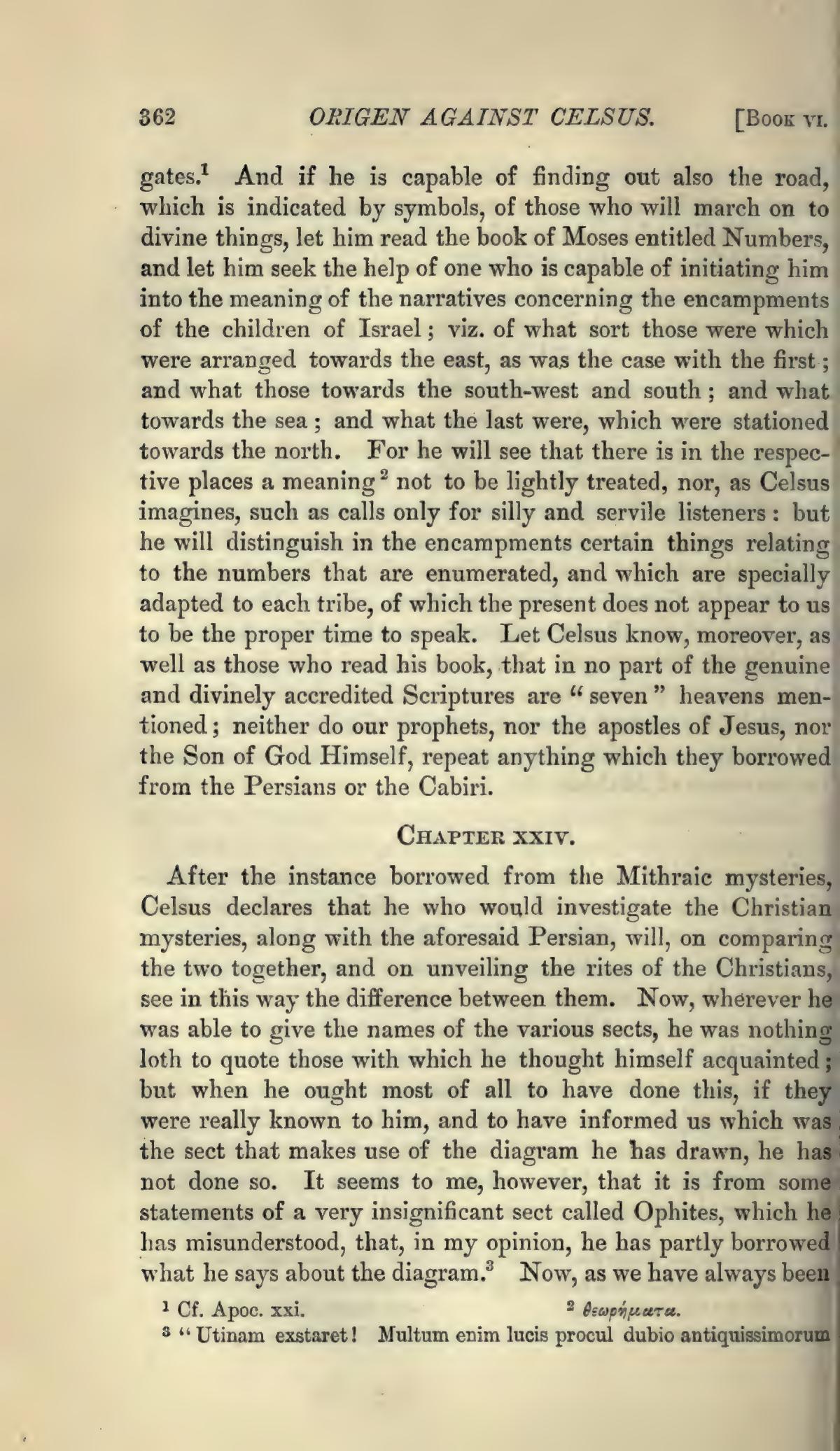
Eğer ilahi şeylere doğru yürüyecek olanların sembollerle gösterilen yolunu da bulma yeteneğine sahipse, Musa'nın Sayılar adlı kitabını okusun ve İsrailoğullarının konaklamalarına dair anlatıların manasını kavramada kendisine yol gösterebilecek birinin yardımını arasın; yani ilkinde olduğu gibi doğuya doğru yerleştirilenlerin, güneybatıya ve güneye doğru olanların, denize doğru olanların ve sonuncusu olup kuzeye konuşlandırılanların ne türden olduğunu öğrensin. Çünkü buralarda Celsus'un sandığı gibi yalnızca ahmak ve köle ruhlu dinleyicileri çağıran değil, hafife alınmaması gereken bir anlam bulunduğunu görecektir; bilakis konak yerlerinde sayılan ve her bir kabileye özel olarak uyarlanmış sayılarla ilgili belirli şeyleri ayırt edecektir ki şu an bunlardan söz etmek için bize uygun bir zaman gibi görünmemektedir. Dahası, gerek Celsus gerekse onun kitabını okuyanlar bilsinler ki hakiki ve ilahi olarak onaylanmış Kutsal Yazıların hiçbir yerinde "yedi" gökten bahsedilmez; ne peygamberlerimiz ne İsa'nın elçileri ne de Tanrı'nın bizzat Kendi Oğlu, Perslerden veya Kabiri'den ödünç aldıkları herhangi bir şeyi tekrarlar.
BÖLÜM XXIV.
Mithra gizemlerinden ödünç alınan örneğin ardından Celsus, Hristiyan gizemlerini yukarıda anılan Pers gizemleriyle birlikte araştıracak bir kimsenin, ikisini birbiriyle karşılaştırarak ve Hristiyanların ayinlerini açığa çıkararak aralarındaki farkı bu yolla göreceğini beyan eder. Oysa çeşitli mezheplerin adlarını verebildiği her yerde, aşina olduğunu düşündüğü mezhepleri zikretmekten hiç çekinmemiştir; fakat bunu en çok yapması gerektiği durumda, eğer gerçekten biliyor olsaydı, çizdiği diyagramdan hangi mezhebin yararlandığını bize bildirmeliydi, ancak bunu yapmamıştır. Ne var ki bana öyle geliyor ki, kanımca diyagram hakkında söylediklerini, Ophitler adı verilen son derece önemsiz bir mezhebin yanlış anladığı bazı ifadelerinden kısmen ödünç almıştır. Bizler daima öğrenme sevgisiyle hareket ettiğimizden, bu diyagramla karşılaştık ve onda Pavlus'un dediği gibi "evlerin içine sokulup çeşitli heveslerle sürüklenen, günahlarla yüklü ahmak kadınları tutsak eden; her zaman öğrenen ama hakikatin bilgisine asla erişemeyen" kimselerin tasvirlerini bulduk. Bununla birlikte diyagram her türlü inandırıcılıktan öylesine yoksundu ki, ne bu kolayca aldatılan kadınlar ne en kaba saba insan sınıfı ne de herhangi bir makul sahtekarın peşine takılmaya hazır olanlar bu diyagrama asla itibar etmemiştir. Gerçekten de, yeryüzünün pek çok yerini ziyaret etmiş ve herhangi bir yerde bilgi iddiasında bulunan herkesi aramış olmamıza rağmen, bu diyagrama herhangi bir inanç besleyen tek bir kimseyle bile karşılaşmadık.
BÖLÜM XXV.
Bu diyagramda birbirinden ayrı fakat her şeyin ruhu olduğu söylenen ve "Leviyatan" olarak adlandırılan tek bir çemberle birleştirilmiş on çember tarif edilmekteydi. Yahudi Kutsal Yazıları, bu ifadeyle ne kastederlerse etsinler, bu Leviyatan'ın Tanrı tarafından bir oyuncak olarak yaratıldığını söyler; zira Mezmurlar'da şöyle buluruz: "Her şeyi hikmetle yaptın: yeryüzü senin yarattıklarınla doludur; işte bu büyük ve geniş deniz de öyle. Orada gemiler dolaşır; irili ufaklı hayvanlar vardır; içinde oynaması için var ettiğin bu ejderha da oradadır." İbranicede "ejderha" kelimesi yerine "leviyatan" terimi yer alır. O halde bu saygısız diyagram, mezmur yazarı tarafından böylesine açıkça değersizleştirilen bu leviyatan hakkında, onun her şeyin içinden geçmiş olan ruh olduğunu söylemiştir! Ayrıca diyagramda, adeta en alt çemberin altına yerleştirilmiş olan "Behemot" adlı varlığı da gözlemledik. Bu lanetli diyagramın mucidi, bu leviyatanı hem çevresine hem de merkezine yazmış, böylece adını iki ayrı yere yerleştirmiştir. Dahası Celsus, diyagramın "kalın siyah bir çizgiyle bölündüğünü ve bu çizginin Tartaros olan Gehenna olarak adlandırıldığının öne sürüldüğünü" söyler. Gehenna'nın İncil'de bir ceza yeri olarak anıldığını gördüğümüz için, eski Kutsal Yazılarda bir yerde geçip geçmediğini araştırdık, özellikle de Yahudilerin de bu kelimeyi kullanması sebebiyle. Ve tespit ettik ki, Kutsal Yazılarda İbranice olarak Ennom oğlunun vadisinin adlandırıldığı yerde, "vadi" yerine, temelde aynı anlamla, hem Ennom vadisi hem de Geenna olarak adlandırılmıştır. Araştırmalarımızı sürdürdüğümüzde, "Geenna" ya da "Ennom vadisi" olarak adlandırılan yerin, Kudüs'ün de bulunduğu Benyamin kabilesinin hissesine dahil olduğunu görüyoruz. Ve göksel Kudüs'ün Benyamin'in hissesine ve Ennom vadisine ait olmasından ne gibi bir çıkarım yapılabileceğini tespit etmeye çalışırken, şu söze uygun olarak, eziyetlerle arındırılacak olan ruhların arındırılması için tasarlanan ceza yerine ilişkin söylenenlerin belirli bir doğrulamasını buluyoruz: "Rab bir tasfiyecinin ateşi gibi ve çamaşırcının sabunu gibi gelir: ve gümüşü ve altını tasfiye edip arındıran biri gibi oturacaktır."
BÖLÜM XXVI.
Öyleyse, arınma sürecinden geçenlerin, ruhlarının özüne bir yerde mecazi olarak "kurşun" diye adlandırılan ve bu sebeple Zekeriya'da kötülüğün bir "kurşun talant" üzerinde otururken tasvir edildiği kötülük unsurlarını almış olanların cezalandırılacağı yer Kudüs'ün civarıdır. Fakat bu konu hakkında yapılabilecek açıklamalar ne herkese yapılmalıdır ne de bu vesileyle dile getirilmelidir; zira bu tür konuların izahını yazıya dökmek tehlikesiz değildir, çünkü halk kitlelerinin günahkarların cezalandırılmasına ilişkin olandan başka bir öğretiye ihtiyacı yoktur; bunun ötesine geçmek ise, sonsuz ceza korkusuyla bile herhangi bir derecedeki kötülüğe ve günahtan kaynaklanan kötülükler seline dalmaktan güçlükle alıkonan kimseler uğruna uygun değildir. O halde Geenna doktrini hem Diyagram'a hem de Celsus'a meçhuldür: zira aksi olsaydı, ilkinin yapıcıları sanki hakikat bunlarla temsil ediliyormuş gibi hayvan ve diyagram resimleriyle övünmezlerdi; Celsus da Hristiyanlara karşı risalesinde, belki de artık var olmayan, tamamen yok olmuş ya da sayıları kolayca sayılabilecek kadar çok az kişiye inmiş olan bazı kimseler tarafından söylenmiş olanların yerine, onların asla dile getirmediği ifadeleri onlara yöneltilen suçlamalar arasına dahil etmezdi. Platon'un doktrinlerini benimsediğini iddia edenlerin Epikuros'u ve onun saygısız fikirlerini savunması nasıl yakışık almazsa, diyagramı savunmak ya da Celsus'un ona yönelttiği suçlamaları çürütmek de bizim işimiz değildir. Bu nedenle onun bu hususlardaki suçlamalarını lüzumsuz ve faydasız sayabiliriz; zira bu tür fikirlere kapılanları Celsus'tan çok daha sert bir şekilde kınarız.
BÖLÜM XXVII.
Diyagram meselesinden sonra, kilise yazarları tarafından "mühür" olarak adlandırılan şey hakkında soru ve cevap biçiminde, eksik bilgiden kaynaklanmayan birtakım canavarca iddialar öne sürer; "mührü basana baba, mühürlenene genç adam ve oğul denir" ve "hayat ağacından beyaz merhemle meshedildim" diye yanıt verir gibi şeyler ki bunların sapkınlar arasında bile vuku bulduğunu asla duymadık. Bundan sonra, mührü teslim edenlerin zikrettiği sayıyı bile belirler; örneğin "ölmekte olan bedenin ruhunun her iki yanına bağlanan yedi meleğin sayısı gibi; bir taraf ışık melekleri, diğerleri ise 'arkontikler' olarak adlandırılır" ve "'arkontikler' olarak adlandırılanların yöneticisine 'lanetli' Tanrı denildiğini" ileri sürer. Ardından bu ifadeye sarılarak, böylesi bir dili kullanmaya cüret edenlere haklı olarak saldırır; ve bu sebeple, eğer yağmuru ve gök gürültüsünü gönderen, bu dünyanın Yaratıcısı, Musa'nın ve onun kaydettiği yaratılışın Tanrısı olan Yahudilerin Tanrısı'na "lanetli" bir ilah diyenler gerçekten varsa, bu tür kimseleri ayıplayanlarla benzer bir infial duygusunu paylaşırız.
Özgün metin (İngilizce)
And if he is capable of finding out also the road, which is indicated by symbols, of those who will march on to divine things, let him read the book of Moses entitled Numbers, and let him seek the help of one who is capable of initiating him into the meaning of the narratives concerning the encampments of the children of Israel; viz. of what sort those were which were arranged towards the east, as was the case with the first; and what those towards the south-west and south; and what towards the sea; and what the last were, which were stationed towards the north. For he will see that there is in the respective places a meaning not to be lightly treated, nor, as Celsus imagines, such as calls only for silly and servile listeners: but he will distinguish in the encampments certain things relating to the numbers that are enumerated, and which are specially adapted to each tribe, of which the present does not appear to us to be the proper time to speak. Let Celsus know, moreover, as well as those who read his book, that in no part of the genuine and divinely accredited Scriptures are "seven" heavens mentioned; neither do our prophets, nor the apostles of Jesus, nor the Son of God Himself, repeat anything which they borrowed from the Persians or the Cabiri.
CHAPTER XXIV.
After the instance borrowed from the Mithraic mysteries, Celsus declares that he who would investigate the Christian mysteries, along with the aforesaid Persian, will, on comparing the two together, and on unveiling the rites of the Christians, see in this way the difference between them. Now, wherever he was able to give the names of the various sects, he was nothing loth to quote those with which he thought himself acquainted; but when he ought most of all to have done this, if they were really known to him, and to have informed us which was the sect that makes use of the diagram he has drawn, he has not done so. It seems to me, however, that it is from some statements of a very insignificant sect called Ophites, which he has misunderstood, that, in my opinion, he has partly borrowed what he says about the diagram. Now, as we have always been animated by a love of learning, we have fallen in with this diagram, and we have found in it the representations of men who, as Paul says, "creep into houses, and lead captive silly women laden with sins, led away with divers lusts; ever learning, and never able to come to the knowledge of the truth." The diagram was, however, so destitute of all credibility, that neither these easily deceived women, nor the most rustic class of men, nor those who were ready to be led away by any plausible pretender whatever, ever gave their assent to the diagram. Nor, indeed, have we ever met any individual, although we have visited many parts of the earth, and have sought out all those who anywhere made profession of knowledge, that placed any faith in this diagram.
CHAPTER XXV.
In this diagram were described ten circles, distinct from each other, but united by one circle, which was said to be the soul of all things, and was called "Leviathan." This Leviathan, the Jewish Scriptures say, whatever they mean by the expression, was created by God for a plaything; for we find in the Psalms: "In wisdom hast Thou made all things: the earth is full of Thy creatures; so is this great and wide sea. There go the ships; small animals with great; there is this dragon, which Thou hast formed to play therein." Instead of the word "dragon," the term "leviathan" is in the Hebrew. This impious diagram, then, said of this leviathan, which is so clearly depreciated by the psalmist, that it was the soul which had travelled through all things! We observed, also, in the diagram, the being named "Behemoth," placed as it were under the lowest circle. The inventor of this accursed diagram had inscribed this leviathan at its circumference and centre, thus placing its name in two separate places. Moreover, Celsus says that the diagram was "divided by a thick black line, and this line he asserted was called Gehenna, which is Tartarus." Now as we found that Gehenna was mentioned in the Gospel as a place of punishment, we searched to see whether it is mentioned anywhere in the ancient Scriptures, and especially because the Jews too use the word. And we ascertained that where the valley of the son of Ennom was named in Scripture in the Hebrew, instead of "valley," with fundamentally the same meaning, it was termed both the valley of Ennom and also Geenna. And continuing our researches, we find that what was termed "Geenna," or "the valley of Ennom," was included in the lot of the tribe of Benjamin, in which Jerusalem also was situated. And seeking to ascertain what might be the inference from the heavenly Jerusalem belonging to the lot of Benjamin and the valley of Ennom, we find a certain confirmation of what is said regarding the place of punishment, intended for the purification of such souls as are to be purified by torments, agreeably to the saying: "The Lord cometh like a refiner's fire, and like fuller's soap: and He shall sit as a refiner and purifier of silver and of gold."
CHAPTER XXVI.
It is in the precincts of Jerusalem, then, that punishments will be inflicted upon those who undergo the process of purification, who have received into the substance of their soul the elements of wickedness, which in a certain place is figuratively termed "lead," and on that account iniquity is represented in Zechariah as sitting upon a "talent of lead." But the remarks which might be made on this topic are neither to be made to all, nor to be uttered on the present occasion; for it is not unattended with danger to commit to writing the explanation of such subjects, seeing the multitude need no further instruction than that which relates to the punishment of sinners; while to ascend beyond this is not expedient, for the sake of those who are with difficulty restrained, even by fear of eternal punishment, from plunging into any degree of wickedness, and into the flood of evils which result from sin. The doctrine of Geenna, then, is unknown both to the Diagram and to Celsus: for had it been otherwise, the framers of the former would not have boasted of their pictures of animals and diagrams, as if the truth were represented by these; nor would Celsus, in his treatise against the Christians, have introduced among the charges directed against them statements which they never uttered, instead of what was spoken by some who perhaps are no longer in existence, but have altogether disappeared, or been reduced to a very few individuals, and these easily counted. And as it does not beseem those who profess the doctrines of Plato to offer a defence of Epicurus and his impious opinions, so neither is it for us to defend the diagram, or to refute the accusations brought against it by Celsus. We may therefore allow his charges on these points to pass as superfluous and useless, for we would censure more severely than Celsus any who should be carried away by such opinions.
CHAPTER XXVII.
After the matter of the Diagram, he brings forward certain monstrous statements, in the form of question and answer, regarding what is called by ecclesiastical writers the "seal," statements which did not arise from imperfect information; such as that "he who impresses the seal is called father, and he who is sealed is called young man and son;" and who answers, "I have been anointed with white ointment from the tree of life," things which we never heard to have occurred even among the heretics. In the next place, he determines even the number mentioned by those who deliver over the seal, as that "of seven angels, who attach themselves to both sides of the soul of the dying body; the one party being named angels of light, the others 'archontics;'" and he asserts that the "ruler of those named 'archontics' is termed the 'accursed' God." Then, laying hold of the expression, he assails, not without reason, those who venture to use such language; and on that account we entertain a similar feeling of indignation with those who censure such individuals, if indeed there exist any who call the God of the Jews who sends rain and thunder, and who is the Creator of this world, and the God of Moses, and of the cosmogony which he records an "accursed" divinity.
Bu metin neden önemli
Ofitlerin diyagramı, iç içe çemberler, Leviathan adlı yılan ve yedi yönetici arkhon ile ruhun ölümden sonra geçmesi gereken katları gösteren bir evren haritasıdır. Origenes, her kapıda söylenmesi gereken parolaları da aktarır. Bu tanıklık, ruhun gezegen kürelerinden yükselişini ve kapı bekçilerine ad bilgisiyle cevap verilmesini anlatan Gnostik ve Hermetik şemanın elimizdeki en somut belgelerinden biridir.
Bu eser Gnostisizm Koleksiyonu'nun parçasıdır →
- Kaynak eser
- The Writings of Origen, cilt II: Origen Contra Celsum, Frederick Crombie çevirisi, Ante-Nicene Christian Library, Edinburgh, T. & T. Clark
- Neşir
- MS yaklaşık 248 / 1872 (Frederick Crombie çevirisi)
- Konum
- VI. Kitap, Ofitlerin diyagramına dair bölümler
- Çeviren
- Şira Nur Uysal
- Dijital nüsha
- Internet Archive
Uysal, Ş. N. (Çev.). (2026). Origenes, Kelsos'a Karşı: Ofitlerin Diyagramı. Kadim Kütüphane. https://kadimkutuphane.com/origenes-kelsosa-karsi-ofit-diyagrami@misc{kk_origenes_kelsosa_karsi_ofit_diyagrami,
author = {Uysal, Şira Nur},
title = {{Origenes, Kelsos'a Karşı: Ofitlerin Diyagramı}},
year = {2026},
publisher = {Kadim Kütüphane},
url = {https://kadimkutuphane.com/origenes-kelsosa-karsi-ofit-diyagrami},
note = {Türkçe çeviri, özgün eser: İskenderiyeli Origenes},
}Yeni metinlerden ilk sen haberdar ol
Tam çeviriler, PDF'ler ve yeni eklenen kaynaklar hazırlandıkça e-postana düşsün.