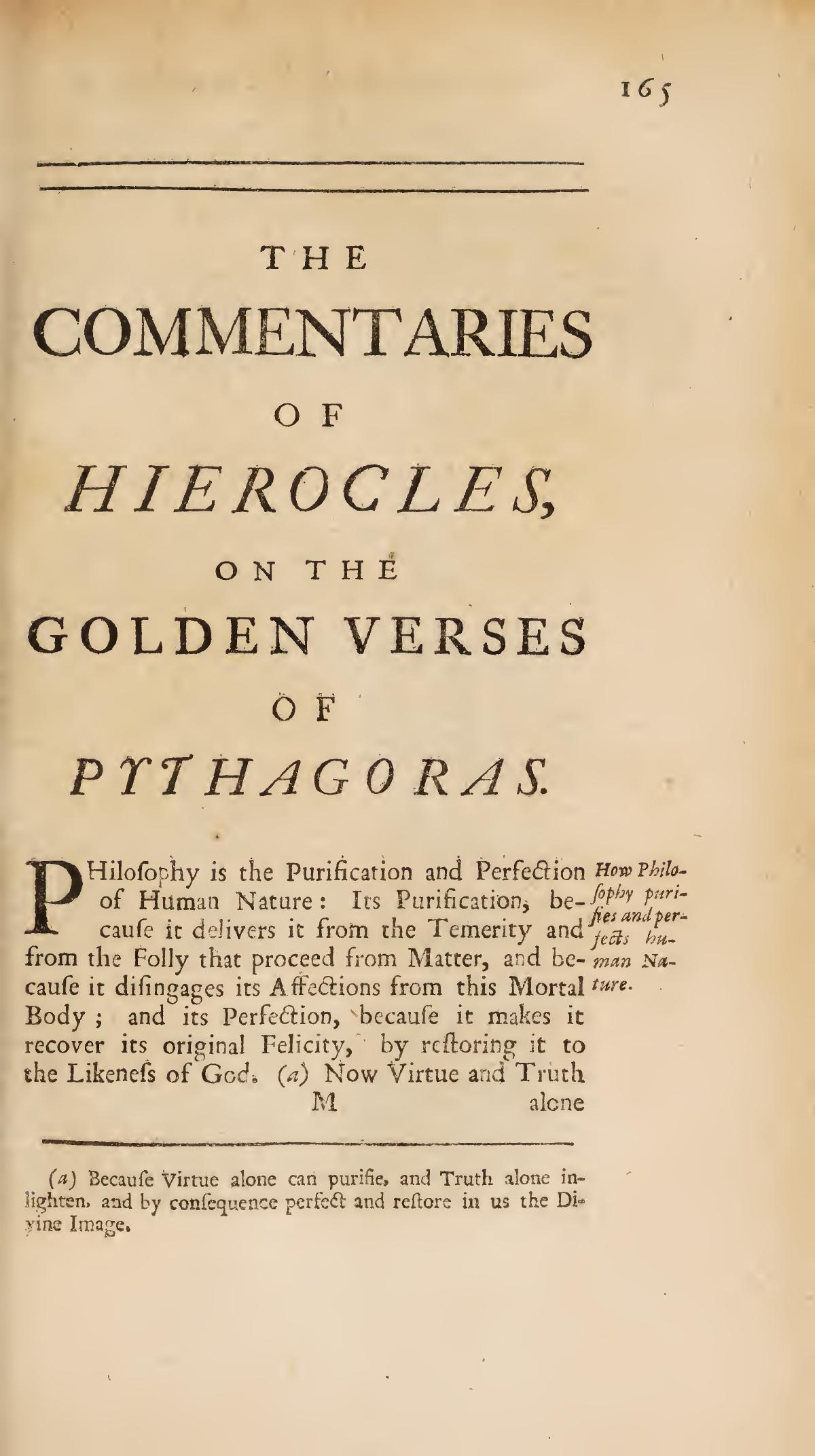
İskenderiyeli Hierokles, MS 5. yüzyılda yaşamış Yeni Platoncu bir filozoftur. Pythagorasçılara atfedilen ve ahlaki ve dinî öğütleri yetmiş bir dizede toplayan Altın Dizeler'e yazdığı şerh, Antik Çağ'dan bu şiire kalmış en kapsamlı yorumdur. Şerh, 17. yüzyılda André Dacier'nin Fransızca çevirisiyle yeniden tanınmış, 1707'de İngilizceye aktarılmıştır. Bu bölüm o İngilizce baskıdan aktarılmıştır.
HİEROKLES'İN PİSAGOR'UN ALTIN AYETLERİ ÜZERİNE ŞERHLERİ.
Felsefe, İnsan Doğasının Arınması ve Yetkinleşmesidir: Arınmasıdır, çünkü onu maddeden kaynaklanan cüretten ve akılsızlıktan kurtarır ve sevgisini bu ölümlü bedenden koparır; yetkinleşmesidir, çünkü onu Tanrı'nın suretine yeniden kavuşturarak ilk baştaki saadetini yeniden kazanmasını sağlar. Oysa yalnızca Erdem ve Hakikat bu iki şeyi gerçekleştirebilir; Erdem tutkuların aşırılığını defederek, Hakikat ise yanılgının karanlığını dağıtarak ve onu kabul etmeye hazır olanlara İlahi Sureti geri kazandırarak bunu yapar.
Dolayısıyla bizi saf ve yetkin kılması gereken bu ilim için, sanatın aforizmaları mesabesinde olacak kısa ve kesin kurallara sahip olmak iyidir; öyle ki bu vasıtalarla, yegane gayemiz olan mutluluğa usulünce ve nizami bir düzen içinde ulaşabilelim.
Felsefenin bir özetini içeren bütün kurallar arasında, Altın Ayetler olarak adlandırılan Pisagor'un Ayetleri haklı olarak ilk sırayı tutar; çünkü hem Faal hem de Nazari Hayatı ilgilendiren yönleriyle bütün Felsefenin genel ilkelerini ihtiva ederler. Bunların vasıtasıyla herkes Hakikati ve Erdemi edinebilir, kendini arındırabilir, kutlu bir şekilde İlahi Benzerliğe erişebilir ve Pisagor öğretisinin son derece dakik bir üstadı olarak görmemiz gereken Platon'un Timaios'unda söylendiği gibi, sağlığını yeniden elde edip bütünlüğüne ve yetkinliğine yeniden kavuştuktan sonra, kendini tekrar masumiyetin ve ışığın o ilksel durumunda görebilir.
Pisagor faal Erdemin ilkeleriyle başlar: Zira her şeyden önce içimizdeki ahmaklığı ve tembelliği dağıtıp uzaklaştırmalı, ardından kendimizi İlahi Şeylerin Bilgisine vermeliyiz: Çünkü nasıl ki hastalıklı ve akıntısından henüz kurtulmamış bir göz göz kamaştırıcı ve parıltılı bir ışığa bakamazsa; aynı şekilde henüz Erdemden yoksun bir Ruh da Hakikatin güzelliğine ve ihtişamına nazar edemez; saflıktan yoksun olanın saf olan şeylere dokunması da caiz değildir.
Pratik Felsefe Erdemin anasıdır ve nazari Erdem de Hakikatin anasıdır; nitekim pratik Felsefenin İnsani Erdem olarak adlandırıldığı ve nazari olanın İlahi Erdem adı altında yüceltildiği bizzat Pisagor'un bu Ayetlerinde de bize böyle öğretilmektedir: Zira toplumsal Erdemin ilkelerini şu sözlerle tamamladıktan sonra; Bütün bunları uygulamaya dikkat et, üzerlerinde iyice tefekkür et; onları bütün kalbinle sevmelisin. Şöyle devam eder: Seni ilahi Erdemin yoluna koyacak ve Tanrı'nın izinden yürütecek olanlar bunlardır.
Bu nedenle önce İnsan olmalı, sonra da Tanrı haline gelmeliyiz. Toplumsal erdemler İnsanı var eder, ilimler ise Tanrı'yı var eden ilahi Erdeme götürür. Şimdi, nizamın kurallarına göre, herhangi bir ilerleme kaydetmek istiyorsak, küçük şeyler daha büyük olanlardan önce gelmelidir: Ve Pisagor'un bu Ayetlerinde Erdem ilkelerinin en başta yer almasının sebebi de budur; ta ki bu hayatta pek lüzumlu olan Erdemlerin Tatbikinin, bizi bizzat İlahi Surete kadar ilerletecek ve yükseltecek bir Yol olduğunu bize öğretsin. Ve bu Erdemlerde gözetilen Düzen ve Gaye, onları okuyanlara diğer İlimlere inisiye olmadan önce Felsefenin gerçek Karakterini kazandırmaktır.
Bunlara altın ayetler denmesi, kendi türlerindeki en mükemmel ve en ilahi ayetler olduklarını bize bildirmek içindir: Zira aynı şekilde, en büyük İnsanları yetiştiren Çağa altın Çağ deriz; ve muhtelif Çağların Ahlak farkını madenlerin kıyaslanabilir nitelikleriyle tarif ederiz: Çünkü Altın, madenlerin en safı olduğundan ve gümüş, demir ve pirinç gibi kendisinden daha aşağı olan diğer metallerde bulunan tüm cüruflu karışımlardan ari bulunduğundan, asla pas üretmeyen yegane metal olarak en mükemmelidir; oysa diğerleri içlerindeki cüruflu karışımın miktarına oranla paslanırlar. Pas bu sebeple Rezilliğin bir sureti ve remzi olduğundan, Takva ve Saflığın hüküm sürdüğü ve her türlü Ahlak Bozulmasından muaf olan Çağa Altın Çağ denmesi son derece makuldü; ve böylece her bakımdan son derece İyi olan bu Ayetler, Altın ve İlahi Ayetler unvanını haklı olarak hak etmişlerdir: Zira diğer bütün şiirlerde olduğu gibi bunlarda bir iyi bir de öyle olmayan mısra bulamazsınız; bilakis hepsi tastamam iyidir, hepsi eşit derecede Ahlakın Saflığını temsil eder, Tanrı ile Benzerliğe götürür ve Pisagor Felsefesinin en mükemmel Gayesini ortaya koyar; nitekim her bir Ayeti ayrı ayrı açıklarken bu durum açıkça görülecektir: O halde ilk ayetle başlayalım.
Özgün metin (İngilizce)
THE COMMENTARIES OF HIEROCLES, ON THE GOLDEN VERSES OF PYTHAGORAS.
Philosophy is the Purification and Perfection of Human Nature: Its Purification, because it delivers it from the Temerity and from the Folly that proceed from Matter, and because it disengages its Affections from this Mortal Body; and its Perfection, because it makes it recover its original Felicity, by restoring it to the Likeness of God. Now Virtue and Truth alone can operate these two things; Virtue, by driving away the Excess of the Passions; and Truth, by dispelling the Darkness of Error, and by returning the Divine Form to such as are dispos'd to receive it.
For this Science therefore, which ought to render us pure and perfect, 'tis good to have short and certain Rules, to be as so many Aphorisms of the Art; that by their Means, we may arrive methodically and in due Order to Happiness, which is our only End.
Among all the Rules that contain a Summary of Philosophy, the Verses of Pythagoras, call'd the Golden Verses, justly hold the first Rank; for they contain the general Precepts of all Philosophy, as well for what regards the Active, as the Contemplative Life. By their means every one may acquire Truth and Virtue, render himself pure, happily attain to the Divine Resemblance, and as is said in the Timaeus of Plato, whom we ought to regard as a very exact Master of the Doctrine of Pythagoras, after having regain'd his Health, and recover'd his Integrity and his Perfection he may see himself again in his primitive State of Innocence and of Light.
Pythagoras begins by the Precepts of active Virtue: For before all things we ought to dissipate and drive away the Folly and the Laziness that are in us, and then apply our selves to the Knowledge of Divine Things: For as an Eye that is diseas'd, and not yet heal'd of its Fluxion, cannot behold a dazzling and resplendent Light; in like manner a Soul that is still destitute of Virtue, cannot fix its View on the Beauty and Splendor of Truth; nor is it lawful for Impurity to touch the Things that are pure.
Practical Philosophy is the Mother of Virtue, and contemplative Virtue is the Mother of Truth, as we are taught by these very Verses of Pythagoras, where practical Philosophy is call'd Human Virtue, and where the contemplative is celebrated under the Name of Divine Virtue: For after having finish'd the Precepts of civil Virtue by these Words; Take care to practise all these things, meditate on them well; thou oughtest to love them with all thy Heart. He continues, 'tis they will put thee in the Way of divine Virtue, and make thee walk in the Footsteps of God.
We must therefore first be Men, and afterwards become God. The civil Virtues make the Man, and the Sciences lead to divine Virtue which makes the God. Now according to the Rules of Order, little things must precede the greater, if we would make any Progress: And this is the reason why in these Verses of Pythagoras the Precepts of Virtue are the first, to teach us, that the Practice of Virtues, which is so necessary in this Life, is the Way whereby we ought to advance and rise even to the Divine Image. And the Order and Design propos'd in these Virtues, is to give to those that read them the true Character of Philosophy, before they are initiated in the other Sciences.
They are call'd golden Verses, to signify to us that they are the most excellent and most divine of any in this kind: For in like manner we call the golden Age, the Age that produc'd the greatest Men; and describe the Difference of the Manners of the several Ages by the analogical Qualities of Metals: For Gold being the purest of all Metals, and free from all the drossie Mixtures that are found in the other Metals that are inferior to it, as Silver, Iron, and Brass, is therefore the most excellent, as being the only Metal that never breeds any Rust, whereas the others grow rusty in proportion to the Quantity of drossie Mixture they have in them. Rust therefore being the Figure and Emblem of Vice, 'twas but reasonable that the Age in which Sanctity and Purity reign'd, and that was exempt from all Corruption of Manners, should be call'd The Age of Gold; and thus these Verses, being every way sovereignly Good, have justly deserv'd the Appellation of Verses Golden and Divine: For we find not in them, as in all other Poems, one good Verse and another that is not so; but they are all perfectly good, they all equally represent the Purity of Manners, lead to the Likeness with God, and discover the most perfect Aim of the Pythagorean Philosophy, as will evidently appear by the Explication we are going to give of each Verse in particular: Let us then begin with the first.
Bu metin neden önemli
Hierokles şerhine felsefeyi insan doğasının arınması ve yetkinleşmesi olarak tanımlayarak başlar: erdem ruhu maddeden gelen düşüncesizlikten arındırır, hakikat ise ona Tanrı'ya benzerliğini geri verir. Bu tanım, felsefeyi bir kurtuluş yolu sayan Yeni Platoncu anlayışın açık bir ifadesidir. Altın Dizeler ve Hierokles'in şerhi, Rönesans'tan Fabre d'Olivet'ye kadar Pythagorasçı bilgeliğe dair ezoterik okumaların temel metinlerinden olmuştur.
Bu eser Neoplatonizm Koleksiyonu'nun parçasıdır →
- Kaynak eser
- The Life of Pythagoras, with his Symbols and Golden Verses, together with the Life of Hierocles and his Commentaries upon the Verses, André Dacier'nin Fransızcasından, Londra, 1707
- Neşir
- MS 5. yüzyıl / 1707 (André Dacier'nin Fransızcasından İngilizce baskı)
- Konum
- Şerhin başı (felsefenin tanımı ve ilk dizeler)
- Çeviren
- Şira Nur Uysal
- Dijital nüsha
- Internet Archive
Uysal, Ş. N. (Çev.). (2026). Hierokles, Pythagoras'ın Altın Dizeleri Şerhi: Felsefe ve Arınma. Kadim Kütüphane. https://kadimkutuphane.com/hierokles-altin-dizeler-serhi-felsefe-ve-arinma@misc{kk_hierokles_altin_dizeler_serhi_felsefe_ve,
author = {Uysal, Şira Nur},
title = {{Hierokles, Pythagoras'ın Altın Dizeleri Şerhi: Felsefe ve Arınma}},
year = {2026},
publisher = {Kadim Kütüphane},
url = {https://kadimkutuphane.com/hierokles-altin-dizeler-serhi-felsefe-ve-arinma},
note = {Türkçe çeviri, özgün eser: İskenderiyeli Hierokles},
}Yeni metinlerden ilk sen haberdar ol
Tam çeviriler, PDF'ler ve yeni eklenen kaynaklar hazırlandıkça e-postana düşsün.