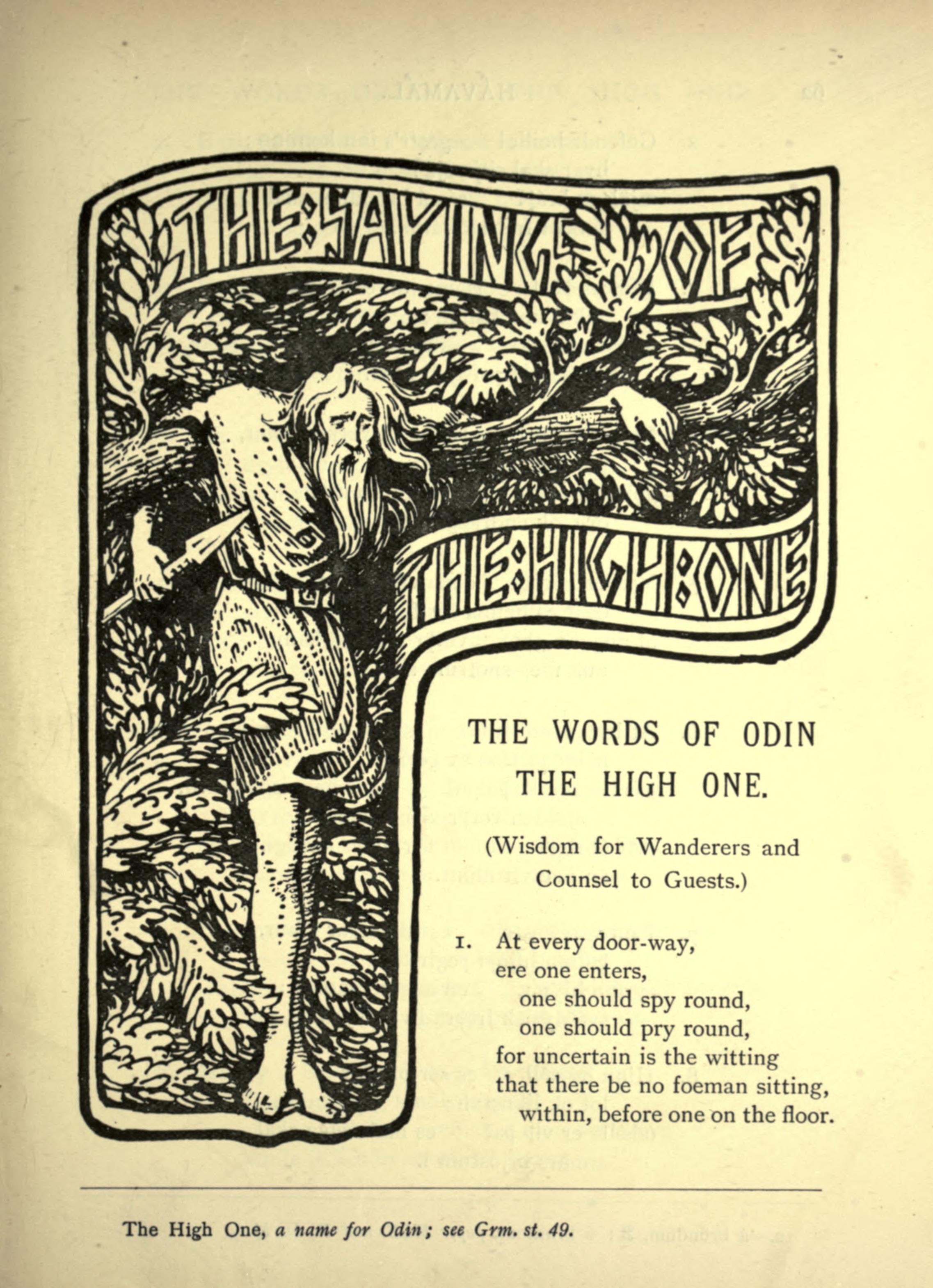
Şiirsel Edda'nın en tanınmış bölümü olan Hávamál, yani "Yüce Olan'ın Sözleri", ağzından konuşan tanrı Odin'in bir gezgin bilgeliği olarak dizdiği öğütlerdir. Aşağıda şiirin tamamı, 164 kıtası ve sekiz bölümüyle yer alır: eve gelen konuğa öğütlerle başlar, dostluk ve ölçülülük üzerine kısa özdeyişlerle sürer, Odin'in Billing'in kızına ve Gunnlöd'e duyduğu tutkuları anlatır, ardından şiir şarkısını Suttung'dan çalışını, dokuz gece rüzgârlı ağaçta asılı kalarak rünleri kazanışını ve son olarak bildiği on sekiz büyü şarkısını sayar. Sığırın da akrabanın da insanın da ölümlü olduğunu, yalnızca kişinin ardında bırakacağı yargının ve namın kalıcı olduğunu söyleyen ünlü dizeler bu şiirin öğüt bölümünün doruğudur.
I. Gezginler İçin Bilgelik ve Konuğa Öğütler (1-79)
Her kapı eşiğinde, içeri girmeden önce, kişi çevresine bakınmalı, sinsice gözetlemelidir; çünkü içeride, tam karşısında, pusuya yatmış bir düşman olmadığından asla emin olunamaz.
Selam olsun size, ey Vericiler! Bir konuk geldi; söyleyin, içeride nereye otursun? Ocak başında sıcaklık ve esenlik arayan kişi, çoğu zaman sıkıntı içindedir.
Şimdi gelen, dizlerine dek soğuktan uyuşmuş olan, ateşe muhtaçtır; dondurucu dağı aşıp gelen gezgin, yiyecek ve giysi ister.
Dinlenmek için gelen su ister, kurulanmak ve dostça bir davet, iyi niyet belirtileri; kazanılabilirse güzel bir nam ve tekrar tekrar hoş karşılanmak ister.
Uzaklara giden kişi aklına muhtaçtır; evde en basit şey bile yeter; ama bilgeler arasında oturup hiçbir şey bilmeyen ahmak, herkesin alay konusu olur.
Hiç kimse aklının büyüklüğüyle övünmesin, bunun yerine zihnini gözetsin. Bir eve temkinli ve sessizce girsin; tedbirliye zarar nadiren gelir, çünkü sağduyu zenginliğinden daha sadık bir dost bulunamaz.
Dinlenmek isteyen temkinli yabancı, kulaklarını dikip sessiz kalsın; kulaklarıyla dinlesin, gözleriyle baksın; her bilge kişi yolunu böyle keşfeder.
Kendine güzel bir nam ve iyi sözler kazanan kişi mutludur; ama bir insanın sahip olduğu şey, başka birinin göğsünde sakladığı sürece huzursuzluk vericidir.
Kendi içinde övgü ve bilgelik taşıyan kişi mutludur; çünkü insan, başka birinin göğsünde doğan öğüdü çoğu kez kötü bulur.
Yolda hiç kimse sağduyusundan daha iyi bir yük taşıyamaz; o, yoksulun sığınağıdır ve denenmemiş bir dünyada servetten daha zengin görünür.
Yolda hiç kimse sağduyusundan daha iyi bir yük taşıyamaz; ve yanında taşıyabileceği en kötü azık, fazla kaçırılmış bir bira yudumudur.
İnsan oğulları için biranın sık içilmesi, söylendiği kadar iyi değildir; çünkü ne kadar çok içerlerse, o kadar az düşünebilir ve akıllarını o kadar az koruyabilirler.
Unutkanlık Kuşu bira şölenlerinin üzerinde çırpınır, insanların aklını çalar; o kuşun tüyleriyle bir zamanlar aşağıda, Gunnlöd'ün bahçelerinde zincire vurulmuştum.
O zaman sarhoştum, o kurnaz Dev'in sarayında fazlasıyla sarhoştum. Ama en iyi bira şöleni, kişinin aklını hemen geri çağırabildiği şölendir.
Bir beyin çocuğu sessiz, düşünceli ve çatışmada yürekli olmalıdır. Her insan, ölümle karşılaşana dek kendini neşeli ve cömert göstersin.
Bir korkak, çatışmadan uzak durursa sonsuza dek yaşayacağına inanır; ama mızraklar hayatını bağışlasa bile, yaşlılık onu uzun süre huzur içinde bırakmaz.
Bir ahmak, bir dosta gittiğinde ağzı açık kalır, sadece mırıldanır ya da somurtur; ama ona bira kupasını uzat, o adamın aklı bir anda ortaya çıkar.
Ancak geniş dolaşmış, yolda uzaklara gitmiş kişi bilir, kafası ve yüreği bilge olan bir insanın nasıl bir zihne sahip olduğunu.
Bal şarabı kupasını elinde tutma, ölçünce iç; gerekli sözleri söyle ya da hiç konuşma: erkenden dinlenmeye çekilirsen, kimse seni terbiyesizlikle suçlamaz.
Açgözlü bir adam, dikkatli olmazsa, kendi canına zarar verecek kadar yer; ahmağın karnı, bilgelerin çevresine girdiğinde onu sık sık küçük düşürür.
Sürüler eve dönme saatini bilir ve otlaktan geri döner; ama midesinin ölçüsünü bilen bir ahmak asla bulunmaz.
Sefil ve kötü niyetli adam her şeyi alaya alır ve en iyi bilmesi gereken şeyi bilmez: kendisinin de kusurlardan azade olmadığını.
Akılsız adam bütün gece uyanık kalır ve her şeyi düşünüp durur; sabah geldiğinde zihni yorgundur ve her şey her zamanki gibi bir yüktür.
Akılsız adam, kendisine gülümseyip yaltaklanan herkesi dost sanır; bilgelerin çevresinde otururken onun hakkında ne sık kötü konuştuklarını fark etmez.
Akılsız adam, kendisine gülümseyip yaltaklanan herkesi dost sanır; ama meclise geldiğinde davasını savunacak pek az kişi bulacaktır.
Akılsız adam, korunaklı bir köşede otururken her şeyi bildiğini sanır; ama insanlar onu sınadığında ne cevap vereceğini bile bilmez.
Akılsız adam için kalabalığın içine girdiğinde en iyisi sessiz kalmaktır, çünkü çok fazla söz harcamazsa kimse aklının eksikliğinin farkına varmaz; zira akıldan yoksun olan, sözleri ne kadar akıcı olursa olsun asla öğrenmez.
İyi soru sorabilen ve aynı zamanda cevap verebilen kişi bilge sayılır; insan oğulları, aralarında anlatılan haberleri sır olarak saklayamaz.
Hiç susmayan kişi, çok fazla tutarsız söz söyler; dizginlenmezse aceleci dil kendi felaketini söyler durur.
Bir yemeğe konuk olarak gelse de, hiç kimse alay konusu sayılmasın: birçoğu, henüz sınanmamışken, kuru tenli otururken yeterince bilge görünür.
Bir konukla alay edip öfkesinden kaçan kişi kendini nüktedan sanır; ama bir yemekte şaka yapan hiç kimse, düşmanlar arasında alay konusu olmayacağından emin olamaz.
Yürekleri birbirine meyilli olsa da, dostlar sofrada çoğu zaman ayrılığa düşer; bir konuğun bir başka konuğu kızdırması, her zaman çekişmenin kaynağı olacaktır.
Bir dostu ziyaret etmiyorsa, insan yemeklerini her zaman vaktinde yemelidir; yoksa oturup somurtur, yarı aç görünür ve ne soru sorabilir ne cevap verebilir.
Yalancı bir dosta giden yol uzundur, o yol üzerinde otursa bile; ama sadık bir dosta, ne kadar uzakta olsa da, yollar dosdoğru ve kısadır.
Bir konuk yeniden yoluna koyulmalıdır, aynı yerde sonsuza dek kalmamalıdır; başkasının sırasında fazla uzun oturursa, sevilen kişi çabucak nefret edilen biri olur.
Küçük de olsa insanın kendi evi en iyisidir; her insan kendi evinde efendidir; sadece iki keçisi ve kabuk çatılı bir kulübesi olsa bile, bu, dilenmekten daha iyidir.
Küçük de olsa insanın kendi evi en iyisidir, her insan kendi evinde efendidir; her öğünde yemeğini dilenmek zorunda kalan kişi, kanayan bir yürekle diler.
Hiç kimse silahları olmadan yola tek bir adım bile atmasın; çünkü dışarıda, yolda bir mızraka ne zaman ihtiyaç duyulacağı asla bilinemez.
Yemeğini o kadar cömertçe paylaşan hiç kimseyi bulmadım ki bir armağanla sevinmesin, ya da armağanlarından o kadar bol veren hiç kimseyi bulmadım ki karşılığını kazanabilseydi sevmesin.
Hiç kimse, hayatta kazandığı servetten kendini yoksun bırakıp ihtiyaç çekmesin; bir dost için ayrılan şey çoğu zaman bir düşmana kalır ve pek çok şey sanılandan daha kötü gider.
Dostlar birbirlerini giysi ve silahla sevindirsin, kişi kendini böyle ispatlar; çünkü kader adilse, sürekli veren ve tekrar veren dostluklar en uzun sürer.
İnsan dostuna dost gibi davranmalı ve armağana armağanla karşılık vermelidir; gülüşe gülüşle karşılık versin, ama yalana yalanla ödesin.
İnsan dostuna, hem ona hem de onun dostuna, dost gibi davranmalıdır; ama düşmanının dostu olan birinin dostu olmamaya dikkat etsin.
İyilik beklediğin, güvendiğin bir dostun var mı? Aklını onunla paylaş, onunla armağan alışverişi yap, sık sık onu görmeye git.
Ama güvenmediğin, yine de iyilik beklediğin biri var mı? Ona güzel sözler söyle, ama içten içe farklı düşün ve yalana yalanla karşılık ver.
Güvenmediğin ve zihninden kuşkulandığın kişiye dair bir söz daha: onunla gül, ama düşünceni sakla; çünkü armağana benzer bir armağanla karşılık verilmelidir.
Bir zamanlar gençtim, yalnız yürüyordum ve yolda şaşkın görünüyordum; sonra bir başkasını buldum ve kendimi zengin saydım, çünkü insan insanın sevincidir.
En kutlu kişi, özgür ve yürekli yaşayan ve hiçbir zaman kederini besleyip büyütmeyendir; çünkü korkak adam her şeyden yılar, cimri adam ise verdiği için yas tutar.
Bir zamanlar kırda, insan biçiminde yapılmış iki sınır taşına giysilerimi verdim; giydirildiklerinde kahramanlar gibi göründüler; utanan çıplak olandır!
Tepede yükselen çam ağacı kurur, ne kabuğu ne iğneleri onu korur; kimsenin sevmediği insan da böyledir; peki neden daha uzun yaşasın?
Kötü dostlar arasında sevgi, ateşten daha şiddetle beş gün yanar; ama altıncı gün gelince sönüverir ve tüm dostluk çabucak bozulur.
İnsan, bir başkasına sadece büyük şeyler vermek zorunda değildir; övgü çoğu zaman hiç değeri olmayan şeyle kazanılır; yarım somun ekmek ve devrilmiş bir kâseyle kendime pek çok dost buldum.
Denizler küçükse kum da azdır, insan akılları da küçüktür; çünkü dünyada hiç kimse hep aynı derecede bilge olmamıştır, bilgelik ahmaklarla bilgeler arasında paylaşılmıştır.
Her insan ölçülü bir biçimde bilge olsun; ama fazla bilge olmasın; çünkü pek çok şey hakkında çok şey bilen kişi hiçbir zaman insanların en mutlusu değildir.
Her insan ölçülü bir biçimde bilge olmalıdır; ama fazla bilge olmasın; sahibi aşırı bilgeyse, bir yürek nadiren sevinçle şarkı söyler.
Her insan ölçülü bir biçimde bilge olmalıdır, ama asla fazla bilge olmasın: kaderini önceden öğrenmeye çalışmayan kişi, yüreğini yüksüz taşır.
Odun parçası, tükenene dek başka bir odundan tutuşur, kıvılcım kıvılcımdan alevlenir; insan, insanla konuşarak kendini açar, ama sessizlik içinde sırlarla örtülür.
Bir başkasının canını ya da servetini kazanmak isteyen kişi erkenden kalkmalıdır; av, uyuyan kurtların önüne nadiren düşer, uyuklayanlara da çatışmada zafer nadiren gelir.
Kendisine hizmet edecek çok az kişisi olan, işine kendisi bakmak zorunda kalan kişi erkenden kalkmalıdır; sabahleyin uyuyan kişi büyük ölçüde geride kalır, gayretli olana ise servet yarı yarıya kazanılmış sayılır.
İnsan, biriktirdiği kuru odunların ve depoladığı çatı kabuğunun miktarını bilebilir, gelecek çeyrek ve yarım yıllar boyunca yetecek yakacak odunun ölçüsünü de.
Meclise, giysileri hiç yeni olmasa da doyurulmuş ve yıkanmış olarak gidilmelidir; ayakkabıların ya da pantolonun için, ya da zavallı bir at için utanma.
Eski okyanusun üzerinde süzülüp avının peşinden kapan bir kartal gibi, davasını savunacak pek az kişi bulan bir adam da meclise öyle gelir.
Bilge olan ve bilge diye anılmak isteyen her insan, doğru soru sormalı ve doğru cevap vermelidir. Sırrını bir kişi bilsin, ama asla ikinci biri bilmesin; çünkü üçü bilirse, binler bilecektir.
Bilgece öğüt almış bir adam, tavrında yumuşak olacak ve gücünü ölçülü kullanacaktır; öfkeli düşmanları arasına girdiğinde, kendinden daha öfkelileriyle karşılaşmasın diye.
Her insan sözlerinde dikkatli ve tedbirli olmalı, bir dosta güvenmekte de acele etmemelidir; çünkü kişinin bir başkasına söylediği sözler, karşılığında kötülük getirebilir.
Pek çok şölene çok geç kaldım, bazılarına ise çok erken geldim; bira ya içilmişti ya da henüz sunulmamıştı: nefret edilen kişi asla tam vaktinde gelmez.
Yemeklerimde ete ihtiyacım olmasaydı, ya da bir tanesini yediğim dostun evinde asılı iki jambon kalsaydı, ara sıra bir eve davet edilirdim.
İnsan oğulları için en değerli şey ateştir, en tatlı şey güneşin görünüşüdür; sağlık iyidir, eğer kişi onu koruyabilirse, ve utanç duymadan bir hayat yaşamak da öyle.
Hasta olan kişi her şeyden yoksun değildir; çünkü kimileri çocuklarıyla kutludur, kimileri akrabalarıyla, kimileri servetiyle, kimileri de işini iyi yapmasıyla.
Yaşayanlar cansızlardan daha kutludur, sığıra kavuşan yaşayandır; zengin adamın salonunda ocak ateşinin yandığını, kendisinin ise kapıda ölü yattığını gördüm.
Topal ata binebilir, elsiz sığır sürebilir, sağır savaşıp galip gelebilir; kör olmak, ölüm ateşinde yanmaktan daha mutlu bir haldir; ama hiç kimse bir cesetten hoşnut değildir.
Geç doğsa ve baba ondan önce ölse bile, bir oğul sahibi olmak en iyisidir: yol kenarındaki taşlar, nadiren akrabalar dışında akrabalar için dikilir.
İkisi bire karşı ordudur, dil başın belasıdır, kaba bir postun altında bir el gizlenmiş olabilir; geceleyin, konaklayacağı yeri bilen kişi mutludur; geminin yatağı kısadır, sonbahar gecesi değişkendir, rüzgâr beşinci güne dek çok döner ve bir ay içinde daha da fazla döner.
Hiçbir şey öğrenmeyen, birinin diğerinin ahmağı olduğunu asla bilemez; çünkü biri zenginse diğeri yoksuldur ve bunun için hiçbir suçlama taşımamalıdır.
Sığır ölür, akraba ölür, sen de pek yakında ölürsün; ama bir şey vardır ki, sanırım, hiç ölmez: hakkıyla kazanılmış güzel nam.
Sığır ölür, akraba ölür, sen de pek yakında ölürsün; ama bir şey vardır ki, sanırım, hiç ölmez: her ölünün üzerine düşen yargı.
Şişmanın oğullarının ağılları hayvanla doluydu, oysa şimdi bir dilenci değneği taşırlar; servet göz açıp kapayana dek sürer, dostların en vefasızıdır.
Şayet bir ahmak kendine servet ya da bir kadının sevgisini bulursa, içinde gurur büyür de bilgelik asla; böylece budalalığı içinde ilerler durur.
Rünlere sorduğun her şey doğru çıkacaktır; onlar ki tanrılardan gelmiştir, yüce Güçler'in yonttuğu ve Odin'in boyadığı rünler. O hâlde susmak elbette en iyisidir.
II. Bütün İnsanlar İçin Özdeyişler (80-88)
Günü akşamında öv, karını öldüğünde, silahı denendiğinde, kızı evlendiğinde, buzu üzerinden geçildiğinde ve birayı içildiğinde öv.
Odunu rüzgârda kes, denizlere hafif esintide aç yelken, kızı karanlıkta kur — çünkü gündüzün gözleri çoktur — gemiyi kayışı için değerlendir, kalkanı sığınağı için, kılıcı vuruşu için, kızı öpücüğü için değerlendir.
Birayı ateşin yanında iç, ama buz üzerinde kay; atı zayıfken, kılıcı paslıyken satın al; atını çatı altında, köpeğini avluda besle.
Hiç kimse bir genç kızın söylediklerine güvenmesin, ne de bir kadının sözlerine; çünkü onların yürekleri dönen bir çark üzerinde şekillenmiştir ve göğüslerinde yalan sabitlenmiştir.
Kırılan yay, ya da alevlenen ateş, aç gözlü kurt, ya da gaklayan karga, saldıran domuz, ya da köksüz ağaç, kabaran dalga, ya da köpüren kazan,
uçan oklar, ya da düşen dalga, gecenin buzu, kıvrılan engerek, kadının yatak sözleri, ya da kırık bir bıçak ağzı, ayı oyunu ya da bir prensin çocuğu,
hasta buzağı ya da dik başlı köle, cadının yaltaklanması, yeni öldürülmüş düşman, ana yolda görülse bile kardeş katili, yarı yanmış ev, ya da fazla hızlı bir at — asla bunlara güvenecek kadar kolay güvenme.
Hiç kimse ilk ekilen meyveye güvenmesin, ne de oğluna çok erken; keyfî hava çocuğu yönetir, hava koşulları da tarlayı; ikisi de rastlantıya açıktır.
Düşünceleri yalan olan kadınların sevgisi, kaygan buz üzerinde nallanmamış, henüz iyi terbiye edilmemiş, hoppa iki yaşındaki bir atı sürmek gibidir; ya da vahşi bir rüzgârda dümensiz bir gemiyi yönetmek gibi, ya da topal birinin, karı erimiş dağda ren geyiği yakalaması gibidir.
III. Sevenler İçin Dersler (89-93)
Şimdi açıkça konuşuyorum, çünkü ikisini de gördüm; erkek kıza karşı sadakatsizdir; düşüncelerimiz en yalan olduğunda onlara en güzel sözleri söyleriz ve en bilge yürekleri bile ayartırız.
Bir kadının sevgisini özleyen kişi, yumuşak sözler söylesin ve servet sunsun, parlak genç kızın güzelliğini övsün — böyle kur yapan kazanır.
Aşkın bağlarına düşürdüğü bir başkasını hiç kimse asla suçlamasın: büyüleyici bir görünüş çoğu zaman bilgeleri kendine çeker, oysa ahmakların yüreğini tutmaz.
Pek çok kişinin başına gelen bir aptallık için hiç kimse asla bir başkasını suçlamasın; aşkın gücü, bir zamanlar bilge olan insan oğullarını ahmağa çevirir.
Sadece zihin, yüreğe en yakın olanı bilir ve ruhun nereye döndüğünü görür: bilge kişiye hiçbir hastalık, hiçbir şeyde hoşnutluk bulamamak kadar acı görünmez.
IV. Odin'in Aşk Arayışları (94-100)
Bunu bir zamanlar hissettim, dışarıda sazlıkta oturup sevgilimi ararken; bedenim ve ruhum o tatlı kıza aitti, yine de onu asla eş olarak kazanamadım.
Billing'in kızını yatağında buldum, güneş ışığından daha güzel uyurken, ve o güzel bedenle yaşamadıkça, beyliğin tatlılıkları bana hiçbir şey gibi göründü.
"Yine de akşama daha yakın gel, Odin, eğer bir kıza kur yapmak istiyorsan: ancak iki kişi bu utanç verici gizli işi bilirse her şey yolunda gider."
Böylece bilge niyetimden vazgeçtim ve sevincimi güvence altında sandım, çünkü onun tüm hoşnutluğunu ve tüm sevgisini kazanacağımı düşündüm.
Çok geçmeden geldiğimde, yürekli savaş birliğinin hepsi uyanık nöbet tutuyordu: yanan meşaleler ve taşınan alevlerle bana kederli yolumu gösterdiler.
Yine de sabaha daha yakın bir kez daha gittim — ev halkı salonda uyuyordu, ama çok geçmeden o güzel kızın yatağına sıkıca bağlanmış havlayan bir köpek buldum.
Aklını bilince pek çok tatlı kızın erkeklere karşı değişken olduğu görülür: o tedbirli genç kızı yoldan çıkarmaya çalıştığımda bunu iyice kanıtladım: kurnaz kız, bana her türlü hakareti yöneltti ve bu yüzden bir eş kazanamadım.
V. Odin'in Şiir Bal Şarabı Arayışı (101-108)
Evinde konuklara neşeli ve cömert ol, tavrında ölçülü ol, bilgelik kazanmak istiyorsan dikkatli ve konuşkan ol, sık sık iyilikten söz et. Söyleyecek hiçbir şeyi olmayan kişiye "Bön" denir, çünkü ahmakların hâli böyledir.
O yaşlı Dev'i aradım, şimdi güvenle geri döndüm, orada sessizliğim işime pek yaramadı; ama pek çok yumuşak söz fısıldayarak Suttung'un salonlarında arzuma ulaştım.
Orada Rati'nin dişiyle kendime bir yol açtım ve kayadan geçecek bir aralık oluşturdum; Devlerin yolları üstümde ve altımda uzanırken, bir yudum için canımı tehlikeye attım.
Bana altın bir tahtta o şanlı bal şarabından bir yudum veren Gunnlöd'dü, ama onun sadık ve dertli yüreğine karşılık ona zavallı bir ödül verdim.
Kurnaz bir kılığa girip isteğimi gerçekleştirdim; bilgeye eksik olan çok azdır, çünkü şimdi Ruh Uyandıran, o tatlı Şiir Bal Şarabı, insanların dünyevi meskenine getirilmiştir.
Tatlı kadın Gunnlöd'den, kollarımda tuttuğum o kadından yararlanmasaydım, Devler ırkının diyarlarından bir daha asla geri dönebilir miydim, kuşkuluyum.
Ertesi gün korkunç Kırağı Devleri ortaya çıktı ve Yüce Olan'ın Salonuna girdiler: sordular — Kötülük İşleyen, Güçlerin arasına geri döndü mü, yoksa Suttung onu aşağıda mı öldürdü?
Odin'in bir yüzük yemini ettiğine inanıyorum — ama onun sözüne kim güvenebilir? — bal şarabını Suttung'dan çalan ve Gunnlöd'ü ağlatan da oydu.
VI. Başıboş Ozan'a Öğütler (109-136)
Şimdi Bilgenin Kürsüsünden konuşma zamanı; Kader Kuyusunun hemen yanında gördüm ve sessiz kaldım, gördüm ve düşündüm, insanların konuşmalarını dinledim.
Rünlerden söz ettiler, rünlerin okunması dudaklarından pek de esirgenmedi: Yüce Olan'ın salonunda, Yüce Olan'ın salonunda, Yüce Olan'ı böyle söylerken duydum:
Sana öğüt veriyorum, ey Başıboş Ozan, öğütlerimi kabul et, onlara uyarsan sana nimet olacaklar, onları kazanırsan senin esenliğin için çalışacaklar: geceleyin asla kalkma, gözetleme yapmıyorsan ya da dışarıda bir yer aramıyorsan.
Onları kazanırsan senin esenliğin için çalışacaklar: bir büyücü kadının kollarında asla uyuma, seni kilitlemesin diye;
böylece seni öyle büyüler ki ne meclisi ne de kralın sözlerini dinlersin, ne yemeğini ne de insanlığın sevinçlerini önemsersin, sadece kederli bir uykuya dalarsın.
Onları kazanırsan senin esenliğin için çalışacaklar: aşk fısıltılarıyla bir başkasının karısını kendine çekmeye asla çalışma.
Onları kazanırsan senin esenliğin için çalışacaklar: dağı ve haliçi aşmayı arzularsan, kendini iyi azıkla donat.
Onları kazanırsan senin esenliğin için çalışacaklar: başına talihsizlik gelirse bunu asla kötü bir adama anlatma; böyle kötü bir dosttan, güvenen zihnine karşılık hiçbir zaman bir şey bekleme.
Kötü bir kadının sözleriyle ölümüne yaralanmış bir adam gördüm; yalancı bir dil onu hayattan mahrum bırakmıştı, hem de hiçbir haklı sebep olmaksızın.
Onları kazanırsan senin esenliğin için çalışacaklar: güvendiğin bir dostun varsa, onu sık sık görmeye git; çünkü hiçbir ayağın geçmediği yol, çalılıkla ve uzun otlarla kaplanır.
Onları kazanırsan senin esenliğin için çalışacaklar: tatlı sohbetle dürüst kişileri yanına çağır, hayattayken bir şifa şarkısı öğren.
Onları kazanırsan senin esenliğin için çalışacaklar: dostluk bağını bozan ilk kişi asla dostunla sen olma; aklındaki her şeyi bir başkasına anlatamıyorsan, kaygı yüreğini kemirir.
Onları kazanırsan senin esenliğin için çalışacaklar: aptal bir alçakla konuşurken asla tek bir kelime bile harcama.
Böyle birinin dudaklarından, kendi iyi niyetinin karşılığını bekleme; ama dürüst bir adam, övgüyle seni lütuf ve sevgide sağlam kılar.
İnsan tüm aklını bir başkasına açıkça söyleyebildiğinde dostlukta gerçek bir kaynaşma vardır; değişken bir dilden daha aşağılık hiçbir şey yoktur; sadece yaltaklanan kişi dost değildir.
Onları kazanırsan senin esenliğin için çalışacaklar: en kötü olan, çoğu zaman en iyi olanı yere serer.
Onları kazanırsan senin esenliğin için çalışacaklar: sadece kendin için olmadıkça ne ayakkabıcı ol ne de ok sapı yapımcısı: ayakkabı biçimsiz ya da sap eğri çıkarsa, başına bir lanet okunur.
Onları kazanırsan senin esenliğin için çalışacaklar: tehlikede olduğunu görürsen, bunu itiraf et, düşmanlarına asla huzur verme.
Onları kazanırsan senin esenliğin için çalışacaklar: kötü haberlere asla sevinme, ama iyilikte ruhun mutlu olsun.
Onları kazanırsan senin esenliğin için çalışacaklar: savaşta, insanlar hayvan gibi olduğunda yukarı bakma; ruhlar seni büyüyle etkilemesin diye.
Onları kazanırsan senin esenliğin için çalışacaklar: kibar bir genç kızın sevincini kazanmak ve onu aşk fısıltısına çekmek istersen, güzel bir söz ver ve ona bağlı kal — kazanabilen kimse kendi esenliğini hor görmez.
Onları kazanırsan senin esenliğin için çalışacaklar: dikkatli ol, ama fazla dikkatli olma diye yalvarırım; en dikkatli olman gereken şeyler bira, başkasının karısı ve bir üçüncü şeydir daha, alçakların seni asla alt etmemesi için.
Onları kazanırsan senin esenliğin için çalışacaklar: salonlarında bir konuğu ya da gezgin bir ruhu hor görme, onunla alay etme.
İçeride oturanlar, gelenin ne tür bir insan olduğunu ancak belirsiz biçimde bilir: hiç kimse öyle iyi değildir ki bir kusuru olmasın, ya da öyle kötü değildir ki hiçbir işe yaramasın.
Onları kazanırsan senin esenliğin için çalışacaklar: ak saçlı ozanı asla hor görme; yaşlıların öğüdü çoğu zaman iyidir; derilerin arasında asılı kalan, tulumlarla sallanan, postlarla sarsılan kişinin solmuş dudaklarından bile bilgelik sözleri gelebilir.
Onları kazanırsan senin esenliğin için çalışacaklar: konuklara hırlama, onları kapıdan kovma, yoksullara karşı kendini nazik göster.
Herkesin içeri girmesi için kaldırılması gereken sürgü ağırdır. Servetini bolca dağıt, yoksa insanlar bedeninin her yerine kötülük diler.
Onları kazanırsan senin esenliğin için çalışacaklar: bira içtiğinde toprağın gücüne seslen — selleri içine çeken topraktır. Toprak içkiye üstün gelir, ateş hastalığa, meşe bağlanmaya, başak cadılığa, çavdar mahmuzu fıtığa, ay öfkeye, ot sığır vebasına, rünler ise zarara üstün gelir.
VII. Odin'in Rünler Arayışı (137-144)
Sanırım o rüzgârlı Ağaç'ta dokuz tam gün ve gece asılı kaldım, bir mızrakla yaralanmış, Odin'e adanmış, kendimi kendime kurban ederek; hiç kimsenin hangi köklerden göğe yükseldiğini bilmediği o Ağacın tepesinde.
Hiç kimse beni yiyecek ya da içecekle canlandırmadı, derinliklere dosdoğru baktım; yüksek sesle bağırarak Rünleri yukarı kaldırdım, sonra oradan geri düştüm.
Bestla'nın babası Bölthorn'un büyük oğlundan dokuz güçlü şarkı öğrendim; o harika Bal Şarabından bir ölçü içtim, Ruh Uyandıranın damlalarıyla ıslandım.
Çok geçmeden meyve verdim ve iyice gelişip serpildim, büyüdüm ve bilgelikte arttım; söz sözü izleyerek kendime sözler buldum, eylem eylemi izleyerek eylemler gerçekleştirdim.
Gizli Rünleri ve yorumlanmış işaretleri arayacaksın, büyük Ozan'ın boyadığı, yüce Güçlerin biçimlendirdiği, tanrıların Sözcüsü'nün kazıdığı pek çok güç ve kudret simgesini.
Tanrılar için Odin kazıdı, elfler için Dain kazıdı, cüceler için Oyalayıcı Dvalin, Devler için Her-şeyi-bilen, ve ben, kendi başıma, insan oğulları için bazılarını kazıdım.
Yazmayı biliyor musun, okumayı biliyor musun, boyamayı biliyor musun, sınamayı biliyor musun, sormayı biliyor musun, sunmayı biliyor musun, göndermeyi biliyor musun, harcamayı biliyor musun?
Fazla sunmaktansa az istemek daha iyidir, armağan nimete uygun olmalıdır; fazla harcamaktansa hiç göndermemek daha iyidir. ... İşte Odin, dünya başlamadan önce böyle kazıdı; sonra derinliklerden yükseldi ve geri döndü.
VIII. Büyü Şarkısı (145-164)
Ne insan oğullarının ne de bir kralın sarayındaki kraliçenin bildiği şarkıları biliyorum; birincisi Yardım'dır, sana tüm dertlerde, kederde ve çatışmada yardım getirecek olan.
İkincisini biliyorum, hastayı iyileştirmek isteyen insan oğlunun söylemesi gereken şarkıyı.
Üçüncüsünü biliyorum: düşmanlarımı durdurmak için bir büyüye ciddi ihtiyaç duyulursa; o şarkıyı söylediğimde kılıçlarını körelttiğim için, ne silahları ne de sopaları yaralayabilir.
Dördüncüsünü biliyorum: insanlar uzuvlarımın eklemlerini zincirlerle sıkıca bağlarsa, beni özgür kılacak o şarkıyı söylediğimde, zincirler ellerimden ve ayaklarımdan fırlar.
Beşincisini biliyorum: düşmanlar tarafından atılan bir okun orduyu delip geçtiğini gördüğümde, ne kadar güçlü uçarsa uçsun, uçuşunu bir an görebilirsem onu durdurabilirim.
Altıncısını biliyorum: bir bey nemli bir ağacın kökündeki rünlerle bana zarar vermeye çalışırsa, benim üzerime çağırdığı lanetin kötülükleri yalnızca onun başına iner.
Yedincisini biliyorum: bir salonun, sıra arkadaşlarının üzerinde alevler içinde yükseldiğini görürsem, alev ne kadar şiddetli olursa olsun onu yine de kurtarabilirim — o şarkıyı nasıl söyleyeceğimi bilirim.
Sekizincisini biliyorum: herkes onu iyi öğrenirse kendi esenliği için söyleyebilir; savaşçı oğullar arasında nefret büyüdüğünde, o şarkıyla onu çabucak yatıştırabilirim.
Dokuzuncusunu biliyorum: teknemi suda tutma ihtiyacı doğduğunda, fırtınalı dalganın üzerindeki rüzgârı susturur ve tüm denizi dinlendiririm.
Onuncusunu biliyorum: geceleyin cadılar havada binip eğlenirken, öyle büyüler örerim ki derilerinden çıkmış ve akılları karışmış halde evlerine dönerler.
On birincisini biliyorum: eski yoldaşlarımı savaşa götürürsem, kalkanların altında şarkı söylerim ve onlar güçlü bir şekilde çatışmaya güvenle girer, çatışmadan güvenle çıkar ve mücadeleden güvenle geri dönerler.
On ikincisini biliyorum: bir ağaçta bir kement ipinden asılı bir ceset görürsem, öyle büyüler yazar ve rünlerle boyarım ki, o varlık aşağı iner ve konuşur.
On üçüncüsünü biliyorum: bir savaşçının yeni doğan oğlunu suyla ıslatırsam, o genç savaşa gittiğinde başarısız olmaz, asla öldürülüp kılıcın önünde eğilmez.
On dördüncüsünü biliyorum: Güçleri insanlara saymam gerekirse, hiç kimsenin öğretilmeden bilemeyeceği tanrıların ve elflerin tüm doğasını bilirim.
On beşincisini biliyorum, Halk Uyandıran cücenin Şafağın kapılarında söylediği şarkıyı; tanrılara güç, elflere beceri, konuşan Odin'e ise bilgelik şarkısı söyledi.
On altıncısını biliyorum: hünerli bir kızdan tüm tatlılığı ve sevgiyi kazanmak istediğimde, yüreğini çeviririm ve sevdiğim o güzel kollu hanımın tüm zihnini değiştiririm.
On yedincisini biliyorum: öyle ki utangaç kız bile sevgimden kaçmakta ağır davranır.
Bu şarkılar, ey Başıboş Ozan, insan oğlunun bilmediği bu şarkılar — onları kazanırsan esenliğin, onlara uyarsan nimetin, belki ele geçirirsen iyiliğin olacak olsa da — hayatında uzun süre eksik kalacaklar.
On sekizincisini biliyorum: bunu asla bir genç kıza ya da bir erkeğin karısına anlatmayacağım, ancak kız kardeşime ya da beni kollarında sımsıkı tutan kadına anlatabilirim; en güvenli sırlar yalnızca bir kişinin bildiği sırlardır — şarkılar sona erdi.
Şimdi Yüce Olan'ın sözleri, insanların esenliği ve Devlerin ıstırabı için salonda söylenmiştir. Selam olsun sana, konuşana! Selam olsun sana, bilene! Selam olsun size, dinleyenlere! Kullan onu, ey öğrenmiş olan!
Özgün metin (İngilizce, 164 kıtanın tamamı)
Wisdom for Wanderers and Counsel to
Guests


1.
At every door-way,
ere one enters,
one should spy round,
one should pry round
for uncertain is the witting
that there be no foeman sitting,
within, before one on the floor

2.
Hail, ye Givers! a guest is come;
say! where shall he sit within?
Much pressed is he who fain on the hearth
would seek for warmth and weal.

3.
He hath need of fire, who now is come,
numbed with cold to the knee;
food and clothing the wanderer craves
who has fared o'er the rimy fell.

4.
He craves for water, who comes for refreshment,
drying and friendly bidding,
marks of good will, fair fame if 'tis won,
and welcome once and again.

5.
He hath need of his wits who wanders wide,
aught simple will serve at home;
but a gazing-stock is the fool who sits
mid the wise, and nothing knows.

6.
Let no man glory in the greatness of his mind,
but rather keep watch o'er his wits.
Cautious and silent let him enter a dwelling;
to the heedful comes seldom harm,
for none can find a more faithful friend
than the wealth of mother wit.

7.
Let the wary stranger who seeks refreshment
keep silent with sharpened hearing;
with his ears let him listen, and look with his eyes;
thus each wise man spies out the way.

8.
Happy is he who wins for himself
fair fame and kindly words;
but uneasy is that which a man doth own
while it lies in another's breast.

9.
Happy is he who hath in himself
praise and wisdom in life;
for oft doth a man ill counsel get
when 'tis born in another's breast.

10.
A better burden can no man bear
on the way than his mother wit;
'tis the refuge of the poor, and richer it seems
than wealth in a world untried.

11.
A better burden can no man bear
on the way than his mother wit:
and no worse provision can he carry with him
than too deep a draught of ale.

12.
Less good than they say for the sons of men
is the drinking oft of ale:
for the more they drink, the less can they think
and keep a watch o'er their wits.

13.
A bird of Unmindfulness flutters o'er ale feasts,
wiling away men's wits:
with the feathers of that fowl I was fettered once
in the garths of Gunnlos below.

14.
Drunk was I then, I was over drunk
in that crafty Jötun's court.
But best is an ale feast when man is able
to call back his wits at once.

15.
Silent and thoughtful and bold in strife
the prince's bairn should be.
Joyous and generous let each man show him
until he shall suffer death.

16.
A coward believes he will ever live
if he keep him safe from strife:
but old age leaves him not long in peace
though spears may spare his life.

17.
A fool will gape when he goes to a friend,
and mumble only, or mope;
but pass him the ale cup and all in a moment
the mind of that man is shown.

18.
He knows alone who has wandered wide,
and far has fared on the way,
what manner of mind a man doth own
who is wise of head and heart.

19.
Keep not the mead cup but drink thy measure;
speak needful words or none:
none shall upbraid thee for lack of breeding
if soon thou seek'st thy rest.

20.
A greedy man, if he be not mindful,
eats to his own life's hurt:
oft the belly of the fool will bring him to scorn
when he seeks the circle of the wise.

21.
Herds know the hour of their going home
and turn them again from the grass;
but never is found a foolish man
who knows the measure of his maw.

22.
The miserable man and evil minded
makes of all things mockery,
and knows not that which he best should know,
that he is not free from faults.

23.
The unwise man is awake all night,
and ponders everything over;
when morning comes he is weary in mind,
and all is a burden as ever.

24.
The unwise man weens all who smile
and flatter him are his friends,
nor notes how oft they speak him ill
when he sits in the circle of the wise.

25.
The unwise man weens all who smile
and flatter him are his friends;
but when he shall come into court he shall find
there are few to defend his cause.

26.
The unwise man thinks all to know,
while he sits in a sheltered nook;
but he knows not one thing, what he shall answer,
if men shall put him to proof.

27.
For the unwise man 'tis best to be mute
when he come amid the crowd,
for none is aware of his lack of wit
if he wastes not too many words;
for he who lacks wit shall never learn
though his words flow ne'er so fast.

28.
Wise he is deemed who can question well,
and also answer back:
the sons of men can no secret make
of the tidings told in their midst.

29.
Too many unstable words are spoken
by him who ne'er holds his peace;
the hasty tongue sings its own mishap
if it be not bridled in.

30.
Let no man be held as a laughing-stock,
though he come as guest for a meal:
wise enough seem many while they sit dry-skinned
and are not put to proof.

31.
A guest thinks him witty who mocks at a guest
and runs from his wrath away;
but none can be sure who jests at a meal
that he makes not fun among foes.

32.
Oft, though their hearts lean towards one another,
friends are divided at table;
ever the source of strife 'twill be,
that guest will anger guest.

33.
A man should take always his meals betimes
unless he visit a friend,
or he sits and mopes, and half famished seems,
and can ask or answer nought.

34.
Long is the round to a false friend leading,
e'en if he dwell on the way:
but though far off fared, to a faithful friend
straight are the roads and short.

35.
A guest must depart again on his way,
nor stay in the same place ever;
if he bide too long on another's bench
the loved one soon becomes loathed.

36.
One's own house is best, though small it may be;
each man is master at home;
though he have but two goats and a bark-thatched hut
'tis better than craving a boon.

37.
One's own house is best, though small it may be,
each man is master at home;
with a bleeding heart will he beg, who must,
his meat at every meal.

38.
Let a man never stir on his road a step
without his weapons of war;
for unsure is the knowing when need shall arise
of a spear on the way without.

39.
I found none so noble or free with his food,
who was not gladdened with a gift,
nor one who gave of his gifts such store
but he loved reward, could he win it.

40.
Let no man stint him and suffer need
of the wealth he has won in life;
oft is saved for a foe what was meant for a friend,
and much goes worse than one weens.

41.
With raiment and arms shall friends gladden each other,
so has one proved oneself;
for friends last longest, if fate be fair
who give and give again.

42.
To his friend a man should bear him as friend,
and gift for gift bestow,
laughter for laughter let him exchange,
but leasing pay for a lie.

43.
To his friend a man should bear him as friend,
to him and a friend of his;
but let him beware that he be not the friend
of one who is friend to his foe.

44.
Hast thou a friend whom thou trustest well,
from whom thou cravest good?
Share thy mind with him, gifts exchange with him,
fare to find him oft.

45.
But hast thou one whom thou trustest ill
yet from whom thou cravest good?
Thou shalt speak him fair, but falsely think,
and leasing pay for a lie.

46.
Yet further of him whom thou trusted ill,
and whose mind thou dost misdoubt;
thou shalt laugh with him but withhold thy thought,
for gift with like gift should be paid.

47.
Young was I once, I walked alone,
and bewildered seemed in the way;
then I found me another and rich I thought me,
for man is the joy of man.

48.
Most blest is he who lives free and bold
and nurses never a grief,
for the fearful man is dismayed by aught,
and the mean one mourns over giving.

49.
My garments once I gave in the field
to two land-marks made as men;
heroes they seemed when once they were clothed;
'tis the naked who suffer shame!

50.
The pine tree wastes which is perched on the hill,
nor bark nor needles shelter it;
such is the man whom none doth love;
for what should he longer live?

51.
Fiercer than fire among ill friends
for five days love will burn;
bun anon 'tis quenched, when the sixth day comes,
and all friendship soon is spoiled.

52.
Not great things alone must one give to another,
praise oft is earned for nought;
with half a loaf and a tilted bowl
I have found me many a friend.

53.
Little the sand if little the seas,
little are minds of men,
for ne'er in the world were all equally wise,
'tis shared by the fools and the sage.

54.
Wise in measure let each man be;
but let him not wax too wise;
for never the happiest of men is he
who knows much of many things.

55.
Wise in measure should each man be;
but let him not wax too wise;
seldom a heart will sing with joy
if the owner be all too wise.

56.
Wise in measure should each man be,
but ne'er let him wax too wise:
who looks not forward to learn his fate
unburdened heart will bear.

57.
Brand kindles from brand until it be burned,
spark is kindled from spark,
man unfolds him by speech with man,
but grows over secret through silence.

58.
He must rise betimes who fain of another
or life or wealth would win;
scarce falls the prey to sleeping wolves,
or to slumberers victory in strife.

59.
He must rise betimes who hath few to serve him,
and see to his work himself;
who sleeps at morning is hindered much,
to the keen is wealth half-won.

60.
Of dry logs saved and roof-bark stored
a man can know the measure,
of fire-wood too which should last him out
quarter and half years to come.

61.
Fed and washed should one ride to court
though in garments none too new;
thou shalt not shame thee for shoes or breeks,
nor yet for a sorry steed.

62.
Like an eagle swooping over old ocean,
snatching after his prey,
so comes a man into court who finds
there are few to defend his cause.

63.
Each man who is wise and would wise be called
must ask and answer aright.
Let one know thy secret, but never a second, --
if three a thousand shall know.

64.
A wise counselled man will be mild in bearing
and use his might in measure,
lest when he come his fierce foes among
he find others fiercer than he.

65.
Each man should be watchful and wary in speech,
and slow to put faith in a friend.
for the words which one to another speaks
he may win reward of ill.

66.
At many a feast I was far too late,
and much too soon at some;
drunk was the ale or yet unserved:
never hits he the joint who is hated.

67.
Here and there to a home I had haply been asked
had I needed no meat at my meals,
or were two hams left hanging in the house of that friend
where I had partaken of one.

68.
Most dear is fire to the sons of men,
most sweet the sight of the sun;
good is health if one can but keep it,
and to live a life without shame.

69.
Not reft of all is he who is ill,
for some are blest in their bairns,
some in their kin and some in their wealth,
and some in working well.

70.
More blest are the living than the lifeless,
'tis the living who come by the cow;
I saw the hearth-fire burn in the rich man's hall
and himself lying dead at the door.

71.
The lame can ride horse, the handless drive cattle,
the deaf one can fight and prevail,
'tis happier for the blind than for him on the bale-fire,
but no man hath care for a corpse.

72.
Best have a son though he be late born
and before him the father be dead:
seldom are stones on the wayside raised
save by kinsmen to kinsmen.

73.
Two are hosts against one, the tongue is the head's bane,
'neath a rough hide a hand may be hid;
he is glad at nightfall who knows of his lodging,
short is the ship's berth,
and changeful the autumn night,
much veers the wind ere the fifth day
and blows round yet more in a month.

74.
He that learns nought will never know
how one is the fool of another,
for if one be rich another is poor
and for that should bear no blame.

75.
Cattle die and kinsmen die,
thyself too soon must die,
but one thing never, I ween, will die, --
fair fame of one who has earned.

76.
Cattle die and kinsmen die,
thyself too soon must die,
but one thing never, I ween, will die, --
the doom on each one dead.

77.
Full-stocked folds had the Fatling's sons,
who bear now a beggar's staff:
brief is wealth, as the winking of an eye,
most faithless ever of friends.

78.
If haply a fool should find for himself
wealth or a woman's love,
pride waxes in him but wisdom never
and onward he fares in his folly.

79.
All will prove true that thou askest of runes --
those that are come from the gods,
which the high Powers wrought, and which Odin painted:
then silence is surely best.


Maxims for All Men

80.
Praise day at even, a wife when dead,
a weapon when tried, a maid when married,
ice when 'tis crossed, and ale when 'tis drunk.
81.
Hew wood in wind, sail the seas in a breeze,
woo a maid in the dark, -- for day's eyes are many, --
work a ship for its gliding, a shield for its shelter,
a sword for its striking, a maid for her kiss;
82.
Drink ale by the fire, but slide on the ice;
buy a steed when 'tis lanky, a sword when 'tis rusty;
feed thy horse neath a roof, and thy hound in the yard.
83.
The speech of a maiden should no man trust
nor the words which a woman says;
for their hearts were shaped on a whirling wheel
and falsehood fixed in their breasts.
84.
Breaking bow, or flaring flame,
ravening wolf, or croaking raven,
routing swine, or rootless tree,
waxing wave, or seething cauldron,
85.
flying arrows, or falling billow,
ice of a nighttime, coiling adder,
woman's bed-talk, or broken blade,
play of bears or a prince's child,
86.
sickly calf or self-willed thrall,
witch's flattery, new-slain foe,
brother's slayer, though seen on the highway,
half burned house, or horse too swift --
be never so trustful as these to trust.
87.
Let none put faith in the first sown fruit
nor yet in his son too soon;
whim rules the child, and weather the field,
each is open to chance.
88.
Like the love of women whose thoughts are lies
is the driving un-roughshod o'er slippery ice
of a two year old, ill-tamed and gay;
or in a wild wind steering a helmless ship,
or the lame catching reindeer in the rime-thawed fell.

Lessons for Lovers

89.
Now plainly I speak, since both I have seen;
unfaithful is man to maid;
we speak them fairest when thoughts are falsest
and wile the wisest of hearts.
90.
-- Let him speak soft words and offer wealth
who longs for a woman's love,
praise the shape of the shining maid --
he wins who thus doth woo.
91.
-- Never a whit should one blame another
whom love hath brought into bonds:
oft a witching form will fetch the wise
which holds not the heart of fools.
92.
Never a whit should one blame another
for a folly which many befalls;
the might of love makes sons of men
into fools who once were wise.
93.
The mind knows alone what is nearest the heart
and sees where the soul is turned:
no sickness seems to the wise so sore
as in nought to know content.

Odin's Love Quests

94.
This once I felt when I sat without
in the reeds, and looked for my love;
body and soul of me was that sweet maiden
yet never I won her as wife.
95.
Billing's daughter I found on her bed,
fairer than sunlight sleeping,
and the sweets of lordship seemed to me nought,
save I lived with that lovely form.
96.
"Yet nearer evening come thou, Odin,
if thou wilt woo a maiden:
all were undone save two knew alone
such a secret deed of shame."
97.
So away I turned from my wise intent,
and deemed my joy assured,
for all her liking and all her love
I weened that I yet should win.
98.
When I came ere long the war troop bold
were watching and waking all:
with burning brands and torches borne
they showed me my sorrowful way.
99.
Yet nearer morning I went, once more, --
the housefolk slept in the hall,
but soon I found a barking dog
tied fast to that fair maid's couch.
100.
Many a sweet maid when one knows her mind
is fickle found towards men:
I proved it well when that prudent lass
I sought to lead astray:
shrewd maid, she sought me with every insult
and I won therewith no wife.

Odin's Quest after the Song Mead

101.
In thy home be joyous and generous to guests
discreet shalt thou be in thy bearing,
mindful and talkative, wouldst thou gain wisdom,
oft making me mention of good.
He is "Simpleton" named who has nought to say,
for such is the fashion of fools.
102.
I sought that old Jötun, now safe am I back,
little served my silence there;
but whispering many soft speeches I won
my desire in Suttung's halls.
103.
I bored me a road there with Rati's tusk
and made room to pass through the rock;
while the ways of the Jötuns stretched over and under,
I dared my life for a draught.
104.
'Twas Gunnlod who gave me on a golden throne
a draught of the glorious mead,
but with poor reward did I pay her back
for her true and troubled heart.
105.
In a wily disguise I worked my will;
little is lacking to the wise,
for the Soul-stirrer now, sweet Mead of Song,
is brought to men's earthly abode.
106.
I misdoubt me if ever again I had come
from the realms of the Jötun race,
had I not served me of Gunnlod, sweet woman,
her whom I held in mine arms.
107.
Came forth, next day, the dread Frost Giants,
and entered the High One's Hall:
they asked -- was the Baleworker back mid the Powers,
or had Suttung slain him below?
108.
A ring-oath Odin I trow had taken --
how shall one trust his troth?
'twas he who stole the mead from Suttung,
and Gunnlod caused to weep.

The Counseling of the Stray-Singer

109.
'Tis time to speak from the Sage's Seat;
hard by the Well of Weird
I saw and was silent, I saw and pondered,
I listened to the speech of men.
110.
Of runes they spoke, and the reading of runes
was little withheld from their lips:
at the High One's hall, in the High One's hall,
I thus heard the High One say: --
111.
I counsel thee, Stray-Singer, accept my counsels,
they will be thy boon if thou obey'st them,
they will work thy weal if thou win'st them:
rise never at nighttime, except thou art spying
or seekest a spot without.
112.
I counsel thee, Stray-Singer, accept my counsels,
they will be thy boon if thou obey'st them,
they will work thy weal if thou win'st them:
thou shalt never sleep in the arms of a sorceress,
lest she should lock thy limbs;
113.
So shall she charm that thou shalt not heed
the council, or words of the king,
nor care for thy food, or the joys of mankind,
but fall into sorrowful sleep.
114.
I counsel thee, Stray-Singer, accept my counsels,
they will be thy boon if thou obey'st them,
they will work thy weal if thou win'st them:
seek not ever to draw to thyself
in love-whispering another's wife.
115.
I counsel thee, Stray-Singer, accept my counsels,
they will be thy boon if thou obey'st them,
they will work thy weal if thou win'st them:
should thou long to fare over fell and firth
provide thee well with food.
116.
I counsel thee, Stray-Singer, accept my counsels,
they will be thy boon if thou obey'st them,
they will work thy weal if thou win'st them:
tell not ever an evil man
if misfortunes thee befall,
from such ill friend thou needst never seek
return for thy trustful mind.
117.
Wounded to death, have I seen a man
by the words of an evil woman;
a lying tongue had bereft him of life,
and all without reason of right.
118.
I counsel thee, Stray-Singer, accept my counsels,
they will be thy boon if thou obey'st them,
they will work thy weal if thou win'st them:
hast thou a friend whom thou trustest well,
fare thou to find him oft;
for with brushwood grows and with grasses high
the path where no foot doth pass.
119.
I counsel thee, Stray-Singer, accept my counsels,
they will be thy boon if thou obey'st them,
they will work thy weal if thou win'st them:
in sweet converse call the righteous to thy side,
learn a healing song while thou livest.
120.
I counsel thee, Stray-Singer, accept my counsels,
they will be thy boon if thou obey'st them,
they will work thy weal if thou win'st them:
be never the first with friend of thine
to break the bond of fellowship;
care shall gnaw thy heart if thou canst not tell
all thy mind to another.
121.
I counsel thee, Stray-Singer, accept my counsels,
they will be thy boon if thou obey'st them,
they will work thy weal if thou win'st them:
never in speech with a foolish knave
shouldst thou waste a single word.
122.
From the lips of such thou needst not look
for reward of thine own good will;
but a righteous man by praise will render thee
firm in favour and love.
123.
There is mingling in friendship when man can utter
all his whole mind to another;
there is nought so vile as a fickle tongue;
no friend is he who but flatters.
124.
I counsel thee, Stray-Singer, accept my counsels,
they will be thy boon if thou obey'st them,
they will work thy weal if thou win'st them:
oft the worst lays the best one low.
125.
I counsel thee, Stray-Singer, accept my counsels,
they will be thy boon if thou obey'st them,
they will work thy weal if thou win'st them:
be not a shoemaker nor yet a shaft maker
save for thyself alone:
let the shoe be misshapen, or crooked the shaft,
and a curse on thy head will be called.
126.
I counsel thee, Stray-Singer, accept my counsels,
they will be thy boon if thou obey'st them,
they will work thy weal if thou win'st them:
when in peril thou seest thee, confess thee in peril,
nor ever give peace to thy foes.
127.
I counsel thee, Stray-Singer, accept my counsels,
they will be thy boon if thou obey'st them,
they will work thy weal if thou win'st them:
rejoice not ever at tidings of ill,
but glad let thy soul be in good.
128.
I counsel thee, Stray-Singer, accept my counsels,
they will be thy boon if thou obey'st them,
they will work thy weal if thou win'st them:
look not up in battle, when men are as beasts,
lest the wights bewitch thee with spells.
129.
I counsel thee, Stray-Singer, accept my counsels,
they will be thy boon if thou obey'st them,
they will work thy weal if thou win'st them:
wouldst thou win joy of a gentle maiden,
and lure to whispering of love,
thou shalt make fair promise, and let it be fast, --
none will scorn their weal who can win it.
130.
I counsel thee, Stray-Singer, accept my counsels,
they will be thy boon if thou obey'st them,
they will work thy weal if thou win'st them:
I pray thee be wary, yet not too wary,
be wariest of all with ale,
with another's wife, and a third thing eke,
that knaves outwit thee never.
131.
I counsel thee, Stray-Singer, accept my counsels,
they will be thy boon if thou obey'st them,
they will work thy weal if thou win'st them:
hold not in scorn, nor mock in thy halls
a guest or wandering wight.
132.
They know but unsurely who sit within
what manner of man is come:
none is found so good, but some fault attends him,
or so ill but he serves for somewhat.
133.
I counsel thee, Stray-Singer, accept my counsels,
they will be thy boon if thou obey'st them,
they will work thy weal if thou win'st them:
hold never in scorn the hoary singer;
oft the counsel of the old is good;
come words of wisdom from the withered lips
of him left to hang among hides,
to rock with the rennets
and swing with the skins.
134.
I counsel thee, Stray-Singer, accept my counsels,
they will be thy boon if thou obey'st them,
they will work thy weal if thou win'st them:
growl not at guests, nor drive them from the gate
but show thyself gentle to the poor.
135.
Mighty is the bar to be moved away
for the entering in of all.
Shower thy wealth, or men shall wish thee
every ill in thy limbs.
136.
I counsel thee, Stray-Singer, accept my counsels,
they will be thy boon if thou obey'st them,
they will work thy weal if thou win'st them:
when ale thou quaffest, call upon earth's might --
'tis earth drinks in the floods.
Earth prevails o'er drink, but fire o'er sickness,
the oak o'er binding, the earcorn o'er witchcraft,
the rye spur o'er rupture, the moon o'er rages,
herb o'er cattle plagues, runes o'er harm.


Odin's Quest after the Runes (137-144)

137.

I trow I hung on that windy Tree

nine whole days and nights,

stabbed with a spear, offered to Odin,

myself to mine own self given,

high on that Tree of which none hath heard

from what roots it rises to heaven.

138.

None refreshed me ever with food or drink,

I peered right down in the deep;

crying aloud I lifted the Runes

then back I fell from thence.

139.

Nine mighty songs I learned from the great

son of Bale-thorn, Bestla's sire;

I drank a measure of the wondrous Mead,

with the Soulstirrer's drops I was showered.

140.

Ere long I bare fruit, and throve full well,

I grew and waxed in wisdom;

word following word, I found me words,

deed following deed, I wrought deeds.

141.

Hidden Runes shalt thou seek and interpreted signs,

many symbols of might and power,

by the great Singer painted, by the high Powers fashioned,

graved by the Utterer of gods.

142.

For gods graved Odin, for elves graved Daïn,

Dvalin the Dallier for dwarfs,

All-wise for Jötuns, and I, of myself,

graved some for the sons of men.

143.

Dost know how to write, dost know how to read,

dost know how to paint, dost know how to prove,

dost know how to ask, dost know how to offer,

dost know how to send, dost know how to spend?

144.

Better ask for too little than offer too much,

like the gift should be the boon;

better not to send than to overspend.

........

Thus Odin graved ere the world began;

Then he rose from the deep, and came again.


The Song of Spells (145-164)

145.

Those songs I know, which nor sons of men

nor queen in a king's court knows;

the first is Help which will bring thee help

in all woes and in sorrow and strife.

146.

A second I know, which the son of men

must sing, who would heal the sick.

147.

A third I know:  if sore need should come

of a spell to stay my foes;

when I sing that song, which shall blunt their swords,

nor their weapons nor staves can wound.

148.

A fourth I know:  if men make fast

in chains the joints of my limbs,

when I sing that song which shall set me free,

spring the fetters from hands and feet.

149.

A fifth I know:  when I see, by foes shot,

speeding a shaft through the host,

flies it never so strongly I still can stay it,

if I get but a glimpse of its flight.

150.

A sixth I know:  when some thane would harm me

in runes on a moist tree's root,

on his head alone shall light the ills

of the curse that he called upon mine.

151.

A seventh I know:  if I see a hall

high o'er the bench-mates blazing,

flame it ne'er so fiercely I still can save it, --

I know how to sing that song.

152.

An eighth I know:  which all can sing

for their weal if they learn it well;

where hate shall wax 'mid the warrior sons,

I can calm it soon with that song.

153.

A ninth I know:  when need befalls me

to save my vessel afloat,

I hush the wind on the stormy wave,

and soothe all the sea to rest.

154.

A tenth I know:  when at night the witches

ride and sport in the air,

such spells I weave that they wander home

out of skins and wits bewildered.

155.

An eleventh I know:  if haply I lead

my old comrades out to war,

I sing 'neath the shields, and they fare forth mightily

safe into battle,

safe out of battle,

and safe return from the strife.

156.

A twelfth I know:  if I see in a tree

a corpse from a halter hanging,

such spells I write, and paint in runes,

that the being descends and speaks.

157.

A thirteenth I know:  if the new-born son

of a warrior I sprinkle with water,

that youth will not fail when he fares to war,

never slain shall he bow before sword.

158.

A fourteenth I know:  if I needs must number

the Powers to the people of men,

I know all the nature of gods and of elves

which none can know untaught.

159.

A fifteenth I know, which Folk-stirrer sang,

the dwarf, at the gates of Dawn;

he sang strength to the gods, and skill to the elves,

and wisdom to Odin who utters.

160.

A sixteenth I know:  when all sweetness and love

I would win from some artful wench,

her heart I turn, and the whole mind change

of that fair-armed lady I love.

161.

A seventeenth I know:  so that e'en the shy maiden

is slow to shun my love.

162.

These songs, Stray-Singer, which man's son knows not,

long shalt thou lack in life,

though thy weal if thou win'st them, thy boon if thou obey'st them

thy good if haply thou gain'st them.

163.

An eighteenth I know:  which I ne'er shall tell

to maiden or wife of man

save alone to my sister, or haply to her

who folds me fast in her arms;

most safe are secrets known to but one-

the songs are sung to an end.

164.

Now the sayings of the High One are uttered in the hall

for the weal of men, for the woe of Jötuns,

Hail, thou who hast spoken!  Hail, thou that knowest!

Hail, ye that have hearkened!  Use, thou who hast learned!
Bu metin neden önemli
Hávamál, on üçüncü yüzyıla ait Codex Regius elyazmasında korunan Şiirsel Edda'nın bir parçasıdır ve çok daha eski sözlü İskandinav geleneğine dayanır. Şiir boyunca konuşanın Odin, yani "Yüce Olan" olduğu varsayılır; öğütler bir konağın eşiğinden içeri giren gezgine ve konuğa seslenir, ardından dostluk ve ölçülülük üzerine özdeyişlere, Odin'in kendi aşk serüvenlerine, şiir sanatının bal şarabını çalışına, dokuz gece kendini asarak rünleri kazanışına ve son olarak bildiği on sekiz büyü şarkısının sayımına uzanır. Şiirin öğüt bölümünün doruğu sayılan "sığır ölür, akraba ölür" dizeleri, geçici olanla kalıcı olanı karşı karşıya koyar ve sözü tanrısal bilginin taşıyıcısı olan rünlere bağlar. Bu çeviri, Olive Bray'in 1908 tarihli edebi manzum aktarımından alınmıştır.
Bu eser Mit ve Kutsal Anlatı Koleksiyonu'nun parçasıdır →
- Kaynak eser
- The Elder or Poetic Edda (Sæmund's Edda), Part I: The Mythological Poems, Hávamál: The Words of Odin the High One
- Neşir
- Olive Bray çevirisi ve düzenlemesi, Viking Club (Londra), 1908
- Konum
- Hávamál, kıta 1-164 (basılı s. 61-111); eserin tamamı
- Çeviren
- Şira Nur Uysal
- Dijital nüsha
- Source Library
Uysal, Ş. N. (Çev.). (2026). Hávamál: Yüce Olan'ın Sözleri. Kadim Kütüphane. https://kadimkutuphane.com/havamal-yuce-olanin-sozleri-sigir-olur-akraba-olur@misc{kk_havamal_yuce,
author = {Uysal, Şira Nur},
title = {{Hávamál: Yüce Olan'ın Sözleri}},
year = {2026},
publisher = {Kadim Kütüphane},
url = {https://kadimkutuphane.com/havamal-yuce-olanin-sozleri-sigir-olur-akraba-olur},
note = {Türkçe çeviri, özgün eser: Olive Bray (çev.)},
}Yeni metinlerden ilk sen haberdar ol
Tam çeviriler, PDF'ler ve yeni eklenen kaynaklar hazırlandıkça e-postana düşsün.