Haçlı Yuhanna (1542-1591), İspanyol Karmelit rahibidir. Avila'lı Teresa'yla birlikte Karmelit tarikatının reformunu yürüttü ve mistik şiirleriyle tanındı. Canlı Sevgi Alevi, şiirsel dörtlüklerinden birine yazdığı şerhtir ve Yuhanna'nın mistik teolojisinin olgun ifadelerinden biri sayılır. Bu bölüm David Lewis'in İngilizce çevirisinden aktarılmıştır.
İçinde yanan bu tatlı aşk alevinin, kendisine her dokunuşunda onu adeta yüceliğin ön tadıyla şereflendirdiğini, öyle ki kendisini içine çekip sardığı her an onu sonsuz yaşama kabul ediyor ve ölümlülüğünün perdesini yırtıyor gibi göründüğünü de müşahede ederek, büyük bir özlemle Kutsal Ruh olan bu aleve yönelir ve bu tatlı buluşmada ölümlü hayatını yok etmesi, vermeye hazır göründüğü şeyi, yani kusursuz yüceliği kendisine fiilen bahşetmesi için O'na yalvararak şöyle feryat eder: 'Ey aşkın diri alevi.'
'Ey aşkın diri alevi.'
2. Ruh, bu dört kıtada konuşurken sahip olduğu coşkuyu ve hürmeti ifade etmek amacıyla, sözlerine büyük bir ciddiyet ve samimiyet bildiren 'Ey' ve 'Nasıl' ile başlar; bunlar her dile getirildiğinde, dille anlatılamayacak kadar derin şeylerin içte cereyan ettiğini gösterir. 'Ey', güçlü bir arzunun ve ikna yoluyla yapılan içten bir yakarışın feryadıdır. Ruh burada bu ifadeyi her iki anlamda da kullanır; zira büyük arzusunu yüceltip hissettirir ve aşktan kendi ölümlü yaşamına son vermesini niyaz eder.
3. Bu aşk alevi, Güvey'in Ruhu olan Kutsal Ruh'tur; ruh O'nun kendi içindeki varlığını yalnızca kendisini yiyip bitiren ve tatlı bir aşka dönüştüren bir ateş olarak değil, aynı zamanda içinde yanan, kendisini yüceliğe gark eden ve sonsuz yaşamın ferahlığıyla yeniden canlandıran bir alev saçan bir ateş olarak da idrak eder. Kutsal Ruh'un, Kendi sevgisiyle dönüşüme uğramış bir ruhtaki işi şudur: Ruhun içindeki dahili eylemi, onu tutuşturmak ve alevler içinde bırakmaktır; bu, iradenin en derin şekilde sevdiği aşk yangınıdır ve irade artık aşk yoluyla o ateş aleviyle bir olmuştur. Dolayısıyla ruhun aşk eylemleri son derece kıymetlidir ve bunlardan tek bir tanesi bile, dönüşüm halinde ortaya çıkmamış pek çok eylemden daha faziletlidir. Aşktaki dönüşüm, aşk alevinden, tıpkı bir melekenin bir fiilden ya da kor haline gelmiş yakıtın yaydığı alevlerden farklı olması gibi ayrılır; zira alevler, orada yanmakta olan ateşin bir neticesidir.
4. Buradan hareketle, aşk içinde dönüşüme uğramış bir ruh hakkında, onun olağan halinin ateşin ortasındaki yakıtın hali olduğunu söyleyebiliriz; böyle bir ruhun eylemleri, aşk ateşinden yükselen alevlerdir; bu alevler, birleşme ateşinin şiddetiyle ve iradenin Kutsal Ruh'un alevinde vecd ile eriyip kaybolmasıyla orantılı olarak şiddetlidir; Manoah'ın yakmalık kurbanını tüketen alevin içinde Tanrı'ya yükselen melek gibi yükselirler. Ruh, mevcut durumunda, Kutsal Ruh'un özel bir esini olmaksızın bu eylemleri meydana getiremeyeceğinden, ruh Tanrı'nın özel tesiri altında olduğu ölçüde, tüm bu eylemler ilahi olmak zorundadır. Bundan ötürü, alev her fışkırdığında ve onun semavi bir meyil ile tatlı tatlı sevmesini sağladığında, ruha sonsuz yaşamının başladığı ve eylemlerinin Tanrı'da ilahi olduğu hissi gelir.
5. Tanrı'nın arınmış ve lekesiz ruhlara hitap ettiği dil işte budur, yani ateşten sözlerdir. Mezmurlar yazarı, 'Senin sözün harlı bir ateştir' der. Yeremya'da da şöyle okuruz: 'Rab, Benim sözlerim bir ateş gibi değil midir? der.' Bizzat Kendisinden öğrendiğimize göre O'nun 'sözleri', 'ruh ve yaşamdır'; bunların kudreti ve tesiri, işitecek kulakları olan, sevgi dolu saf ruhlar tarafından hissedilir. Fakat damağı sıhhatli olmayan, arzusu başka şeylere yönelmiş ruhlar, O'nun sözlerinin ruhunu ve yaşamını kavrayamazlar. Bu sebeple, Tanrı'nın Oğlu'nun sözleri ne kadar harikulade olursa olsun, içinde yaşadıkları murdarlık yüzünden, onları işiten bazı kimseler için o kadar lezzetsiz ve yavan gelir.
Özgün metin (İngilizce)
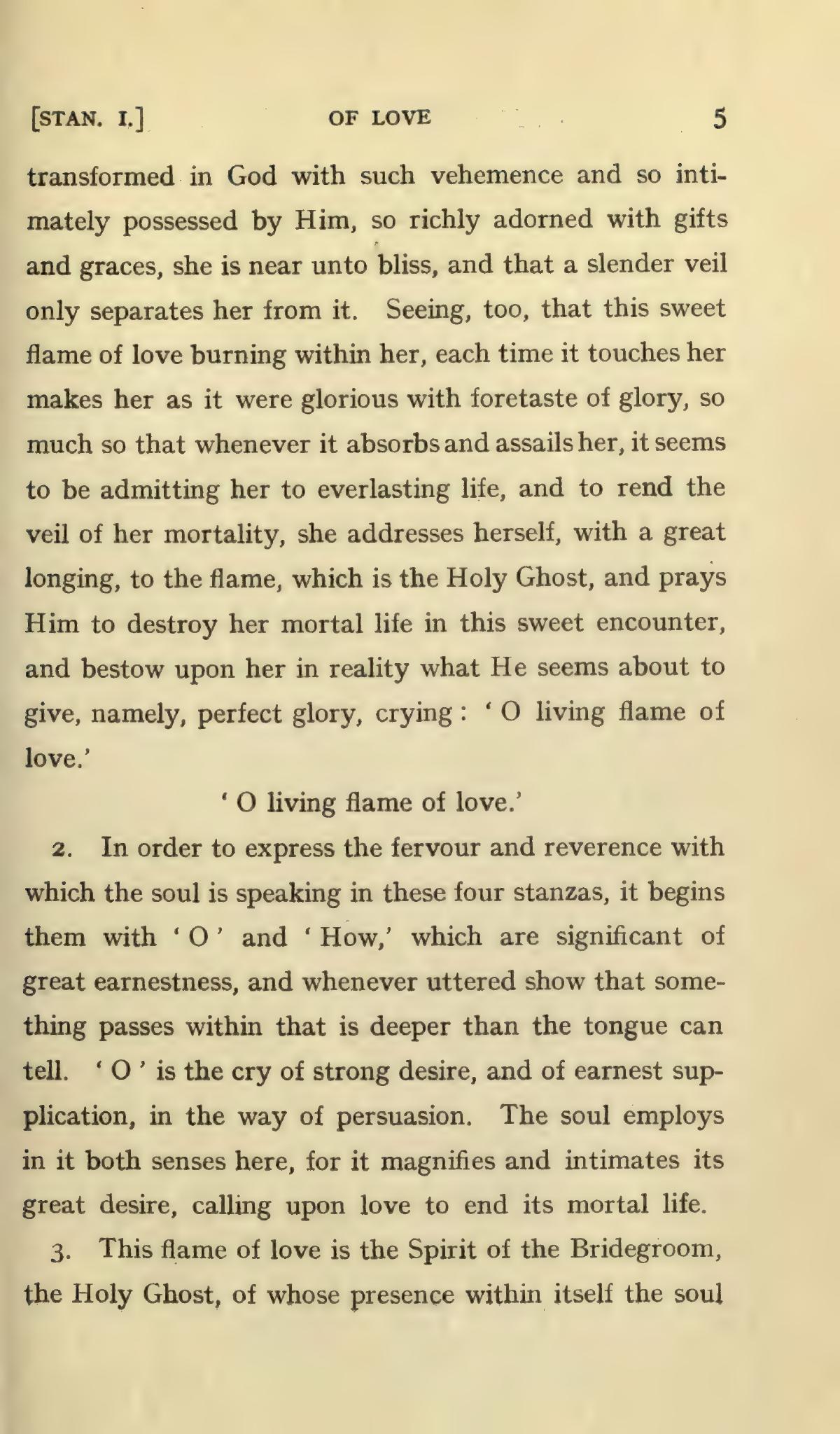
Seeing, too, that this sweet flame of love burning within her, each time it touches her makes her as it were glorious with foretaste of glory, so much so that whenever it absorbs and assails her, it seems to be admitting her to everlasting life, and to rend the veil of her mortality, she addresses herself, with a great longing, to the flame, which is the Holy Ghost, and prays Him to destroy her mortal life in this sweet encounter, and bestow upon her in reality what He seems about to give, namely, perfect glory, crying: 'O living flame of love.'
'O living flame of love.'
2. In order to express the fervour and reverence with which the soul is speaking in these four stanzas, it begins them with 'O' and 'How,' which are significant of great earnestness, and whenever uttered show that something passes within that is deeper than the tongue can tell. 'O' is the cry of strong desire, and of earnest supplication, in the way of persuasion. The soul employs in it both senses here, for it magnifies and intimates its great desire, calling upon love to end its mortal life.
3. This flame of love is the Spirit of the Bridegroom, the Holy Ghost, of whose presence within itself the soul is conscious, not only as fire which consumes it, and transforms it in sweet love, but as a fire burning within it, sending forth a flame which bathes it in glory and recreates it with the refreshment of everlasting life. The work of the Holy Ghost in a soul transformed in His love is this: His interior action within it is to kindle it and set it on fire; this is the burning of love, in union with which the will loves most deeply, being now one by love with that flame of fire. And thus the soul's acts of love are most precious, and even one of them more meritorious than many elicited not in the state of transformation. The transformation in love differs from the flame of love as a habit differs from an act, or as the glowing fuel from the flames it emits, the flames being the effect of the fire which is there burning.
4. Hence then we may say of the soul which is transformed in love, that its ordinary state is that of the fuel in the midst of the fire; that the acts of such a soul are the flames which rise up out of the fire of love, vehement in proportion to the intensity of the fire of union, and to the rapture and absorption of the will in the flame of the Holy Ghost; rising like the angel who ascended to God in the flame which consumed the holocaust of Manue. And as the soul, in its present condition, cannot elicit these acts without a special inspiration of the Holy Ghost, all these acts must be divine, in so far as the soul is under the special influence of God. Hence then it seems to the soul, as often as the flame breaks forth, causing it to love sweetly with a heavenly disposition, that its life everlasting is begun, and that its acts are divine in God.
5. This is the language in which God addresses purified and stainless souls, namely, words of fire. 'Thy word,' saith the Psalmist, 'is a vehement fire.' And in Jeremias we read, 'are not My words as a fire? saith our Lord.' His 'words,' we learn from Himself, 'are spirit and life;' the power and efficacy of which are felt by such souls as have ears to hear; pure souls full of love. But those souls whose palate is not healthy, whose desire is after other things, cannot perceive the spirit and life of His words. And therefore the more wonderful the words of the Son of God, the more insipid they are to some who hear them, because of the impurity in which they live.
Bu metin neden önemli
Yuhanna bu şerhte ruhun Kutsal Ruh ile birleşmesini bir alev imgesiyle anlatır. Ruh hem yakan hem aydınlatan bir ateşi içinde duyar. Metin, mistik birleşmenin bir kavramsal tanım olarak değil, yaşanan bir deneyim olarak nasıl betimlendiğini gösterir. Şerhin ilk bölümleri, sonraki sayfalarda geliştirilen ruhun dönüşümü öğretisinin zeminini kurar.
Bu eser Mistik Teoloji Koleksiyonu'nun parçasıdır →
- Kaynak eser
- St. John of the Cross, The Living Flame of Love, David Lewis çevirisi, Benedict Zimmerman'ın yeni baskısı, Londra 1919
- Neşir
- 16. yüzyıl / 1919 yeniden baskı
- Konum
- 1. Kıta şerhi, ilk bölümler
- Çeviren
- Şira Nur Uysal
- Dijital nüsha
- Internet Archive
Uysal, Ş. N. (Çev.). (2026). Haçlı Yuhanna, Canlı Sevgi Alevi: Birinci Kıta Şerhi. Kadim Kütüphane. https://kadimkutuphane.com/hacli-yuhanna-canli-sevgi-alevi-ilk-kitap@misc{kk_hacli_yuhanna_canli_sevgi_alevi_ilk_kita,
author = {Uysal, Şira Nur},
title = {{Haçlı Yuhanna, Canlı Sevgi Alevi: Birinci Kıta Şerhi}},
year = {2026},
publisher = {Kadim Kütüphane},
url = {https://kadimkutuphane.com/hacli-yuhanna-canli-sevgi-alevi-ilk-kitap},
note = {Türkçe çeviri, özgün eser: Haçlı Yuhanna (Juan de la Cruz)},
}Yeni metinlerden ilk sen haberdar ol
Tam çeviriler, PDF'ler ve yeni eklenen kaynaklar hazırlandıkça e-postana düşsün.