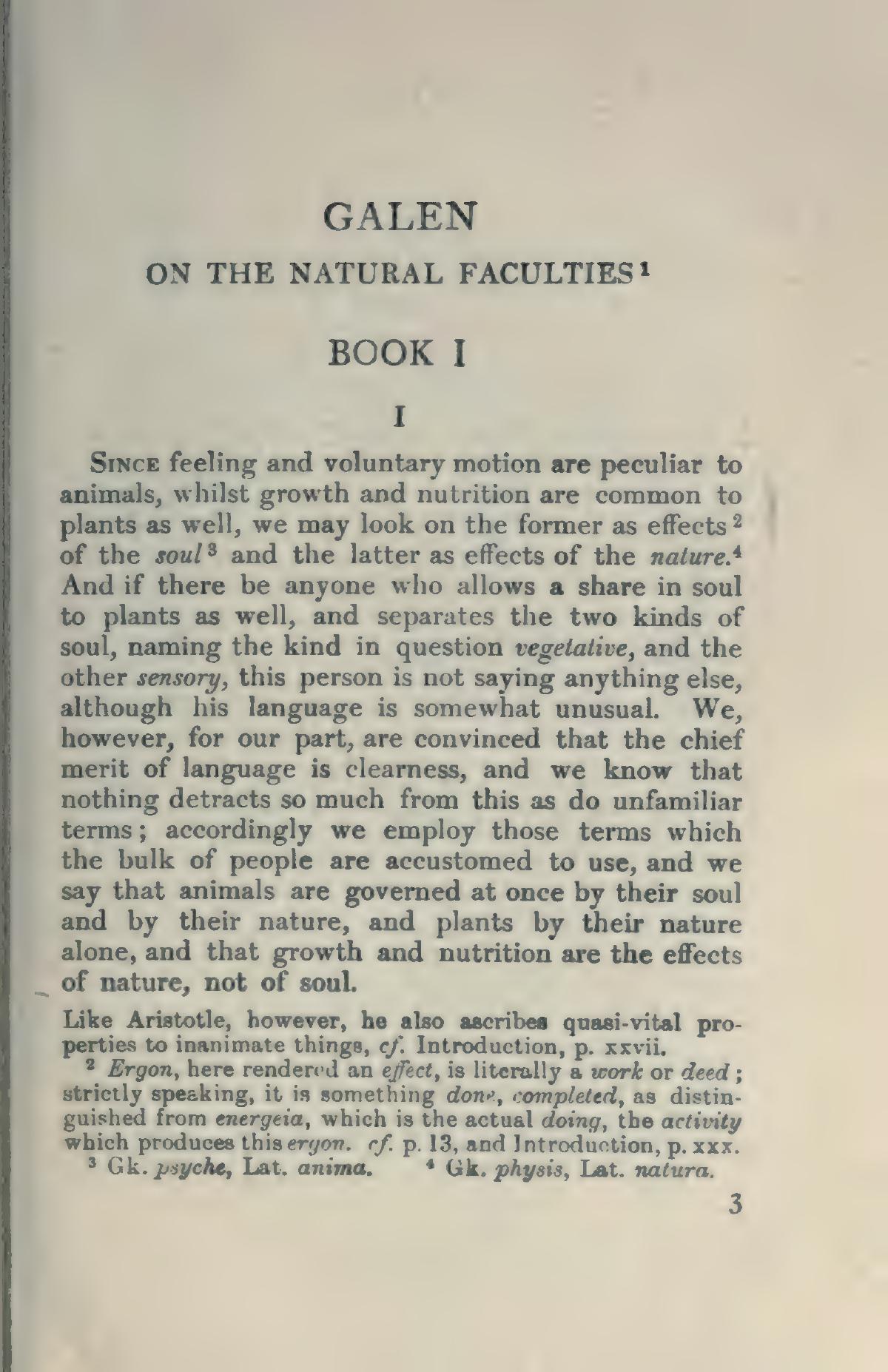
Galenos (129-yaklaşık 216), Bergama'da doğmuş Yunan hekimdir. Roma'da çalıştı ve çağının tıp bilgisini toplayan çok sayıda eser yazdı. Doğal Yetiler Üzerine, bedende büyüme, beslenme ve üreme gibi işlevleri yöneten yetileri ele alır. Aktarılan bölüm A. J. Brock'un 1916 çevirisinden alınmıştır.
GALENOS
DOĞAL YETİLER ÜZERİNE
I. KİTAP
I
Hissetme ve istemli hareket hayvanlara özgü iken, büyüme ve beslenme bitkiler için de ortak olduğundan, ilki ruhun etkileri, ikincisi ise doğanın etkileri olarak görülebilir. Şayet bitkilere de ruhtan pay tanıyan ve bu iki tür ruhu birbirinden ayırarak söz konusu türe bitkisel, diğerine ise duyusal adını veren biri çıkarsa, ifadesi biraz alışılmadık olsa da aslında başka bir şey söylüyor değildir. Biz ise kendi adımıza, dilin en temel erdeminin açıklık olduğuna inanıyoruz ve hiçbir şeyin buna yabancı terimler kadar zarar vermediğini biliyoruz; bu nedenle çoğunluğun kullanmaya alışkın olduğu terimleri benimsiyor ve hayvanların hem ruhları hem de doğaları tarafından, bitkilerin ise yalnızca doğaları tarafından yönetildiğini; büyüme ve beslenmenin ruhun değil, doğanın etkileri olduğunu söylüyoruz.
II
Böylece bu inceleme boyunca, gerek bu etkilerin gerekse bulunabilecek diğer tüm doğa etkilerinin hangi yetilerden kaynaklandığını araştıracağız.
Ancak öncelikle, bu incelemede kullanacağımız çeşitli terimleri ve bunları hangi şeylere uyguladığımızı açıkça ayırt etmeli ve açıklamalıyız; bu durum yalnızca terimlerin bir açıklaması olmakla kalmayacak, aynı zamanda doğanın etkilerinin bir kanıtı olacaktır.
Şu halde, filanca bir cisim mevcut durumundan hiçbir değişime uğramadığında, onun sükûnet halinde olduğunu söyleriz; fakat bundan herhangi bir bakımdan uzaklaşırsa, o vakit bu bakımdan bir harekete maruz kaldığını söyleriz. Dolayısıyla, önceden var olan durumundan çeşitli şekillerde uzaklaştığında, çeşitli türlerde hareketlere maruz kaldığı söylenecektir. Böylece, şayet beyaz olan siyaha ya da siyah olan beyaza dönüşürse, renk bakımından harekete maruz kalır; veya daha önce tatlı olan bir şey şimdi acılaşırsa ya da tersine, acıyken şimdi tatlı hale gelirse, tat bakımından harekete maruz kaldığı söylenecektir; hem bu iki örneğe hem de daha önce zikredilenlere niteliksel hareket terimini uygulayacağız. Dahası, harekete maruz kaldığını söylediğimiz şeyler yalnızca renk ve tat bakımından değişime uğrayanlar değildir; sıcak bir şey soğuduğunda ve soğuk bir şey ısındığında da burada onun bir harekete maruz kaldığından söz ederiz; benzer şekilde nemli bir şey kuruduğunda ya da kuru bir şey nemlendiğinde de durum böyledir. İşte bütün bu durumlara uyguladığımız ortak terim başkalaşımdır.
Bu bir tür harekettir. Ancak konum değiştiren ya da dediğimiz gibi bir yerden başka bir yere geçen cisimlerde meydana gelen başka bir tür daha vardır; bunun adı yer değiştirmedir.
O halde bu iki hareket türü yalın ve birincildir; bunlardan bileşik olarak ise, her biri aynı zamanda kendi özel biçimini korurken küçük bir şeyin büyümesi veya büyük bir şeyin küçülmesinde olduğu gibi büyüme ve küçülmeye sahibizdir. Diğer iki hareket türü ise oluş ve yok oluştur; oluş varlığa geliş, yok oluş ise bunun karşıtıdır.
Şimdi, her tür hareketin ortak özelliği önceden var olan durumdan değişim iken, her sükûnet durumunun ortak özelliği önceden var olan durumun korunmasıdır. Bununla birlikte Sofistler, ekmeğin kana dönüşürken görme, tatma ve dokunma bakımından değiştiğini kabul etseler de bu değişimin gerçekte meydana geldiğini kabul etmeyeceklerdir. Nitekim bazısı bu tür olguların tümünün duyularımızın aldatmacaları ve yanılsamaları olduğunu öne sürer; dediklerine göre duyular bir öyle bir böyle etkilenmektedir, oysa altta yatan töz isimleri verilen bu değişimlerin hiçbirini kabul etmez. Diğerleri ise (Anaxagoras gibi) niteliklerin onun içinde gerçekten var olduğunu, ancak bunların ezelden ebede kadar değişmez ve başkalaşmaz olduğunu, bu görünürdeki başkalaşımların ayrışma ve birleşme yoluyla meydana geldiğini iddia ederler.
Şimdi, şayet yolumdan sapıp bu kimseleri çürütmeye kalkışsaydım, tali görevim asıl görevimden daha büyük olurdu. Dolayısıyla, Aristoteles'in ve ardından Khrysippos'un yazdığı "Tözün Tam Başkalaşımı Üzerine" adlı eserlerdeki her şeyi bilmiyorlarsa, kendilerinden bu adamların yazılarıyla aşinalık kurmalarını rica etmek durumundayım. Şayet bunları biliyor ve yine de bilerek kötü görüşleri iyilere tercih ediyorlarsa, şüphesiz benim argümanlarımı da akılsızca bulacaklardır. Bu görüşlerin, Aristoteles'ten çok daha önce yaşamış olan Hippokrates tarafından da paylaşıldığını başka bir yerde göstermiştim. Aslında, hem hekim hem de filozof olduğu tarafımızca bilinen herkes arasında, karşılıklı etkileşim içinde olan toplam dört nitelik bulunduğunu ve varlığa gelen ile varlıktan çıkan her şeyin oluş ve yok oluşunun bunların işleyişine bağlı olduğunu göstermeye ilk girişen Hippokrates olmuştur. Dahası, Hippokrates bütün bu niteliklerin birbiriyle içli dışlı bir karışım geçirdiğini ilk fark eden kişiydi; ve en azından Aristoteles'in daha sonra ele aldığı kanıtların başlangıçları ilk olarak Hippokrates'in yazılarında bulunmaktadır.
Kitionlu Zenon'un daha sonra bildirdiği gibi, niteliklerinin yanı sıra tözlerin de bu içli dışlı karışımı geçirdiğini varsayıp varsaymayacağımıza gelince, bu incelemede bu meseleyi daha fazla irdelemeyi gerekli görmüyorum; zira şimdiki amaçlarımız bakımından yalnızca tözün tam başkalaşımını kabul etmemiz yeterlidir. Bu sayede hiç kimse ekmeğin kemik, et, sinir ve diğer tüm parçalar için bir tür buluşma yeri teşkil ettiğini ve bunların her birinin sonradan bedende ayrılarak kendi türüne katılmaya gittiğini varsaymayacaktır; herhangi bir ayrışma gerçekleşmeden önce, ekmeğin tamamı açıkça kan haline gelir; (ne olursa olsun, bir kimse uzun bir süre boyunca başka hiçbir yiyecek almasa bile, damarlarında yine de kan bulunacaktır). Ve bu durum, elementleri değişmez kabul edenlerin görüşünü açıkça çürütmektedir; nitekim aynı şekilde lambanın alevinde tamamen tükenen yağ veya biraz daha uzun bir sürede ateşe dönüşen çalı çırpı da bunu çürütür.
Yine de bu insanlarla bir tartışmaya girmeyeceğimi söylemiştim ve bundan söz etmemin tek nedeni, örneğin tıp konusundan alınmış olması ve bu inceleme için ona ihtiyaç duymamdır. O halde dediğim gibi, onlarla olan çekişmemizden vazgeçeceğiz; zira arzu edenler, bu meselelere dair kendi şahsi araştırmalarımızdan kadimlerin görüşlerini gayet iyi kavrayabilirler.
Özgün metin (İngilizce)
GALEN
ON THE NATURAL FACULTIES
BOOK I
I
SINCE feeling and voluntary motion are peculiar to animals, whilst growth and nutrition are common to plants as well, we may look on the former as effects of the soul and the latter as effects of the nature. And if there be anyone who allows a share in soul to plants as well, and separates the two kinds of soul, naming the kind in question vegetative, and the other sensory, this person is not saying anything else, although his language is somewhat unusual. We, however, for our part, are convinced that the chief merit of language is clearness, and we know that nothing detracts so much from this as do unfamiliar terms; accordingly we employ those terms which the bulk of people are accustomed to use, and we say that animals are governed at once by their soul and by their nature, and plants by their nature alone, and that growth and nutrition are the effects of nature, not of soul.
II
Thus we shall enquire, in the course of this treatise, from what faculties these effects themselves, as well as any other effects of nature which there may be, take their origin.
First, however, we must distinguish and explain clearly the various terms which we are going to use in this treatise, and to what things we apply them; and this will prove to be not merely an explanation of terms but at the same time a demonstration of the effects of nature.
When, therefore, such and such a body undergoes no change from its existing state, we say that it is at rest; but, if it departs from this in any respect we then say that in this respect it undergoes motion. Accordingly, when it departs in various ways from its pre-existing state, it will be said to undergo various kinds of motion. Thus, if that which is white becomes black, or what is black becomes white, it undergoes motion in respect to colour; or if what was previously sweet now becomes bitter, or, conversely, from being bitter now becomes sweet, it will be said to undergo motion in respect to flavour; to both of these instances, as well as to those previously mentioned, we shall apply the term qualitative motion. And further, it is not only things which are altered in regard to colour and flavour which, we say, undergo motion; when a warm thing becomes cold, and a cold warm, here too we speak of its undergoing motion; similarly also when anything moist becomes dry, or dry moist. Now, the common term which we apply to all these cases is alteration.
This is one kind of motion. But there is another kind which occurs in bodies which change their position, or as we say, pass from one place to another; the name of this is transference.
These two kinds of motion, then, are simple and primary, while compounded from them we have growth and decay, as when a small thing becomes bigger, or a big thing smaller, each retaining at the same time its particular form. And two other kinds of motion are genesis and destruction, genesis being a coming into existence, and destruction being the opposite.
Now, common to all kinds of motion is change from the pre-existing state, while common to all conditions of rest is retention of the pre-existing state. The Sophists, however, while allowing that bread in turning into blood becomes changed as regards sight, taste, and touch, will not agree that this change occurs in reality. Thus some of them hold that all such phenomena are tricks and illusions of our senses; the senses, they say, are affected now in one way, now in another, whereas the underlying substance does not admit of any of these changes to which the names are given. Others (such as Anaxagoras) will have it that the qualities do exist in it, but that they are unchangeable and immutable from eternity to eternity, and that these apparent alterations are brought about by separation and combination.
Now, if I were to go out of my way to confute these people, my subsidiary task would be greater than my main one. Thus, if they do not know all that has been written, "On Complete Alteration of Substance" by Aristotle, and after him by Chrysippus, I must beg of them to make themselves familiar with these men's writings. If, however, they know these, and yet willingly prefer the worse views to the better, they will doubtless consider my arguments foolish also. I have shown elsewhere that these opinions were shared by Hippocrates, who lived much earlier than Aristotle. In fact, of all those known to us who have been both physicians and philosophers Hippocrates was the first who took in hand to demonstrate that there are, in all, four mutually interacting qualities, and that to the operation of these is due the genesis and destruction of all things that come into and pass out of being. Nay, more; Hippocrates was also the first to recognise that all these qualities undergo an intimate mingling with one another; and at least the beginnings of the proofs to which Aristotle later set his hand are to be found first in the writings of Hippocrates.
As to whether we are to suppose that the substances as well as their qualities undergo this intimate mingling, as Zeno of Citium afterwards declared, I do not think it necessary to go further into this question in the present treatise; for immediate purposes we only need to recognize the complete alteration of substance. In this way, nobody will suppose that bread represents a kind of meeting-place for bone, flesh, nerve, and all the other parts, and that each of these subsequently becomes separated in the body and goes to join its own kind; before any separation takes place, the whole of the bread obviously becomes blood; (at any rate, if a man takes no other food for a prolonged period, he will have blood enclosed in his veins all the same). And clearly this disproves the view of those who consider the elements unchangeable, as also, for that matter, does the oil which is entirely used up in the flame of the lamp, or the faggots which, in a somewhat longer time, turn into fire.
I said, however, that I was not going to enter into an argument with these people, and it was only because the example was drawn from the subject-matter of medicine, and because I need it for the present treatise, that I have mentioned it. We shall then, as I said, renounce our controversy with them, since those who wish may get a good grasp of the views of the ancients from our own personal investigations into these matters.
Bu metin neden önemli
Galenos birinci kitabın girişinde hissetme ve istemli hareketi ruhun, büyüme ve beslenmeyi ise doğanın etkileri olarak ayırır. Terimler konusunda dilin başlıca erdeminin açıklık olduğunu söyler. Metin, Galenos'un yetiler anlayışının temelini ve bilimsel dil konusundaki tutumunu gösterir.
Bu eser Ezoterik Tıp Koleksiyonu'nun parçasıdır →
- Kaynak eser
- Galen, On the Natural Faculties, A. J. Brock çevirisi, Londra, Loeb Classical Library, 1916
- Neşir
- MS 2. yüzyıl / 1916 çeviri
- Konum
- I. Kitap, ilk bölümler
- Çeviren
- Şira Nur Uysal
- Dijital nüsha
- Internet Archive
Uysal, Ş. N. (Çev.). (2026). Galenos, Doğal Yetiler Üzerine: Birinci Kitap. Kadim Kütüphane. https://kadimkutuphane.com/galenos-dogal-yetiler-uzerine-birinci-kitap@misc{kk_galenos_dogal_yetiler_uzerine_birinci_ki,
author = {Uysal, Şira Nur},
title = {{Galenos, Doğal Yetiler Üzerine: Birinci Kitap}},
year = {2026},
publisher = {Kadim Kütüphane},
url = {https://kadimkutuphane.com/galenos-dogal-yetiler-uzerine-birinci-kitap},
note = {Türkçe çeviri, özgün eser: Galenos},
}Yeni metinlerden ilk sen haberdar ol
Tam çeviriler, PDF'ler ve yeni eklenen kaynaklar hazırlandıkça e-postana düşsün.