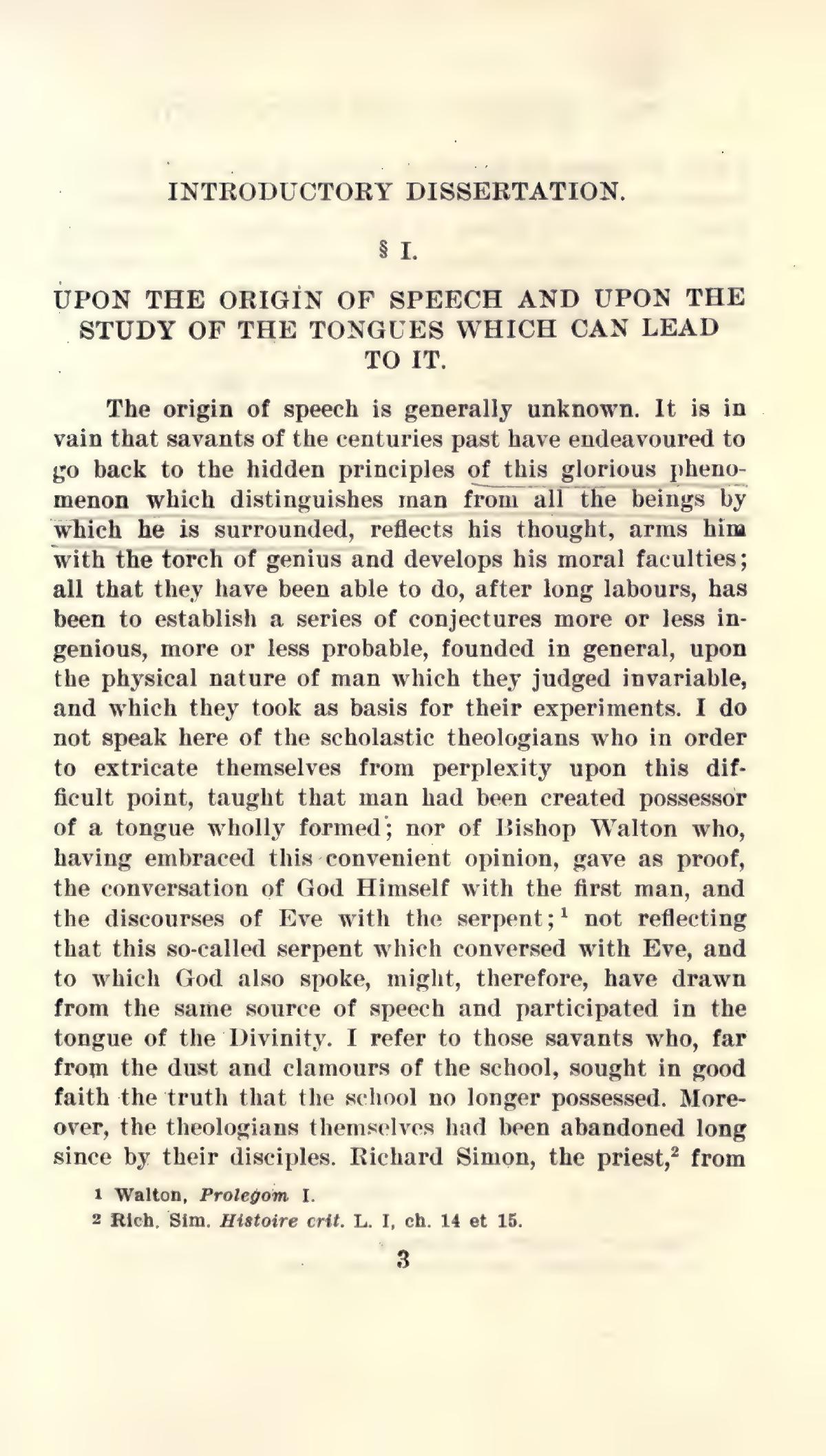
Antoine Fabre d'Olivet (1767-1825), Fransız yazar ve dilbilimcidir. La Langue hébraïque restituée adlı eserini 1815-1816'da yayımladı. Eser İbranice'yi kök anlamlarından yeniden kurmayı amaçlar. Aktarılan bölüm Giriş Tezi'nin ilk paragrafıdır ve Nayán Louise Redfield'in 1921 çevirisinden alınmıştır.
GİRİŞ TEZİ.
§ I.
SÖZÜN KÖKENİ VE ONA ULAŞTIRABİLECEK DİLLERİN İNCELENMESİ ÜZERİNE.
Sözün kökeni genel olarak bilinmemektedir. Geçmiş yüzyılların bilginleri, insanı kendisini çevreleyen tüm varlıklardan ayıran, düşüncesini yansıtan, onu dehanın meşalesiyle donatan ve ahlaki melekelerini geliştiren bu muazzam fenomenin gizli ilkelerine geri dönmek için boşuna çaba sarf etmişlerdir; uzun emeklerden sonra yapabildikleri tek şey, insanın değişmez kabul ettikleri ve deneylerine temel aldıkları fiziksel doğasına genel olarak dayanan, az ya da çok ustalıklı, az ya da çok muhtemel bir dizi varsayım ortaya koymaktan ibaret olmuştur. Bu zor meseledeki şaşkınlıktan kurtulmak adına, insanın eksiksiz teşekkül etmiş bir dilin sahibi olarak yaratıldığını öğreten skolastik ilahiyatçılardan ve bu elverişli görüşü benimseyerek Tanrı'nın bizzat ilk insanla konuşmasını ve Havva'nın yılanla olan mükâlemesini delil gösteren Piskopos Walton'dan söz etmiyorum; zira o, Havva ile konuşan ve Tanrı'nın da kendisiyle konuştuğu bu sözde yılanın da aynı söz kaynağından beslenmiş ve İlahîliğin diline ortak olmuş olabileceğini düşünmemiştir. Ben, mektebin tozundan ve patırtısından uzakta, mektebin artık sahip olmadığı hakikati iyi niyetle arayan bilginleri kastediyorum. Kaldı ki ilahiyatçılar da öğrencileri tarafından çoktan terk edilmişlerdi. Eski Ahit'in mükemmel bir tenkit tarihini borçlu olduğumuz rahip Richard Simon, Nyssa'lı Aziz Gregorios'un otoritesine dayanarak bu hususta ilahiyatçı görüşü reddetmekten ve dilin oluşumunu insanın doğasına ve ihtiyaçlarının sevkine bağlayan Diodoros Sikolos'un ve hatta Lucretius'un görüşünü benimsemekten çekinmemiştir.
Burada Diodoros Sikolos'un veya Lucretius'un görüşünü ilahiyatçıların görüşünün karşısına koymamdan, bunu en iyisi olarak gördüğüm anlamı çıkarılmamalıdır. J. J. Rousseau'nun bütün fesahati bile bunu bana onaylatamaz. Bu, bir aşırılığın başka bir aşırılığa çarpması ve tam da bu nedenle hakikatin bulunduğu mutedil orta yoldan uzaklaşmasıdır. Rousseau, o heyecanlı ve tutkulu üslubuyla, dilin oluşumundan ziyade toplumun oluşumunu tasvir eder: Kurgularını en canlı renklerle süsler ve bizzat kendisi, muhayyilesine kapılarak, yalnızca hayal ürünü olan şeyi gerçek zanneder. Onun metinlerinde medeniyetin olası bir başlangıcı açıkça görülür, fakat sözün muhtemel bir kökeni asla görülmez. Güney dillerinin hazzın, Kuzey dillerinin ise ihtiyacın kızları olduğunu söylemiş olması beyhudedir: İnsan hâlâ hazzın ya da ihtiyacın, bütün bir kabilenin anlamakta ve her şeyden önce benimsemekte hemfikir olduğu kelimeleri nasıl aynı anda ortaya çıkarabildiğini sormaktadır. Soğuk ve katı bir akıl yürütmeyle, dilin ancak bir mutabakatla tesis edilebileceğini ve bu mutabakatın da dil olmadan düşünülemeyeceğini söyleyen kendisi değil midir? Çağdaş bir teozofun içine hapsettiği bu kısır döngüden kaçınmak mümkün müdür? Bu teozof şöyle der: "Dillerimizi ve anlayışımızın bütün ilmini yalnızca tabii koşulların vasıtalarıyla ve yalnızca insani imkânlarımızla teşekkül ettirme iddiasına bağlananlar, bizzat kendilerinin ortaya attığı bu korkunç itiraza bilerek maruz kalırlar; zira sadece inkâr eden kişi yıkmış olmaz ve bir argümanı sırf tasvip etmediği için çürütmüş sayılmaz: Şayet insanın dili bir mutabakatsa, bu mutabakat dil olmadan nasıl kurulmuştur?"
Hem Locke'u hem de onun en gayretli müridi Condillac'ı dikkatle okuyunuz; dilerseniz ustalıklı bir mekanizmanın parçalara ayrılışına şahitlik etmiş olursunuz; parçalara ayıranın maharetine belki hayran kalırsınız; fakat hem bu mekanizmanın kökeni, müellifinin güttüğü amaç, onun içsel tabiatı ve işleyişini harekete geçiren ilke konusunda daha önce olduğu kadar cahil kalırsınız. İster kendi kanaatinize göre tefekkür edin, ister uzun çalışmalar size başkalarına göre düşünmeyi öğretmiş olsun, bu becerikli tahlilcide, tiyatroda falanca aktörün nasıl ve niçin dans ettiğini size açıkladığı vehmine kapılarak eline neşteri alıp bir cesedin bacaklarını teşrih eden gülünç bir ameliyatçıdan başkasını göremezsiniz. Hafızanız Sokrates ve Platon'u hatırlatır. Onların dönemlerinin fizikçilerini ve metafizikçilerini sert bir şekilde azarladıklarını yeniden işitirsiniz; onların karşı konulmaz delillerini bu ampirik yazarların boş böbürlenmeleriyle kıyaslar ve bir saati sırf parçalarına ayırmanın onun hareketinin sebebini açıklamaya yetmediğini açıkça hissedersiniz.
Çünkü sözün bilgisi, dilin unsurlarının ve kökeninin bilgisi, başkalarına kolayca aktarılabilecek veya geometricilerin tarzında parçalara ayrılabilecek kazanımlar değildir. Kişi bunlara ne derece sahip olursa olsun, bunlar zihne ne kadar derin kökler salmış olursa olsun, orada ne kadar çok meyve vermiş olursa olsun, yalnızca ilkesi iletilebilir. Nitekim temel tabiatta hiçbir şey aynı anda çoğalmaz: En gürbüz ağaç, en mükemmel hayvan kendi benzerini aynı anda meydana getirmez. Kendi türlerine göre, başlangıçta kendilerinden çok farklı olan ve dışarıdan hiçbir şey gelişimine yardım etmezse kısır kalan bir tohum verirler.
Özgün metin (İngilizce)
INTRODUCTORY DISSERTATION.
§ I.
UPON THE ORIGIN OF SPEECH AND UPON THE STUDY OF THE TONGUES WHICH CAN LEAD TO IT.
The origin of speech is generally unknown. It is in vain that savants of the centuries past have endeavoured to go back to the hidden principles of this glorious phenomenon which distinguishes man from all the beings by which he is surrounded, reflects his thought, arms him with the torch of genius and develops his moral faculties; all that they have been able to do, after long labours, has been to establish a series of conjectures more or less ingenious, more or less probable, founded in general, upon the physical nature of man which they judged invariable, and which they took as basis for their experiments. I do not speak here of the scholastic theologians who in order to extricate themselves from perplexity upon this difficult point, taught that man had been created possessor of a tongue wholly formed; nor of Bishop Walton who, having embraced this convenient opinion, gave as proof, the conversation of God Himself with the first man, and the discourses of Eve with the serpent; not reflecting that this so-called serpent which conversed with Eve, and to which God also spoke, might, therefore, have drawn from the same source of speech and participated in the tongue of the Divinity. I refer to those savants who, far from the dust and clamours of the school, sought in good faith the truth that the school no longer possessed. Moreover, the theologians themselves had been abandoned long since by their disciples. Richard Simon, the priest, from whom we have an excellent critical history of the Old Testament, did not fear, relying upon the authority of Saint Gregory of Nyssa, to reject theological opinion in this respect, and to adopt that of Diodorus Siculus and even that of Lucretius, who attribute the formation of language to the nature of man and to the instigation of his needs.
It is not because I here oppose the opinion of Diodorus Siculus or Lucretius to that of the theologians, that one should infer that I consider it the best. All the eloquence of J. J. Rousseau could not make me approve of it. It is one extreme striking another extreme, and by this very thing departing from the just mean where truth abides. Rousseau in his nervous, passionate style, pictures the formation of society rather than that of language: he embellishes his fictions with most vivid colours, and he himself, drawn on by his imagination, believes real what is only fantastic. One sees plainly in his writing a possible beginning of civilization but no probable origin of speech. It is to no purpose that he has said that the meridional tongues are the daughters of pleasure and those of the North, of necessity: one still asks, how pleasure or necessity can bring forth simultaneously, words which an entire tribe agrees in understanding and above all agrees in adopting. Is it not he who has said, with cold, severe reason, that language could be instituted only by an agreement and that this agreement could not be conceived without language? This vicious circle in which a modern theosophist confines it, can it be eluded? "Those who devote themselves to the pretension of forming our tongues and all the science of our understanding, by the expedients of natural circumstances alone, and by our human means alone," says this theosophist, "expose themselves voluntarily to this terrible objection that they themselves have raised; for he who only denies, does not destroy, and he does not refute an argument because he disapproves of it: if the language of man is an agreement, how is this agreement established without language?"
Read carefully both Locke and his most painstaking disciple Condillac; you will, if you desire, have assisted at the decomposition of an ingenious contrivance; you will have admired, perhaps, the dexterity of the decomposer; but you will remain as ignorant as you were before, both concerning the origin of this contrivance, the aim proposed by its author, its inner nature and the principle which moves its machinations. Whether you reflect according to your own opinion, or whether long study has taught you think according to others, you will soon perceive in the adroit analyst only a ridiculous operator who, flattering himself that he is explaining to you how and why such an actor dances in the theatre, seizes a scalpel and dissects the legs of a cadaver. Your memory recalls Socrates and Plato. You hear them again rebuking harshly the physicists and the metaphysicians of their time; you compare their irresistible arguments with the vain jactancy of these empirical writers, and you feel clearly that merely taking a watch to pieces does not suffice to give reason for its movement.
For the knowledge of speech, that of the elements and the origin of language, are not attainments that can be transmitted readily to others, or that can be taken to pieces after the manner of the geometricians. To whatever extent one may possess them, whatever profound roots they may have thrown into the mind, whatever numerous fruits they may have developed there, only the principle can ever be communicated. Thus, nothing in elementary nature is propagated at the same time: the most vigorous tree, the most perfect animal do not produce simultaneously their likeness. They yield, according to their specie, a germ at first very different from them, which remains barren if nothing from without coöperates for its development.
Bu metin neden önemli
Fabre d'Olivet girişte sözün kökeninin bilinmediğini söyler. Önceki yüzyılların bilginlerinin bu konuda ancak varsayımlar üretebildiğini belirtir. Ardından hangi dillerin bu kökene ulaştırabileceğini araştırmayı önerir. Metin, Fabre d'Olivet'nin dil ve köken sorusunu nasıl kurduğunu gösterir.
Bu eser Hermetizm Koleksiyonu'nun parçasıdır →
- Kaynak eser
- Fabre d'Olivet, The Hebraic Tongue Restored, Nayán Louise Redfield çevirisi, New York, Putnam, 1921
- Neşir
- 1815-1816 / 1921 çeviri
- Konum
- Giriş Tezi, § I
- Çeviren
- Şira Nur Uysal
- Dijital nüsha
- Internet Archive
Uysal, Ş. N. (Çev.). (2026). Fabre d'Olivet, Yeniden Kurulan İbrani Dili: Sözün Kökeni. Kadim Kütüphane. https://kadimkutuphane.com/fabre-dolivet-yeniden-kurulan-ibrani-dili-konusmanin-kokeni@misc{kk_fabre_dolivet_yeniden_kurulan_ibrani_dil,
author = {Uysal, Şira Nur},
title = {{Fabre d'Olivet, Yeniden Kurulan İbrani Dili: Sözün Kökeni}},
year = {2026},
publisher = {Kadim Kütüphane},
url = {https://kadimkutuphane.com/fabre-dolivet-yeniden-kurulan-ibrani-dili-konusmanin-kokeni},
note = {Türkçe çeviri, özgün eser: Antoine Fabre d'Olivet},
}Yeni metinlerden ilk sen haberdar ol
Tam çeviriler, PDF'ler ve yeni eklenen kaynaklar hazırlandıkça e-postana düşsün.