Mary Anne Atwood (1817-1910), İngiliz yazar ve simya araştırmacısıdır. A Suggestive Inquiry into the Hermetic Mystery adlı kitabı 1850'de yayımlandı. Kitap simyayı yalnızca madenlerle değil, ruhun ve bilincin dönüşümüyle ilişkilendiren bir yorum sunar. Aktarılan bölüm kitabın ilk bölümünden alınmıştır.
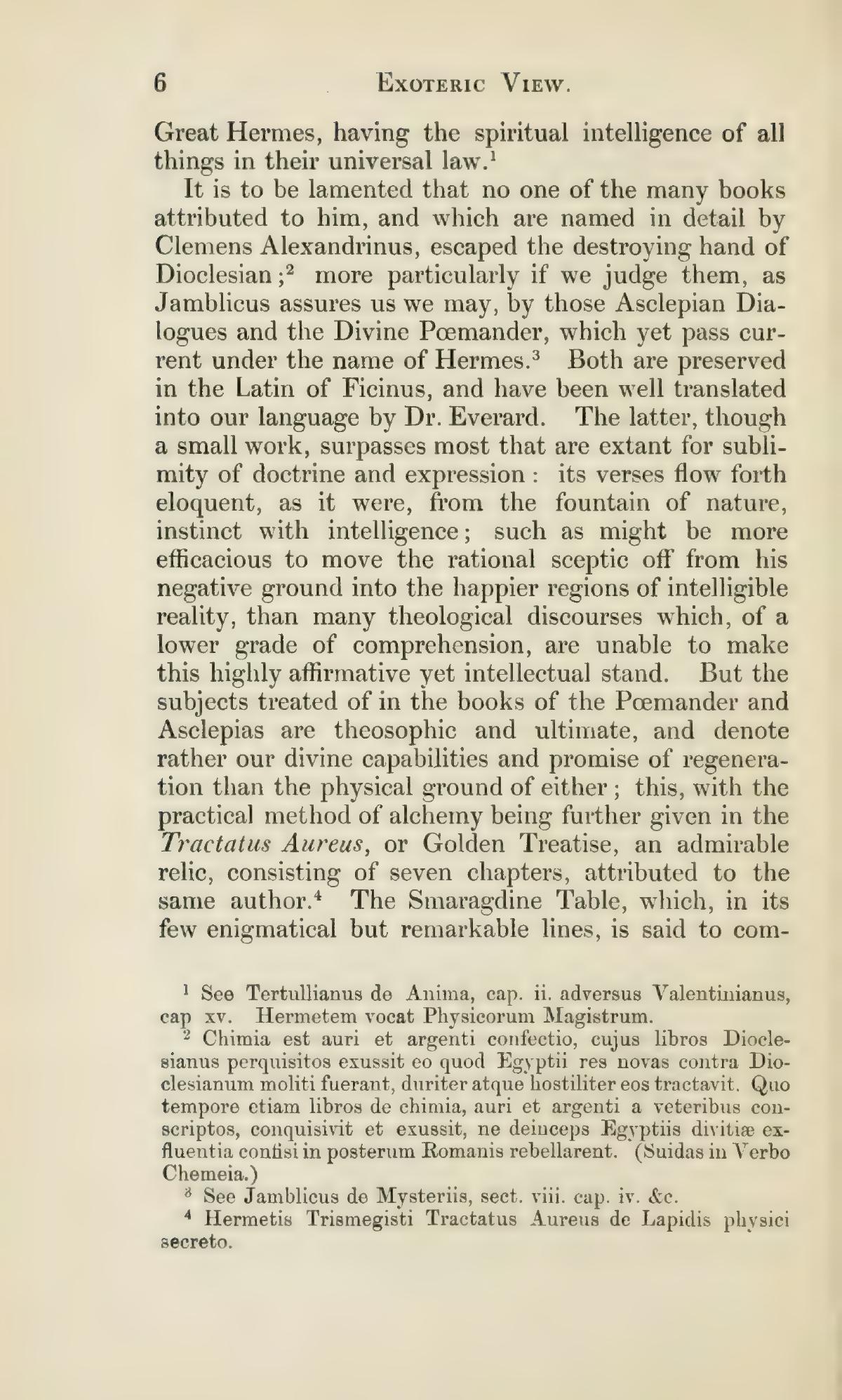
İskenderiyeli Klemens tarafından ayrıntılarıyla zikredilen ve ona atfedilen pek çok kitaptan hiçbirinin Diokletianus'un yok edici elinden kurtulamamış olması esef vericidir; hele ki Iamblikhos'un bize temin ettiği üzere, onları günümüzde hâlâ Hermes adıyla tedavülde bulunan o Asklepios Diyalogları ve İlahi Poimandres ile değerlendirecek olursak durum daha da böyledir. Her ikisi de Ficino'nun Latince tercümesinde muhafaza edilmiş olup Dr. Everard tarafından dilimize layıkıyla çevrilmiştir. İkincisi, küçük bir eser olmasına rağmen, öğreti ve ifade yüceliği bakımından günümüze ulaşanların çoğunu geride bırakır: Mısraları adeta tabiatın kaynağından, zekâ ile dopdolu ve beliğ bir surette akar; öyle ki bu durum, akılcı şüpheciyi bulunduğu olumsuz zeminden alıp kavranabilir hakikatin daha mesut sahalarına taşımada, daha alt düzey bir kavrayışa sahip olan ve bu denli müspet fakat fikrî duruşu sergileyemeyen birçok teolojik söylemden çok daha tesirli olabilir. Ancak Poimandres ve Asklepios kitaplarında ele alınan konular teozofik ve nihaidir; her ikisinin de fiziki zemininden ziyade ilahi kabiliyetlerimizi ve yeniden doğuş vaadimizi gösterir; bu zemin ve simyanın tatbiki yöntemi, yine aynı müellife atfedilen, yedi bölümden müteşekkil hayranlık uyandırıcı bir kalıntı olan Tractatus Aureus yahut Altın Risale adlı eserde ayrıca verilmiştir. Birkaç muammalı fakat dikkat çekici satırında sanatın işleyiş ilkesini ve bütün konusunu ihtiva ettiği söylenen Zümrüt Levha'yı buraya ekliyoruz: Orijinal Arapça ve Yunanca nüshalarından Kircher tarafından Latinceye şu şekilde aktarılmıştır:
TABULA SMARAGDINA HERMETIS.
Verum sine mendacio certum et verissimum; quod est superius est sicut quod est inferius; et quod est inferius est sicut quod est superius, ad perpetranda miracula rei unius: et sicut omnes res fuerunt ab uno, mediatione unius, sic omnes res notæ fuerunt ab hac unâ re adaptatione. Pater ejus Sol est, mater vera Luna; portavit id ventus in ventre suo, nutrix ejus terra est; pater omnis telesmi, sive consummatio totius mundi est hic. Vis ejus integra est si versa fuerit in terram. Separabis terram ab igni, subtile a spisso, suaviter cum multo ingenio; ascendit a terrâ in cœlum, iterumque descendit in terram, recipitque vim superiorum et inferiorum. Sic habebis gloriam totius mundi, ideò fugit a te omnis obscuritas; hic est totius fortitudinis fortis, qui vincet omnem rem subtilem omnemque solidam penetrabit. Sicut mundus creatus est. Hinc erunt adaptationes mirabiles quarum modus est hic. Itaque vocatus sum Hermes Trismegistus, habens tres partes philosophiæ totius mundi. Completum est quod dixi operatione Solis.
Felsefi konuyu etken ve edilgen münasebetleri içinde ve bu Hermetik ışık kaynaklarının birleşimindeki mahrem sırrı hususi olarak incelemeye geçtiğimizde, ileride bu levhaya ve onun tatbik edilebilirliğine yeniden dönme fırsatımız olacaktır. Yazıt şu şekilde tercüme edilebilir:
HERMES'İN ZÜMRÜT LEVHASI.
Yalandan uzak, kesin ve en doğrudur ki; Tek Bir Şey'in mucizelerini gerçekleştirmek üzere, yukarıda olan ne ise aşağıdaki de onun gibidir ve aşağıda olan ne ise yukarıdaki de onun gibidir; ve bütün şeyler bir olandan, bir olanın aracılığıyla var olduğuna göre, bütün şeyler de uyarlama yoluyla bu tek bir şeyden meydana gelmiştir; onun babası Güneş'tir, annesi Ay'dır; rüzgâr onu karnında taşımıştır; dadısı ise topraktır. Bu, bütün mükemmelliğin babasıdır yahut tüm dünyanın kemalidir. Eğer toprağa dönüştürülürse gücü eksiksizdir. Toprağı ateşten, latif olanı kesif olandan, büyük bir basiretle ve tatlılıkla ayıracaksın; o, topraktan göğe yükselir ve yeniden toprağa iner: ve hem yukarıdakilerin hem de aşağıdakilerin kuvvetini bünyesine alır; böylece bütün dünyanın ihtişamına sahip olursun; bu sebeple her türlü karanlık önünden kaçsın. Bu, her türlü latif şeyi alt eden ve her türlü katı şeyin içine işleyen, tüm kuvvetlerin en kuvvetlisidir. Dünya işte böyle yaratıldı. Tarzı bu minval üzere olan harikulade uyarlamalar buradan neşet etmiştir. Bu yüzden bana, bütün dünyanın felsefesinin Üç Bölümüne sahip olduğum için, Üç Kere Büyük Hermes adı verilmiştir. Güneş'in işleyişine dair söylediklerim tamamlanmıştır.
Bu Zümrüt Levha, ne kadar eşsiz ve sahih kabul edilirse edilsin, Kutsal Sanatından Mısır'dan bize kalan yegâne şeydir. Yunanlar tarafından muhafaza edilmiş, hepsi az çok kusurlu birkaç bilmece ve masal ile bazı anlaşılmaz hiyeroglifler, belirli simya kayıtlarında hâlâ alıntılanmış halde bulunabilir: fakat asılları tamamen yok olup gitmiştir. Ve o kadim hanedanın vakanüvisleri tarafından aktarılan her şey, onun güç, servet, bilgelik ve büyü maharetine dair akıllara durgunluk veren şöhreti; ve tüm bunlar solup gittiğinde dahi, Firavunların rahiplik idaresi Kambises tarafından devrildikten ve o vahşi fatih tapınakları yakıp ruhban sınıfını neredeyse tamamen ortadan kaldırdıktan sonra, yabancıların akınına izin verilip iç savaş Asklepios kehanetini neredeyse gerçekleştirecek raddeye vardığında, Herodot şehri ziyaret ettiğinde tarihçinin onun geriye kalan debdebe ve azametine dair kaydettiği harikalar layıkıyla düşünüldüğünde; bunca yok edici çağın geçmesinden sonra, çöküşlerinin son merhalesinde bile üstün ve devasa olan, böylesi bir ihtişamın halen güçlü bir şekilde ayakta kalan şahitlerini incelerken şimdi ne sonuca varmalıyız? Kadim rivayetlerin tasavvur edilemeyecek kadar harikulade oldukları için asılsız olduğunu mu varsayacağız; yoksa yitirilmiş bir ilmin açık delilleri ve bizimkinden üstün bir zekânın izleri şu anda gözlerimizin önünde mevcut değil midir? Milletler Memfis'e ne için akın etti? Pythagoras, Thales, Demokritos ve Platon, o Mısırlıların bilgeliğine ve ilmine inisiye olmaktan başka ne için orada birkaç münzevi yıl boyunca kapalı kaldılar?
Özgün metin (İngilizce)
It is to be lamented that no one of the many books attributed to him, and which are named in detail by Clemens Alexandrinus, escaped the destroying hand of Dioclesian; more particularly if we judge them, as Jamblicus assures us we may, by those Asclepian Dialogues and the Divine Pœmander, which yet pass current under the name of Hermes. Both are preserved in the Latin of Ficinus, and have been well translated into our language by Dr. Everard. The latter, though a small work, surpasses most that are extant for sublimity of doctrine and expression: its verses flow forth eloquent, as it were, from the fountain of nature, instinct with intelligence; such as might be more efficacious to move the rational sceptic off from his negative ground into the happier regions of intelligible reality, than many theological discourses which, of a lower grade of comprehension, are unable to make this highly affirmative yet intellectual stand. But the subjects treated of in the books of the Pœmander and Asclepias are theosophic and ultimate, and denote rather our divine capabilities and promise of regeneration than the physical ground of either; this, with the practical method of alchemy being further given in the Tractatus Aureus, or Golden Treatise, an admirable relic, consisting of seven chapters, attributed to the same author. The Smaragdine Table, which, in its few enigmatical but remarkable lines, is said to comprehend the working principle and total subject of the art, we here subjoin: from the original Arabic and Greek copies, it has been rendered into Latin by Kircher as follows:—
TABULA SMARAGDINA HERMETIS.
Verum sine mendacio certum et verissimum; quod est superius est sicut quod est inferius; et quod est inferius est sicut quod est superius, ad perpetranda miracula rei unius: et sicut omnes res fuerunt ab uno, mediatione unius, sic omnes res notæ fuerunt ab hac unâ re adaptatione. Pater ejus Sol est, mater vera Luna; portavit id ventus in ventre suo, nutrix ejus terra est; pater omnis telesmi, sive consummatio totius mundi est hic. Vis ejus integra est si versa fuerit in terram. Separabis terram ab igni, subtile a spisso, suaviter cum multo ingenio; ascendit a terrâ in cœlum, iterumque descendit in terram, recipitque vim superiorum et inferiorum. Sic habebis gloriam totius mundi, ideò fugit a te omnis obscuritas; hic est totius fortitudinis fortis, qui vincet omnem rem subtilem omnemque solidam penetrabit. Sicut mundus creatus est. Hinc erunt adaptationes mirabiles quarum modus est hic. Itaque vocatus sum Hermes Trismegistus, habens tres partes philosophiæ totius mundi. Completum est quod dixi operatione Solis.
We shall have occasion to revert to this tablet and its applicability hereafter, when we come to a particular examination of the philosophic subject in its active and passive relations, and the intimate mystery of those Hermetic luminaries in conjunction. The inscription may be thus rendered.
THE SMARAGDINE TABLE OF HERMES.
True, without error, certain and most true; that which is above is as that which is below, and that which is below is as that which is above, for performing the miracles of the One Thing; and as all things were from one, by the mediation of one, so all things arose from this one thing by adaptation; the father of it is the Sun, the mother of it is the Moon; the wind carried it in its belly; the nurse thereof is the earth. This is the father of all perfection, or consummation of the whole world. The power of it is integral, if it be turned into earth. Thou shalt separate the earth from the fire, the subtle from the gross, gently with much sagacity; it ascends from earth to heaven, and again decends to earth: and receives the strength of the superiors and of the inferiors—so thou hast the glory of the whole world; therefore let all obscurity flee before thee. This is the strong fortitude of all fortitudes, overcoming every subtle and penetrating every solid thing. So the world was created. Hence were all wonderful adaptations of which this is the manner. Therefore am I called Thrice Great Hermes, having the Three Parts of the philosophy of the whole world. That which I have written is consummated concerning the operation of the Sun.
This Emerald Table, unique and authentic as it may be regarded, is all that remains to us from Egypt of her Sacred Art. A few riddles and fables, all more or less imperfect, that were preserved by the Greeks, and some inscrutable hieroglyphics are still to be found quoted in certain of the alchemical records: but the originals are entirely swept away. And—duly considering all that is related by the chroniclers of that ancient dynasty, her amazing reputation for power, wealth, wisdom, and magic skill;—and, even when all these had faded, when Herodotus visited the city, after the priestly government of the Pharoes had been overthrown by Cambyses, and that savage conqueror had burned the temples and almost annihilated the sacerdotal order,—after the influx of strangers had been permitted, and civil war had raged almost to the fulfilment of the Asclepian prophecy,—the wonders then recorded by the historian of her remaining splendour and magnificence;—what shall we now conclude, when, after the lapse of so many more destroying ages, we review the yet mightily surviving witnesses of so much glory, surpassing and gigantic even in the last stage of their decay? Shall we suppose the ancient accounts fallacious because they are too wonderful to be conceived; or have we not now present before our eyes the plain evidence of lost science and the vestiges of an intelligence superior to our own? For what did the nations flock to Memphis? For what did Pythagoras, Thales, Democritus, and Plato become immured there for several solitary years, but to be initiated in the wisdom and learning of those Egyptians?
Bu metin neden önemli
Atwood bu bölümde Hermes Trismegistos'a atfedilen yazılardan ve Zümrüt Levha'dan söz eder, antik filozofların Mısır'daki bilgelik okullarına neden gittiğini sorar. Bu, Atwood'un simyayı kadim bir inisiyasyon geleneği olarak okuyan yaklaşımının erken bir ifadesidir. Metin, on dokuzuncu yüzyıl hermetik yorumunun hangi sorulardan yola çıktığını gösterir.
Bu eser Simya Koleksiyonu'nun parçasıdır →
- Kaynak eser
- Mary Anne Atwood, A Suggestive Inquiry into the Hermetic Mystery, Londra, Trelawney Saunders, 1850
- Neşir
- 1850
- Konum
- Birinci Bölüm, Hermes ve Zümrüt Levha üzerine ilk sayfalar
- Çeviren
- Şira Nur Uysal
- Dijital nüsha
- Internet Archive
Uysal, Ş. N. (Çev.). (2026). Atwood, Hermetik Sırra Yönelik Bir Araştırma: Hermes Felsefesi. Kadim Kütüphane. https://kadimkutuphane.com/atwood-hermetik-sirra-yonelik-arastirma-hermes-felsefesi@misc{kk_atwood_hermetik_sirra_yonelik_arastirma_,
author = {Uysal, Şira Nur},
title = {{Atwood, Hermetik Sırra Yönelik Bir Araştırma: Hermes Felsefesi}},
year = {2026},
publisher = {Kadim Kütüphane},
url = {https://kadimkutuphane.com/atwood-hermetik-sirra-yonelik-arastirma-hermes-felsefesi},
note = {Türkçe çeviri, özgün eser: Mary Anne Atwood},
}Yeni metinlerden ilk sen haberdar ol
Tam çeviriler, PDF'ler ve yeni eklenen kaynaklar hazırlandıkça e-postana düşsün.