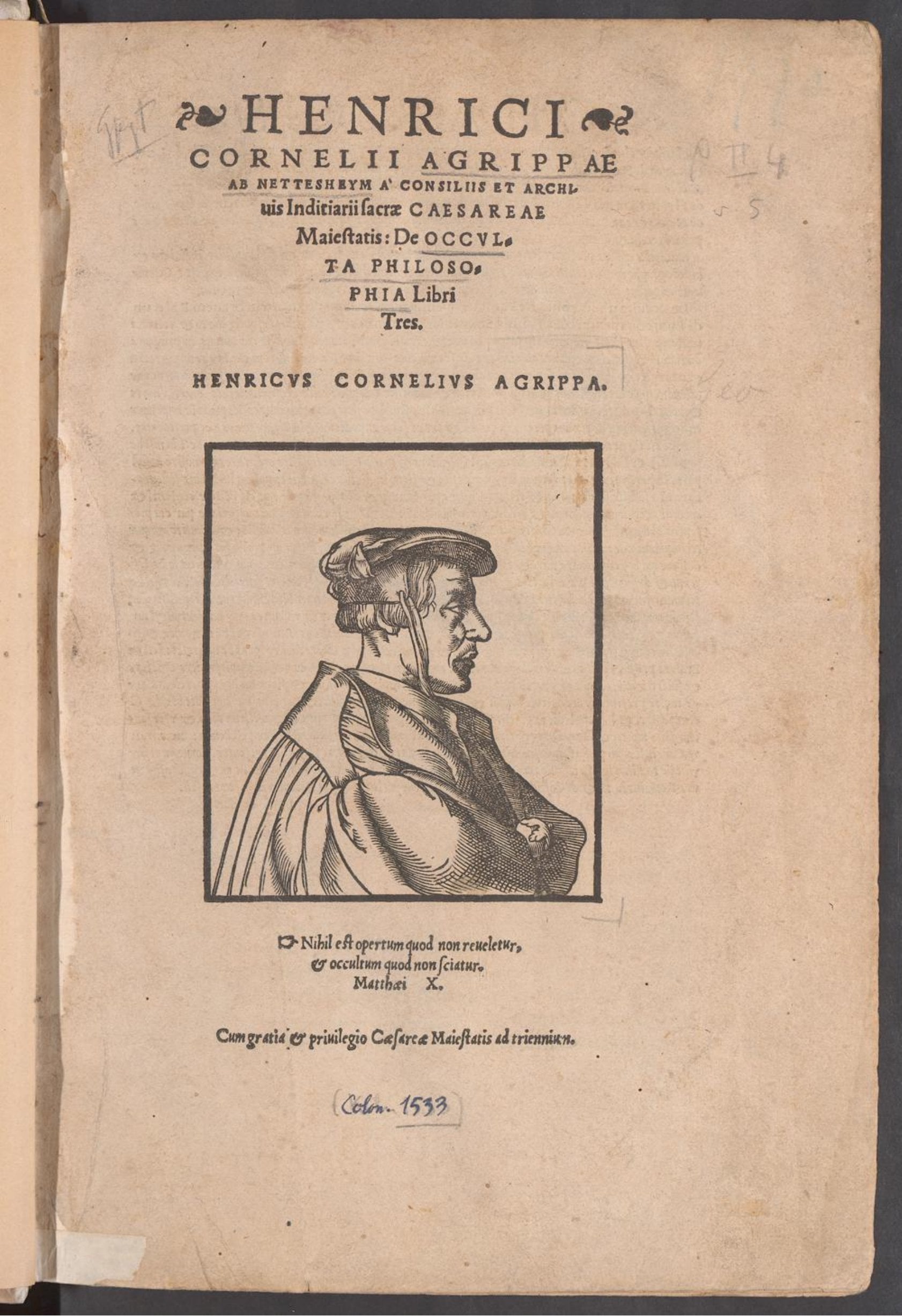
Rönesans döneminin en cüretkâr eserlerinden biri olan Okült Felsefe Üzerine Üç Kitap, doğanın gizli erdemlerini üç dünyanın (unsurlar, gökler ve akli tözler) uyumu içinde okur. Aşağıdaki bölüm, Birinci Kitap'ın açılışını —büyünün ne olduğu, büyücünün hangi üç bilimde (doğa felsefesi, matematik, ilahiyat) yetkin olması gerektiği— ve ardından dört unsurun (ateş, toprak, su, hava) niteliklerini, karışımlarını, üçlü mertebesini ve göklerden meleklere, hatta Tanrı'ya dek nasıl yankılandığını anlatan sekiz bölümü (I-VIII) bütünüyle kapsar. Agrippa burada toprağı, üzerinde durup geçtiğimiz cansız bir zemin olarak değil, bütün tohumların ve dişil erdemlerin gizli barındığı, göksel güçlerle gebe kalıp her şeyi kendinden doğuran ilk madde ve kadim ana olarak tarif eder. Doğal büyünün özündeki kavrayış tam da budur: en aşağı görünenin, arındırıldığında en yüce sırları taşıdığı.
Bölüm I — Büyücüler Erdemleri Üçlü Dünyadan Nasıl Devşirir, Bu Üç Kitapta Anlatılmaktadır
Üçlü bir dünya bulunduğuna göre —Unsurlar dünyası, Gökler dünyası ve Akli dünya— ve her aşağı olan kendinden üstün olan tarafından yönetilip onun erdeminin etkisini aldığına göre, her şeyin aslı ve baş işçisi olan da Melekler, Gökler, Yıldızlar, Unsurlar, Hayvanlar, Bitkiler, Madenler ve Taşlar aracılığıyla, kendileri için yarattığı ve var ettiği bizlere, kendi Kadir-i Mutlaklığının erdemlerini ulaştırır. Bilge kişiler, aynı basamaklardan geçerek bizim de her dünyadan yükselip bütün şeylerin Yapıcısı, İlk Neden olan o asıl Dünyaya —her şeyin kendisinden gelip kendisine döndüğü kaynağa— erişebilmemizin hiç de akıl dışı olmadığını düşünürler; öyle ki yalnızca daha yüce şeylerde zaten bulunan erdemlerden yararlanmakla kalmayıp, bunlara ek olarak yukarıdan yeni erdemler de devşirebiliriz. İşte bu yüzden insanlar Unsurlar dünyasının erdemlerini Tıp'ın ve Doğa Felsefesi'nin yardımıyla, doğal şeylerin çeşitli karışımlarında ararlar; ardından Gökler dünyasının erdemlerini, Astrologların kurallarına ve Matematikçilerin öğretilerine göre ışınlarında ve etkilerinde arayıp bunları öncekinin göksel erdemleriyle birleştirirler. Dahası bütün bunları, dinlerin kutsal Törenleri aracılığıyla çeşitli Akılların güçleriyle onaylar ve pekiştirirler. Bu üç kitapta bütün bunların düzenini ve işleyişini ortaya koymaya çalışacağım: birincisi doğal Büyüyü, ikincisi göksel Büyüyü, üçüncüsü törensel Büyüyü içerecektir. Ne var ki bu denli az yargı ve öğrenime sahip bir kişinin, daha gençliğinde böylesine güç, çetin ve girift bir işe bu kadar cüretkârca girişmesinin bağışlanmaz bir küstahlık olup olmadığını bilemiyorum. Bu yüzden şimdiye dek söylediğim ve bundan sonra söyleyeceğim hiçbir şeye, Evrensel Kilise ve İmanlılar Cemaati onaylamadıkça, kimsenin —ne de kendimin— inanmasını istemem.
Bölüm II — Büyü Nedir, Kısımları Nelerdir, Onu İcra Edenler Nasıl Nitelikli Olmalıdır
Büyü, en gizli şeylerin en derin tefekkürünü, bunların doğasını, gücünü, niteliğini, cevherini ve erdemlerini içeren, aynı zamanda doğanın bütününe dair bilgiyi de kapsayan, en yüce sırlarla dolu şaşırtıcı bir erdem yetisidir; bize şeylerin kendi aralarındaki ayrılık ve uyumu öğretir; buradan da şeylerin erdemlerini birbirine ve kendilerine uygun aşağı öznelere uygulayarak, üstün bedenlerin güç ve erdemleriyle onları sıkı sıkıya birleştirip bağlayarak şaşırtıcı etkiler üretir. Bu, en kusursuz ve baş bilimdir; o kutsal ve yüce felsefe türüdür; nihayet bütün seçkin felsefenin en eksiksiz kemalidir. Çünkü bütün düzenleyici felsefe Doğal, Matematiksel ve İlahiyata ait olmak üzere üçe ayrılır: Doğal Felsefe dünyadaki şeylerin doğasını öğretir; onların nedenlerini, etkilerini, zamanlarını, yerlerini, biçimlerini, olaylarını, bütünlerini ve parçalarını araştırıp sorgular; ayrıca Unsurlar denen şeylerin sayısını ve doğasını, Ateşin, Toprağın, Havanın neyi doğurduğunu; Göklerin nereden başladığını; med-cezirin, gökkuşağının kaynağını; toplanıp kararan bulutların şimşek ve gök gürlemesi salmasının nedenini; geceleyin görülen alevlerin ve kuyrukluyıldızların nasıl oluştuğunu; toprağın nasıl şişip sarsıldığını; madenlerin ve altının tohumunun ne olduğunu, doğanın hazinesinde ne tür erdemlerin ve zenginliklerin saklı olduğunu öğretir. Doğa Felsefesi, doğanın gözlemcisi olarak bütün bunları, Vergilius'un dediği gibi, bize öğretir: her şeyin nereden aktığını, insanın ve hayvanın, ateşin, yağmurun ve karın nereden geldiğini; depremlerin nedenini; koca Okyanus'un kıyılarını neden aşıp yeniden çekildiğini; otların gücünü, hayvanların hırçınlığını, taşların çeşitlerini, sürüngenleri ve meyveleri öğretir. Matematiksel Felsefe ise bize doğal Bedenlerin üç boyuta yayılmış niceliğini bilmeyi, ayrıca Göksel Bedenlerin hareketini ve seyrini kavramayı öğretir: altın yıldızların neden bu denli hızla yürüdüğünü, Ay'ın yüzünü bazen nasıl örttüğünü, Güneş'in de sanki bir utanç içindeymiş gibi nasıl kararttığını. Vergilius'un söylediği gibi, Güneş'in on iki Zodyak burcuyla nasıl hükmettiğini, çizgilerle ölçülen Göğü, gökyüzünün yıldızlı yolunu ve Güneş ile Ay'ın tuhaf tutulmalarını da bildirir. Arktürüs'ü, yağmur yıldızlarını, Ülker'i ve Büyük Ayı'yı da; Kış güneşlerinin neden bu denli hızla Batı'ya yöneldiğini, gecelerin neden bu denli uzadığını da Matematiksel Felsefe aracılığıyla anlarız. Yine gökler sayesinde bütün mevsimleri, ekip biçme zamanlarını, denize açılma vaktini, savaşma ve barış içinde dinlenme zamanını, ağaçları söküp yeniden dikme zamanını önceden bilebiliriz ki bol ürün versinler. İlahiyat Felsefesi ya da Tanrıbilim ise Tanrı'nın ne olduğunu, Aklın, bir Zekânın, bir Meleğin, bir Şeytanın, Ruhun, dinin, kutsal kurumların, Ayinlerin, Tapınakların, Törenlerin ve kutsal Sırların ne olduğunu öğretir; ayrıca bize İman'ı, Mucizeleri, Sözlerin ve Şekillerin erdemlerini, Mühürlerin gizli işleyişini ve sırlarını öğretir; Apuleius'un dediği gibi, Törensel Yasaları, kutsal şeylerin denkliğini ve dinlerin kuralını doğru anlamayı ve bunlara vâkıf olmayı da öğretir. Büyü işte bu üç temel yetiyi kapsar, birleştirir ve etkin kılar; bu yüzden Kadimler tarafından haklı olarak en yüce ve en kutsal Felsefe sayılmıştır. Bildiğimiz kadarıyla, en bilge yazarlar ve en ünlü müellifler tarafından ortaya konmuştur; bunlar arasında özellikle Zamolksis ile Zerdüşt öyle ünlüydüler ki birçokları onları bu bilimin mucidi sandı. Onların izinden Hiperborealı Abaris, Kharmondas, Damigeron, Eudoksos, Hermippos gitti; ayrıca Hermes Trismegistos, Porphyrios, İamblikhos, Plotinos, Proklos, Dardanos, Trakyalı Orpheus, Yunanlı Gog, Babilli Germa, Tyanalı Apollonios gibi seçkin kişiler ve Osthanes de bu sanat üzerine mükemmel eserler yazdı; kitapları neredeyse kaybolduğunda Abdera'lı Demokritos onları kendi yorumlarıyla yeniden derledi. Bunlara ek olarak Pythagoras, Empedokles, Demokritos, Platon ve daha nice ünlü Filozof bu sanatı öğrenmek için denizler aşarak uzaklara gitti; döndüklerinde onu büyük bir sır sayarak şaşırtıcı bir bağlılıkla öğrettiler. Pythagoras ile Platon'un Memphis Kâhinlerine gitmek için Suriye, Mısır, Yahudiye ve Kaldelilerin Okullarının hemen hepsinden geçtikleri, böylece Büyünün en kutsal Belgelerinden habersiz kalmamaya ve İlahi şeylerle donanmaya çalıştıkları da bilinir. Bu yüzden bu Yetiyi öğrenmek isteyen kişi, eğer şeylerin niteliklerinin açığa çıktığı ve her Varlığın gizli özelliklerinin bulunduğu Doğa Felsefesinde usta değilse; eğer her şeyin yüce erdemi ve özelliğinin bağlı olduğu Matematik'te, Yıldızların Açı ve Şekillerinde becerikli değilse; eğer her şeyi dağıtan ve yöneten Maddesiz tözlerin açığa çıktığı İlahiyat'ta öğrenim görmemişse, Büyünün akla uygunluğunu anlayabilmesi olanaksızdır. Çünkü yalnız Büyüyle yapılan hiçbir iş, yalnız Büyüsel hiçbir eser yoktur ki bu üç Yetiyi birden içermesin.
Bölüm III — Dört Unsur Üzerine, Onların Nitelikleri ve Karşılıklı Karışımları Üzerine
Cismani şeylerin dört Unsuru ve asıl temelleri vardır: Ateş, Toprak, Su, Hava; bütün unsurlanmış aşağı bedenler bunlardan bileşiktir — üst üste yığılarak değil, dönüşüm ve birleşme yoluyla; yıkıldıklarında da yine Unsurlara ayrışırlar. Zira duyulur Unsurların hiçbiri saf değildir; hepsi az ya da çok karışmıştır ve birbirine dönüşmeye elverişlidir. Toprak çamurlaşıp çözündüğünde Suya döner; aynı Su koyulaşıp sertleştiğinde yeniden Toprak olur; ısıyla buharlaştığında ise Havaya geçer, Hava tutuştuğunda Ateşe dönüşür, Ateş söndüğünde yeniden Havaya döner, ama yanmasının ardından soğuduğunda Toprak, Taş ya da Kükürt olur; bu da Şimşekte açıkça görülür. Platon da Toprağın büsbütün değişebilir olduğu, öbür Unsurların ise hem buna hem birbirlerine ardışık olarak dönüştüğü kanısındaydı. Daha ince düşünen Filozofların görüşü ise Toprağın değişmediği, ama onu çözen öbür Unsurlarla yumuşayıp karıştığı, sonra yine kendisine döndüğüdür. Her Unsurun iki özgül niteliği vardır: birincisini kendine özgü olarak taşır, ikincisiyle ise bir ara nitelik olarak kendisinden sonra gelen Unsurla uyuşur. Zira Ateş sıcak ve kurudur, Toprak kuru ve soğuktur, Su soğuk ve nemlidir, Hava nemli ve sıcaktır. Bu yüzden Unsurlar, iki karşıt niteliğe göre birbirine karşıttır: Ateş Suya, Toprak da Havaya. Ayrıca Unsurlar başka bir bakımdan da birbirine karşıttır: kimi ağırdır, Toprak ve Su gibi; kimi hafiftir, Hava ve Ateş gibi. Bu yüzden Stoacılar öncekilere edilgen, sonrakilere ise etkin adını vermiştir. Platon ise onları başka bir biçimde ayırmış, her birine üç nitelik yakıştırmıştır: Ateşe parlaklık, incelik ve hareket; Toprağa ise karanlık, kalınlık ve durgunluk. Bu niteliklere göre Ateş ile Toprak Unsurları birbirine karşıttır. Öbür Unsurlar ise niteliklerini bunlardan ödünç alır: Hava, Ateşten iki nitelik —incelik ve hareket— Topraktan da bir nitelik —karanlık— devralır. Aynı şekilde Su, Topraktan iki nitelik —karanlık ve kalınlık— Ateşten de bir nitelik —hareket— devralır. Ne var ki Ateş, Havadan iki kat daha ince, üç kat daha hareketli, dört kat daha parlaktır; Hava da Sudan iki kat daha parlak, üç kat daha ince, dört kat daha hareketlidir. Bu yüzden Su, Topraktan iki kat daha parlak, üç kat daha ince, dört kat daha hareketlidir. Böylece Ateş Havaya nasılsa, Hava da Suya öyledir, Su da Toprağa öyledir; yine Toprak Suya nasılsa, Su da Havaya öyledir, Hava da Ateşe öyledir. İşte bütün bedenlerin, doğaların, erdemlerin ve şaşırtıcı işlerin kökü ve temeli budur; Unsurların bu niteliklerini ve karışımlarını bilen kişi, şaşırtıcı ve hayret verici şeyleri kolaylıkla başarır ve Büyüde kemale erer.
Bölüm IV — Unsurların Üçlü Değerlendirilişi Üzerine
Söylediğimiz gibi dört Unsur vardır; bunların kusursuz bilgisi olmaksızın Büyüde hiçbir şey başaramayız. Her biri üçlüdür, öyle ki dördün sayısı on ikiyi tamamlasın; yedi sayısından ona geçilerek, bütün erdem ve şaşırtıcı işleyişin dayandığı yüce Birliğe doğru bir ilerleyiş olsun. Birinci Düzenin Unsurları saf olanlardır; ne bileşiktir ne değişkendir, karışıma da izin vermezler; yozlaşmazlar ve bütün doğal şeylerin erdemlerinin kendilerinden değil ama kendileri aracılığıyla eyleme geçtiği Unsurlardır. Onların erdemlerini hiç kimse tam olarak anlatamaz, çünkü her şey üzerinde her şeyi yapabilirler. Bunları bilmeyen kişi hiçbir zaman şaşırtıcı bir işi başaramaz. İkinci Düzenin Unsurları bileşik, değişken ve saf olmayanlardır, ama sanat yoluyla yeniden saf yalınlığına indirgenebilirler; bu yalınlığa indirgendiklerinde erdemleri, doğanın bütün gizli ve olağan işlemlerini her şeyden üstün biçimde kusursuzlaştırır; bunlar bütün doğal Büyünün temelidir. Üçüncü Düzenin Unsurları ise özleri gereği Unsur olmayan, ama iki kez bileşik, çok yönlü ve birbirine dönüşebilen unsurlardır. Bunlar aldanmaz Vasıta'dır, bu yüzden orta doğa ya da orta doğanın Ruhu diye adlandırılır; derin sırlarını anlayan pek azdır. Onların içinde, belirli sayılar, derecelerle düzenler aracılığıyla, ister Doğal, ister Göksel, ister Göküstü olsun, her şeyin etkisinin kemali bulunur; şaşkınlık ve sırlarla doludurlar, hem doğal hem İlahi Büyüde etkindirler: çünkü bunlardan, bunlar aracılığıyla, her şeyin bağlanması, çözülmesi, dönüştürülmesi, gelecek şeylerin bilinip önceden haber verilmesi, kötü ruhların kovulup iyi ruhların kazanılması meydana gelir. Bu üç Unsur türünü ve bunların bilgisini edinmeden hiç kimse Büyünün ve Doğanın gizli Bilimlerinde bir şey başarabileceğinden emin olmasın. Ama bir Düzenin Unsurlarını başka bir Düzene, saf olmayanı saf olana, bileşiği yalına nasıl indirgeyeceğini bilen, cevheri bölmeksizin onların doğasını, erdemini ve gücünü sayı, derece ve düzen içinde ayrı ayrı kavrayabilen kişi, bütün Doğal şeylerin ve Göksel sırların bilgisine ve kusursuz işleyişine kolaylıkla erişir.
Bölüm V — Ateş ile Toprağın Şaşırtıcı Doğaları Üzerine
Hermes'e göre iki şey vardır —Ateş ve Toprak— ki bütün şaşırtıcı işlerin gerçekleşmesi için yeterlidir: önceki etkindir, sonraki edilgen. Dionysios'un dediği gibi Ateş, her şeyde ve her şey aracılığıyla parlayarak gelir ve gider; her şeyde parlaktır, ama aynı zamanda gizli ve bilinmezdir. Kendi başına olduğunda —kendi eylemini gösterebileceği başka bir madde ona ulaşmadığında— sınırsız ve görünmezdir, kendine özgü her eylem için kendinde yeterlidir; hareketlidir, kendisine yaklaşan her şeye bir bakıma boyun eğer; yeniler, doğayı korur, aydınlatır, örtük ışıklarla kavranmaz; berrak, ayrışan, geri sıçrayan, yukarı doğru eğilen, hareketi çabuk, yüce, sürekli hareket doğuran, bir başkasını kavrayan ama kendisi kavranmayan, başka bir şeye muhtaç olmayan, kendiliğinden gizlice artan, büyüklüğünü kendisini alanlara gösteren; etkin, güçlü, bütün şeylerde aynı anda görünmez biçimde hazır bulunan; karşı konulmasına ya da meydan okunmasına izin vermez, tersine bir öç alma edasıyla şeyleri ansızın kendisine boyun eğdirir; kavranamaz, dokunulamaz, eksilmez, kendi dağıtımlarının tümünde en zengin olandır. Plinius'un dediği gibi Ateş, doğa şeylerinin sınırsız ve zararlı bir parçasıdır; en çok şeyi mi yok ettiği yoksa en çok şeyi mi ürettiği bile kuşkuludur. Pythagorasçıların dediği gibi Ateş özde bir tektir ve her şeyin içinden geçer; Göklerde yayılır ve parlar, ama yeraltı yerinde sıkışmış, karanlık ve işkence edicidir; ortada olan ise her ikisinden de pay alır. Kikero'da tanık olduğumuz gibi Kleanthes'in dediğince Ateş kendinde birdir, ama kendisini alan şeyde çok biçimlidir ve değişik konularda değişik biçimde dağılır. Bizim kullandığımız Ateş de başka şeylerden çıkarılır: taşların içindedir ve çelik darbesiyle çıkarılır; Toprağın içindedir ve kazıldığında onu tüttürür; Suyun içindedir ve kaynakları, kuyuları ısıtır; denizin derinliğindedir ve rüzgârla çalkalandığında onu ılıklaştırır; Havanın içindedir ve sık sık gördüğümüz gibi onu tutuşturur. Bütün Hayvanlar ve yaşayan şeyler, keza bütün Bitkiler de sıcaklıkla korunur; yaşayan her şey, içine kapanmış ısı sayesinde yaşar. Yukarıdaki Ateşin özellikleri, her şeyi bereketli kılan sıcaklık ve her şeye can veren ışıktır. Yeraltı Ateşinin özellikleri ise her şeyi tüketen kavurucu bir ısı ve her şeyi kısır bırakan karanlıktır. Göksel ve parlak Ateş karanlığın ruhlarını kovar; Odunla yaktığımız bu ateşimiz de aynısını yapar, çünkü o Yüce ışığın aracı olan bir benzeşimi taşır; “Ben Dünyanın Işığıyım” diyenin de, bütün iyi şeylerin kendisinden geldiği Işıkların Babası'nın da ışığını taşır; O ışığını önce Güneş'e, sonra öbür Göksel bedenlere gönderir, onlar da aracı araçlar olarak bu ışığı bizim Ateşimize taşır. Karanlığın ruhları karanlıkta nasıl güçleniyorsa, Işık Melekleri olan iyi ruhlar da yalnız İlahi ve Göksel Güneş ışığıyla değil, bizim sıradan Ateşimizin ışığıyla da güçlenir. Bu yüzdendir ki dinlerin ve Törenlerin ilk ve en bilge kurucuları, Duaların, İlahilerin ve her türlü İlahi Tapınmanın yanan Mumlar ya da Meşaleler olmadan yapılmamasını buyurmuşlardır (bu yüzden Pythagoras'ın “Tanrı'dan Işık olmadan söz etme” şeklindeki anlamlı sözü de vardır) ve kötü ruhları kovmak için, ölülerin naaşları yanında Işıkların ve Ateşlerin yakılmasını, kefaret törenleri kutsal biçimde tamamlanıp gömülünceye dek bunların söndürülmemesini emretmişlerdir. Yüce Yehova'nın kendisi de eski Yasada bütün Kurbanlarının Ateşle sunulmasını, Sunağın üzerinde Ateşin sürekli yanmasını buyurmuştur; Romalılar arasında Sunak Rahipleri de bu geleneği hep sürdürmüştür. Bütün Unsurların Temeli ve dayanağı ise Topraktır; çünkü o, bütün Göksel ışınların ve etkilerin nesnesi, öznesi ve alıcı kabıdır; onda bütün şeylerin tohumları ve Tohumsal erdemleri saklıdır; bu yüzden onun Hayvansal, Bitkisel ve Madensel olduğu söylenir. Öbür Unsurlarca ve Göklerce bereketlendirilen o, her şeyi kendisinden doğurur; her şeyin bolluğunu alır ve sanki her şeyin kaynadığı ilk pınar gibidir; her şeyin merkezi, temeli ve anasıdır. Ondan gizli, yıkanmış, arınmış, inceltilmiş olan neyi alırsanız alın; onu bir süre açık gök altında bırakırsanız, kısa süre sonra bereketlenip göksel güçlerle gebe kalarak kendisinden bitkiler çıkaracak, kurtlar ve öbür canlıları doğuracak, ayrıca taşlar ve madenlerin parlak kıvılcımlarını meydana getirecektir. Onda büyük sırlar vardır, eğer bir gün Ateşin yardımıyla arındırılır ve uygun bir yıkamayla yalınlığına döndürülürse. O, yaratılışımızın ilk maddesidir ve bizi onaracak, koruyacak en gerçek devadır.
Bölüm VI — Su, Hava ve Rüzgârların Şaşırtıcı Doğaları Üzerine
Öbür iki Unsur, yani Su ile Hava, öncekilerden daha az etkili değildir; doğa onlarda da şaşırtıcı işler yapmaktan geri durmaz. Suya öyle büyük bir gereksinim vardır ki onsuz hiçbir canlı yaşayamaz. Hiçbir Ot, hiçbir Bitki, Suyun nemlendirmesi olmadan dal budak salamaz. Onda bütün şeylerin, özellikle de tohumu belirgin biçimde sulu olan Hayvanların Tohumsal erdemi vardır. Ağaçların ve Bitkilerin tohumları da, toprak olsalar bile, verimli olabilmek için zorunlu olarak Suda çürütülmelidir; ister Toprağın nemiyle, ister Çiy ya da Yağmurla, ister özellikle bu amaçla verilen başka bir Suyla olsun. Musa da yalnız Toprak ile Suyun canlı bir ruh doğurduğunu yazar. Ne var ki Suya çift bir doğurganlık yükler: sularda yüzenlerin doğurganlığı ve Toprak üstünde, Havada uçanların doğurganlığı. Toprak üstünde ve içinde gerçekleşen bu doğumların bir kısmının da bizzat Suya bağlandığını aynı Kutsal Yazı doğrular; Tanrı Toprağa yağmur yağdırmadığı için Bitkilerin ve Otların büyümediğini söylediği yerde. Su Unsurunun etkisi öylesine büyüktür ki Mesih'in Nikodemus'a bildirdiği gibi, Ruhsal yeniden doğuş onsuz gerçekleşemez. Tanrı'ya yönelik dinsel Tapınmada, kefaret ve arınma törenlerinde de erdemi çok büyüktür; gerekliliği Ateşinkinden aşağı kalmaz. Yararları sonsuz, kullanımları çeşitlidir, çünkü bütün şeyler onun erdemiyle var olur, doğar, beslenir ve büyür. Bu yüzden Milet'li Thales ile Hesiodos, Suyun her şeyin başlangıcı olduğu, Unsurların ilki ve en güçlüsü olduğu sonucuna varmışlardır; çünkü öbür bütün Unsurlar üzerinde egemenlik kurar. Plinius'un dediği gibi Sular Toprağı yutar, alevleri söndürür, yükseklere ağar, bulutları yayarak Göğü kendine mal eder; aynı Sular yeryüzüne düştüğünde ise Toprakta yetişen her şeyin nedeni olur. Plinius'un, Solinus'un ve daha nice Tarihçinin yazdığına göre Sularca gerçekleştirilen sayısız harika vardır; Ovidius da bu şaşırtıcı erdemden dizelerinde söz eder: boynuzlu Hammon'un suları öğle vakti soğuk, gün doğumu ve batımında sıcaktır; Athemas'ın kaynayan sularında, Ay Güneş'ten en uzakta olduğunda odun bile tutuşur; Kirkeon akıntıları içenin bağırsaklarını, içine düşürülen her şeyi taşa çevirir; dağlardan yuvarlanan Krathis ile Sybaris saçları kehribar ya da som altın rengine boyar; kimi pınarlar bedeni değil, aklı bile değiştirir. Kim duymamıştır o utanç verici Salmakis'i? Ya da Habeş gölünü, ondan tadan kimsenin aklını yitirdiğini ya da derin bir uykuya daldığını? Klitorios pınarından susuzluğunu gideren kişi Şaraptan tiksinir, yalnız Su sever. Bunların tam tersine Linkestus akıntıları, çok içenleri sarhoş gibi sendeletir. Güzel Arkadya'da eski adı Pheneus olan, iki türlü olduğundan kuşku duyulan bir Göl vardır; geceleri ondan içmekten sakınılır çünkü gece zararlı, gündüz şifalıdır. Josephus da Suriye şehirleri Arkea ile Raphanea arasındaki bir ırmağın şaşırtıcı doğasından söz eder: Sebt günü dolu bir yatakla akar, sonra ansızın durur, sanki kaynaklar tıkanmış gibi, altı gün boyunca kuru ayakla geçilebilir; ama yedinci gün —bunun nedenini kimse bilmez— sular yeniden eskisi gibi bol bol geri döner. Bu yüzden çevredeki halk, Yahudiler için kutsal olan Yedinci güne atfen bu ırmağa Sebt-günü ırmağı demiştir. İncil de bir koyun havuzundan söz eder; Melek tarafından Suyu karıştırıldıktan sonra oraya ilk giren kişi, hangi hastalığa yakalanmış olursa olsun şifa bulurdu. Aynı erdem ve etkiyi, Elis kentine bağlı topraklarda, Kitheron ırmağı yakınındaki Herakleia köyünde bulunan İyonya Perilerinin pınarında da okuruz: kim hasta haldeyken oraya girerse, bütün hastalıklarından arınmış olarak çıkardı. Pausanias da, Arkadya'nın bir dağı olan Lykeos'ta, kuraklık ürünlerin yok olmasını tehdit ettiğinde Lykeoslu Jüpiter'in Rahibinin gidip Kurban sunduktan sonra elinde bir Meşe Dalı tutarak dindarca dua ettiği ve kutsal Pınarın dibine daldırdığı Agria adlı bir pınardan söz eder; ardından sular karıştırılır, oradan yükselen bir buhar Havaya karışıp Bulutlara dönüşür, bunlar birleştiğinde bütün Gök kaplanır; kısa süre sonra da yağmura dönüşerek bütün ülkeyi bolca sular. Efes'li hekim Ruffus da, başka nice yazarın yanı sıra, bildiğim kadarıyla başka hiçbir yazarda bulunmayan, Suların harikaları üzerine şaşırtıcı şeyler yazmıştır.
Şimdi sıra Havaya geldi. Bu, bütün Varlıkların içinden geçen, her şeye yaşam ve varlık veren, her şeyi bağlayan, harekete geçiren ve dolduran hayat verici bir ruhtur. Bu yüzden İbrani Bilginleri onu Unsurlar arasında saymaz, şeyleri birbirine bağlayan bir Vasıta ya da tutkal, dünyanın çalgısının yankılanan ruhu olarak görürler. Bütün Göksel bedenlerin etkilerini dolaysızca kendi içine alır, sonra bunları öbür Unsurlara, hatta bütün karışık bedenlere iletir. Ayrıca sanki İlahi bir Ayna gibi, hem doğal hem yapay bütün şeylerin, her türlü sözün görüntülerini kendi içine alır ve saklar; bunları yanında taşıyarak, İnsanların ve öbür Hayvanların bedenlerine gözeneklerinden girip, hem uyurlarken hem uyanıkken üzerlerinde bir iz bırakır, çeşit çeşit garip Düşlere ve Kehanetlere malzeme sağlar. Bu yüzden bir insanın, öldürülmüş birinin ya da yeni gizlenmiş bir Cesedin bulunduğu yerden geçerken korku ve dehşete kapıldığı söylenir; çünkü o yerin Havası, Cinayetin ürkütücü görüntüleriyle doludur ve nefes alındığında insanın ruhunu benzer görüntülerle rahatsız eder, bu yüzden de korkuya kapılır. Zira ansızın iz bırakan her şey doğayı şaşkına çevirir. Bu yüzden nice Filozof, Havanın düşlerin ve zihnin daha nice izleniminin nedeni olduğu görüşündedir; şeylerden ve sözlerden dökülen, Havada çoğalan İmgeler ya da benzerlikler ya da görüntüler duyulara, sonra hayal gücüne ve alıcının ruhuna ulaşana dek; kaygılardan kurtulmuş, hiçbir engelle karşılaşmamış ruh, tam da bu tür görüntülerle karşılaşmayı bekleyerek onlardan bilgilenir. Zira şeylerin görüntüleri, kendi doğaları gereği genellikle insanların ve öbür hayvanların duyularına taşınsa da, Havada bulundukları sürece Gökten de bir izlenim alabilir; bu izlenim, alıcının uygunluk ve eğilimiyle birleşince, birinin duyusuna ötekinden daha kolay taşınabilir. İşte bu yüzden, hiçbir başka ruh araya girmeksizin, hiçbir batıl inanca dayanmadan, bir insanın çok uzak ve bilinmeyen bir mesafede bulunan başka bir insana aklından geçeni doğal yollarla bildirebilmesi olanaklıdır; kesin olarak ne zaman gerçekleşeceğini kestiremese de, zorunlu olarak 24 saat içinde olur; bunu ben kendim nasıl yapacağımı bilirim ve sık sık yaptım. Geçmişte Trithemius Başrahibi de aynı şeyi hem bilir hem yapardı. Ayrıca yalnız ruhsal değil doğal bazı görünümler de şeylerden akıp çıkar —bir bakıma bedenlerden bedenlere doğru bir akış biçiminde— Havada güç kazanınca, ışıkla da hareketle de kendilerini bize gösterir, görme duyusuna da öbür duyulara da; kimi zaman Plotinos'un gösterip öğrettiği gibi üzerimizde şaşırtıcı işler yapar. Güney rüzgârıyla Havanın nasıl ince bulutlar biçiminde yoğunlaştığını, bunların bir Ayna gibi uzaktaki Kaleleri, Dağları, Atları ve İnsanları, öbür şeyleri nasıl yansıttığını, bulutlar dağıldığında bu yansımaların hemen kaybolduğunu görürüz. Aristoteles Meteorolojisinde, Gökkuşağının bir Ayna gibi Havanın bir bulutunda oluştuğunu gösterir. Albertus da bedenlerin görüntülerinin, nemli Havada, doğanın gücüyle, şeylerdeki temsillerle aynı biçimde kolaylıkla temsil edilebileceğini söyler. Aristoteles, görüşünün zayıflığı yüzünden yakınındaki Havanın kendisi için bir Ayna haline geldiği, görme ışınının kendi üzerine geri yansıdığı ve Havayı geçemediği için nereye giderse gitsin kendi görüntüsünü, yüzü kendisine dönük biçimde önünde giderken gördüğünü sanan bir adamdan söz eder. Aynı biçimde, bazı Aynaların yapaylığıyla, Aynaların ötesinde, Havada uzaktan istediğimiz görüntüler üretilebilir; bilgisiz insanlar bunu gördüğünde ruhların ya da hayaletlerin görüntülerini gördüklerini sanır; oysa bunlar kendilerine benzer, cansız görünümlerden başka bir şey değildir. Işığın yalnızca küçük bir delikten içeri sızdığı karanlık bir yerde, o ışığa karşı beyaz bir kâğıt ya da düz bir Ayna konursa, dışarıda olup biten her şeyin, Güneşin aydınlattığı biçimiyle bu kâğıt ya da aynada görülebileceği de iyi bilinir. Daha da şaşırtıcı bir başka hüner de şudur: birisi sanatla resmedilmiş görüntüleri ya da yazılmış harfleri alıp berrak bir gecede dolunayın ışınlarına karşı tutarsa, Havada çoğalan ve yukarı taşınan, Ay ışınlarıyla birlikte geri yansıyan benzerlikleri, işten haberdar başka biri çok uzak bir mesafeden Ay'ın çemberinde görebilir, okuyabilir, anlayabilir; sırların bu şekilde bildirilmesi kuşatma altındaki Kentler ve Şehirler için çok yararlıdır; Pythagoras'ın çoktan sık sık yaptığı, günümüzde de bazılarınca —kendimi de bundan ayrı tutmayacağım— bilinmeyen bir şey değildir. Bütün bunlar, hatta bunlardan daha büyükleri, Havanın kendi doğasına dayanır, nedenleri ve gerekçeleri Matematik ile Optik'te açıklanır. Bu benzerlikler görme duyusuna nasıl geri yansıyorsa, kimi zaman işitme duyusuna da yansır, Yankıda görüldüğü gibi. Ama bunlardan daha gizli sanatlar da vardır; öyle ki biri, çok uzak bir mesafede başka birinin söylediğini ya da alçak sesle fısıldadığını duyup anlayabilir.
Havasal Unsurdan Rüzgârlar da doğar. Zira bunlar Havanın harekete geçirilip kımıldatılmasından başka bir şey değildir. Bunların dördü başlıcadır, Göğün dört köşesinden eser: Güneyden Notus, Kuzeyden Boreas, Batıdan Zephyrus, Doğudan Eurus; Pontanus bunları şu dizelerde toplar: soğuk Boreas Olympos'un tepesinden eser, bulutlu Notus da dipten akar; verimli Zephyrus batan Phoebus'tan uçar, kısır Eurus da Güneşin doğuşundan gelir. Notus, bulutlu, nemli, sıcak ve hastalık verici Güney rüzgârıdır; Hieronimus onu yağmurların sakisi diye adlandırır. Ovidius onu şöyle betimler: Güney rüzgârı damlayan kanatlarıyla dışarı uçar, korkulu yüzünü zift renkli bulutlarda gizler, beyaz saçları akar, sakalı yağmurla şişmiştir, sisler alnını bağlar, göğsünden yağmur boşalır. Boreas ise Notus'un tersine, Kuzey rüzgârıdır; sert ve gürleyicidir, bulutları dağıtarak Havayı durultur, Suyu Ayazla bağlar. Ovidius onun kendisiyle ilgili şu sözlerini aktarır: bana güç yakışır, bu koyu bulutla sürüklerim; mavi dalgaları savurur, düğümlü meşeleri sökerim; yumuşak karı dondurur, toprağı doluyla döverim; Havada kardeşlerime saldırdığımda —çünkü bizim alanımız odur— öyle bir çarpışmayla karşılaşırız ki gürleyen Gökler karşılaşmalarımızla sarsılır; bulut çarpması sonucu şimşek yükseklerden çakar; Toprağın yarıklarından geçerken onu oyuk mağaralarında zorlarım, Hayaletleri titretir, yeri sarsarım. Batıdan hoş bir esintiyle esen Zephyrus ise en yumuşak rüzgârdır; soğuk ve nemlidir, Kışın etkilerini giderir, Dalları ve Çiçekleri meydana getirir. Bunun tersi olan Eurus, Doğu rüzgârıdır ve Apeliotes diye anılır; sulu, bulutlu ve yağmacıdır. Ovidius bu ikisi için şöyle söyler: Eurus Persis ile Sabea'ya uçar, tütsüleri kızaran Şafağı kokutur; Akşama ve batan Phoebus'un parladığı kıyıya doğru çiçekli Zephyrus eser; korkunç Boreas İskitya'da, Kutup Yıldızının ve donmuş Araba'nın altında hüküm sürer; buna karşı olan toprağı ise Auster, verimli sağanaklar ve sürekli ağlayan bulutlarla ıslatır.
Bölüm VII — Bileşiklerin Türleri Üzerine, Bunların Unsurlarla İlişkisi ve Unsurların Kendi Aralarında İnsanın Ruhu, Duyuları ve Mizacıyla İlişkisi Üzerine
Dört yalın Unsurun ardından, onlardan bileşik kusursuz dört Beden türü gelir: Taşlar, Madenler, Bitkiler ve Hayvanlar. Her birinin oluşumunda bileşimde bütün Unsurlar bir araya gelse de, her biri en baskın olan Unsuru izler ve ona benzer. Bütün Taşlar Topraksaldır, çünkü doğaları gereği ağırdır ve aşağı iner, kuruluk yüzünden öyle sertleşmiştir ki eritilemezler. Madenler ise Sulsudur ve eritilebilirler; Doğa Bilimcileri bunu kabul eder, Simyacılar da yapışkan bir Sudan ya da sulu civadan oluştuklarını doğru bulur. Bitkilerin Havayla öyle bir yakınlığı vardır ki açık Havada olmadıkça ne sürer ne çoğalırlar. Bütün Hayvanlar da doğalarında en ateşli bir güç taşır, Göksel bir kaynaktan doğarlar; Ateş onlara öylesine doğaldır ki o söndüğünde hemen ölürler. Yine her tür kendi içinde Unsurların dereceleri bakımından ayrılır. Taşlar arasında koyu renkli ve daha ağır olanlar özellikle Topraksal diye adlandırılır; saydam olup Sudan oluşanlar, örneğin Billur, Beril ve balık kabuklarındaki İnciler Sulsu diye adlandırılır; Su üzerinde yüzen ve Sünger Taşları, Ponza Taşı ve Sophus Taşı gibi süngerimsi olanlar Havasal diye adlandırılır; içinden Ateş çıkarılan ya da Ateşe dönüşen ya da Ateşten üretilenler, Yıldırım Taşları, Çakmak Taşları ve Amyant Taşı gibi, Ateşsel diye adlandırılır. Madenler arasında da Kurşun ve Gümüş Topraksaldır; Civa Sulsudur; Bakır ve Kalay Havasaldır; Altın ve Demir Ateşseldir. Bitkilerde de Kökler kalınlıkları yüzünden Toprağa, yapraklar özsuları yüzünden Suya, Çiçekler incelikleri yüzünden Havaya, Tohumlar çoğaltıcı ruhları yüzünden Ateşe benzer. Bunlara ek olarak kimileri sıcak, kimileri soğuk, kimileri nemli, kimileri kuru diye adlandırılır; adlarını Unsurların niteliklerinden ödünç alırlar. Hayvanlar arasında da bazıları başkalarına göre Topraksaldır ve Toprağın bağrında yaşar, Kurtlar, Köstebekler ve nice küçük sürüngen Haşarat gibi; bazıları Sulsudur, Balıklar gibi; bazıları Havasaldır, Havanın dışında yaşayamaz; bazıları da Ateşseldir, Semenderler ve Cırcırböcekleri gibi Ateşte yaşar, ya da Güvercinler, Devekuşları, Aslanlar gibi ateşli bir sıcaklığa sahiptir; bilge kişinin Ateş soluyan hayvanlar dediği türler de böyledir. Hayvanlarda Kemikler Toprağa, Et Havaya, hayat ruhu Ateşe, hıltlar (humor) Suya benzer. Bu hıltlar da Unsurlardan pay alır: sarı safra Ateşin, kan Havanın, balgam Suyun, kara safra ya da melankoli de Toprağın yerini tutar. Nihayet, Augustinus'a göre, Ruhun kendisinde de anlayış Ateşe, akıl Havaya, hayal gücü Suya, duyular Toprağa benzer. Duyular da kendi aralarında Unsurlara göre ayrılır: görme Ateşseldir, Ateş ve Işık olmadan algılayamaz; işitme Havasaldır, çünkü ses Havanın çarpışmasıyla oluşur; koklama ve tatma Suya benzer, çünkü Suyun nemliliği olmadan ne koku ne tat vardır; en sonunda dokunma büsbütün Topraksaldır, nesnesi olarak kaba bedenleri alır. İnsanın eylemleri ve işleyişleri de Unsurlarca yönetilir. Toprak yavaş ve sağlam bir hareketi imler; Su korkaklığı, üşengeçliği ve işte gevşekliği imler; Hava neşeyi ve sevimli bir mizacı imler; Ateş ise sert, çabuk ve öfkeli bir mizacı imler. Unsurlar öyleyse her şeyin ilkidir, bütün şeyler onlardan ve onlara göredir; her şeyde bulunurlar ve erdemlerini her şeye yayarlar.
Bölüm VIII — Unsurların Göklerde, Yıldızlarda, Şeytanlarda, Meleklerde ve Nihayet Tanrı'nın Kendisinde Nasıl Bulunduğu Üzerine
Bütün Platoncuların ortak görüşüne göre, asıl ve örnek Dünyada her şey her şeyde bulunduğu gibi, bu cismani dünyada da her şey her şeydedir; öyleyse Unsurlar yalnız bu aşağı bedenlerde değil, Göklerde, Yıldızlarda, Şeytanlarda, Meleklerde ve nihayet her şeyin yapıcısı ve asıl örneği olan Tanrı'da da bulunur. Bu aşağı bedenlerde Unsurlara çok kaba madde eşlik eder; Göklerde ise Unsurlar kendi doğaları ve erdemleriyle, yani Göksel ve daha üstün bir biçimde bulunur, ay-altı şeylerdekinden farklı olarak. Zira Göksel Toprağın sağlamlığı orada Suyun kabalığından arınmıştır; Havanın çevikliği sınırlarını aşmadan bulunur; Ateşin sıcaklığı yakmadan, yalnızca parlayarak ve ısısıyla her şeye can vererek bulunur. Yıldızlar arasında da kimileri Ateşseldir, Mars ve Güneş gibi; kimileri Havasaldır, Jüpiter ve Venüs gibi; kimileri Sulsudur, Satürn ve Merkür gibi; kimileri Topraksaldır, sekizinci Küreyi ve —nicelerince Sulsu sayılsa da— Ay'ı meskun kılanlar gibi; çünkü Ay, sanki Toprakmış gibi, Göksel suları kendine çeker, onlarla emilmiş halde, bize yakınlığı yüzünden bunları bize aktarır ve iletir. Burçlar arasında da kimileri Ateşsel, kimileri Topraksal, kimileri Havasal, kimileri Sulsudur; Göklerde de Unsurlar onlara hükmeder, her Unsurun bu üçlü değerlendirilişini —başlangıcı, ortasını ve sonunu— onlara dağıtır: böylece Koç Ateşin başlangıcını, Aslan ilerleyişini ve artışını, Yay ise sonunu üstlenir. Boğa Toprağın başlangıcını, Başak ilerleyişini, Oğlak sonunu üstlenir. İkizler Havanın başlangıcını, Terazi ilerleyişini, Kova sonunu üstlenir. Yengeç Suyun başlangıcını, Akrep ortasını, Balık sonunu üstlenir. Bu Gezegenlerin ve Burçların Unsurlarla karışımından bütün bedenler oluşur. Dahası Şeytanlar da bu bakımdan birbirinden ayrılır, öyle ki kimileri Ateşsel, kimileri Topraksal, kimileri Havasal, kimileri de Sulsu diye adlandırılır. Bu yüzden dört Cehennem Irmağı da vardır: Ateşsel Phlegethon, Havasal Kokytos, Sulsu Styks, Topraksal Akheron. İncil'de de Cehennem Ateşinden, lanetlilerin gönderileceği sonsuz Ateşten okuruz; Vahiy'de bir Ateş Gölünden, Yeşaya'da ise Rab'bin lanetlileri bozuk bir Havayla vuracağından söz edilir. Eyüp'te, Kar sularından en aşırı sıcağa sıçrayacaklarını, yine aynı kitapta Toprağın karanlık, ölüm karanlığı ve sefil karanlıkla örtülü olduğunu okuruz. Ayrıca bu Unsurlar Göklerdeki Meleklerde ve kutsanmış Akıllarda da bulunur: onlarda özlerinin bir sağlamlığı vardır ki bu Topraksal bir erdemdir, Tanrı'nın sarsılmaz tahtı da bu erdemdedir; keza merhametleri ve dindarlıkları da arındırıcı Sulsu bir erdemdir. Bu yüzden Mezmurlar Yazarınca Sular diye adlandırılırlar, Gökleri anlatırken “Göklerin üstündeki Suları hükmeden Sensin” dediği yerde; onlarda incelikli soluk da Havadır, sevgileri de parlayan Ateştir. Bu yüzden Kutsal Yazıda Rüzgârın Kanatları diye anılırlar; başka bir yerde Mezmurlar Yazarı onlar için “Melekleri kendi Ruhların, hizmetkârlarını alev alev Ateş yapan” der. Melek Sınıflarına göre de kimileri Ateşseldir, Serafim, otoriteler ve güçler gibi; kimileri Topraksaldır, Kerubim gibi; kimileri Sulsudur, Tahtlar ve Başmelekler gibi; kimileri Havasaldır, Hükümranlıklar ve Reislikler gibi. Her şeyin asıl Yapıcısı için de okumuyor muyuz ki toprak açılacak ve bir Kurtarıcı doğuracak? Yine aynı Kişi için, arındıran ve yeniden doğuran bir diri Su Pınarı olacağı söylenmiyor mu? Aynısı, yaşam soluğunu üfleyen Ruh değil midir; Musa'nın ve Pavlus'un tanıklığına göre aynısı, yakıp yok eden bir Ateş değil midir? Öyleyse Unsurların her yerde ve her şeyde, kendi tarzınca bulunduğunu hiç kimse yadsıyamaz: önce bu aşağı bedenlerde tortulu ve kaba biçimde, Göksellerde ise daha saf ve berrak; ama Göküstülerde canlı ve her bakımdan kutsanmış biçimde. Öyleyse örnek dünyada Unsurlar, üretilecek şeylerin İdealarıdır; Akıllarda dağıtılmış güçlerdir; Göklerde erdemlerdir; aşağı bedenlerde ise kaba biçimlerdir.
Unsurlar her şeyin ilkidir; bütün şeyler onlardan ve onlara göredir, her şeyde bulunur ve erdemlerini her şeye yayarlar.
Bu sayfada Birinci Kitap'ın I-VIII. bölümlerinin tam çevirisi yer alır (büyünün tanımından dört unsurun göklerdeki, meleklerdeki ve Tanrı'daki yansımasına dek). Kitabın geri kalan bölümleri ile İkinci ve Üçüncü Kitaplar zamanla eklenecektir; yeni eklemelerden haberdar olmak isterseniz bültene katılabilirsiniz ↓
Özgün metin (İngilizce)
Chap. i. How Magicians Collect vertues from the three-fold World, is declared in these three Books.
eeing there is a three-fold World, Elementary, Celestiall, and Intellectual, and every inferior is governed by its superior, and receiveth the influence of the vertues thereof, so that the very original, and chief Worker of all doth by Angels, the Heavens, Stars, Elements, Animals, Plants, Metals, and Stones convey from himself the vertues of his Omnipotency upon us, for whose
service he made, and created all these things: Wise men conceive it no way irrationall that it should be possible for us to ascend by the same degrees through each World, to the same very originall World it self, the Maker of all things, and first Cause, from whence all things are, and proceed; and also to enjoy not only these vertues, which are already in the more excellent kind of things, but also besides these, to draw new vertues from above. Hence it is that they seek after the vertues of the Elementary world, through the help of Physick [=medicine], and Naturall Philosophy in the various mixtions of Naturall things, then of the Celestiall world in the Rayes, and influences thereof, according to the rules of Astrologers, and the doctrines of Mathematicians, joyning the Celestiall vertues to the former: Moreover, they ratifie and confirm all these with the powers of divers Intelligencies, through the sacred Ceremonies of Religions. The order and process of all these I shall endeavor to deliver in these three Books: Whereof the forst contains naturall Magick, the second Celestiall, and the third Ceremoniall. But I know not whether it be an unpardonable presumption in me, that I, a man of so little judgement and learning, should in my very youth so confidently set upon a business so difficult, so hard, and intricate as this is. Wherefore, whatsoever things have here already, and shall afterward be said by me, I would not have any one assent to them, nor shall I my self, any further then they shall be approved of by the Universall Church, and the Congregation of the Faithfull.
Chap. ii. What Magick is, What are the Parts thereof, and how the Professors thereof must be Qualified.
Magick is a faculty of wonderfull vertue, full of most high mysteries, containing the most profound Contemplation of most secret things, together with the nature, power, quality, substance, and vertues thereof, as also the
knowledge of whole nature, and it doth instruct us concerning the differing, and agreement of things amongst themselves, whence it produceth its wonderfull effects, by uniting the vertues of things through the application of them one to the other, and to their inferior sutable subjects, joyning and knitting them together thoroughly by the powers, and vertues of the superior Bodies. This is the most perfect and chief Science, that sacred and sublimer kind of Phylosophy [philosophy], and lastly the most absolute perfection of all most excellent Philosophy. For seeing that all regulative Philosophy is divided into Naturall, Mathematicall, and Theologicall: (Naturall Philosophy teacheth the nature of those things which are in the world, searching and enquiring into their Causes, Effects, Times, Places, Fashions, Events, their Whole, and Parts, also
The Number and the Nature of those things, / Cal'd Elements, what Fire, Earth, Aire forth brings: / From whence the Heavens their beginnings had; / Whence Tide, whence Rainbow, in gay colours clad. / What makes the Clouds that gathered are, and black, / To send forth Lightnings, and a Thundring crack; / What doth the Nightly Flames, and Comets make; / What makes the Earth to swell, and then to quake: / What is the seed of Metals, and of Gold / What Vertues, Wealth, doth Nature's Coffer hold. / All these things doth naturall Philosophy, the viewer of nature contain, teaching us according to Virgil's Muse. / ----------Whence all things flow, / Whence Mankind, Beast; whence Fire, whence Rain, and Snow, / Whence Earth-quakes are; why the whole Ocean beats / Over his Banks, and then again retreats; / Whence strength of Hearbs [herbs], whence Courage, rage of Bruits [brutes], / All kinds of Stone, of Creeping things, and Fruits. / But Mathematicall Philosophy teacheth us to know the / quantity of naturall Bodies, as extended into three dimensions, as also to conceive of the motion, and course of Celestiall Bodies. / ----- As in great hast [haste], / What makes the golden Stars to march so fast; / What makes the Moon sometimes to mask her face, / The Sun also, as if in some disgrace. / And as Virgil sings, / How th' Sun doth rule with twelve Zodiack Signs, / The Orb thats measur'd round about with Lines, / It doth the Heavens Starry way make known, / And strange Eclipses of the Sun, and Moon. / Arcturus also, and the Stars of Rain, / The Seaven Stars likewise, and Charles his Wain, / Why Winter Suns make tow'rds the West so fast; / What makes the Nights so long ere they be past? / All which is understood by Mathematicall Philosophy. / ----- Hence by the Heavens we may foreknow / The seasons all; times for to reap and sow, / And when 'tis fit to launch into the deep, / And when to War, and when in peace to sleep, / And when to dig up Trees, and them again / To set; that so they may bring forth amain.
Now Theologicall Philosophy, or Divinity, teacheth what God is, what the Mind, what an Intelligence, what an Angel, what a Divell [devil], what the Soul, what Religion, what sacred Institutions, Rites, Temples, Observations, and sacred Mysteries are: It instructs us also concerning Faith, Miracles, the vertues of Words and Figures, the secret operations and mysteries of Seals, and as Apuleius saith, it teacheth us rightly to understand, and to be skilled in the Ceremoniall Laws, the equity of Holy things and rule of Religions. But to recollect my self)
these three principall faculties Magick comprehends, unites, and actuates; deservedly therefore was it by the Ancients esteemed as the highest, and most sacred Philosophy. It was, as we find, brought to light by most sage Authours [authors], and most famous Writers; amongst which principally Zamolxis and Zoroaster were so famous, that many believed they were the inventors of this Science. Their track [footsteps] Abbaris the Hyperborean, Charmondas, Damigeron, Eudoxus, Hermippus followed: there were also other eminent, choice men, as Mercurius Tresmegistus [Trismegistus], Porphyrius [Porphyry], Iamblicus [Iamblichus], Plotinus, Proclus, Dardanus, Orpheus the Thracian, Gog the Grecian, Germa the Babilonian [Babylonian], Apollonius of Tyana, Osthanes also wrote excellently in this Art; whose Books being as it were lost, Democritus of Abdera recovered, and set forth with his own Commentaries. Besides Pythagoras, Empedocles, Democritus, Plato, and many other renowned Philosophers travelled far by Sea to learn this Art: and being returned, published it with wonderfull devoutness, esteeming of it as a great secret. Also it is well known that Pythagoras, and Plato went to the Prophets of Memphis to learn it, and travelled through almost all Syria, Egypt, Judea, and the Schools of the Caldeans [Chaldaeans], that they might not be ignorant of the most sacred Memorials, and Records of Magick, as also that they might be furnished with Divine things. Whosoever therefore is desirous to study in this Faculty, if he be not skilled in naturall Philosophy, wherein are discovered the qualities of things, and in which are found the occult properties of every Being, and if he be not skilful in the Mathematicks, and in the Aspects, and Figures of the Stars, upon which depends the sublime vertue, and property of every thing; and if he be not learned in Theologie [theology], wherein are manifested those immateriall substances, which dispence [dispense], and minister all things, he cannot be possibly able to understand the rationality of Magick. For there is no work that is done by meer Magick, nor any work that is meerly Magicall, that doth not comprehend these three Faculties.
Chap. iii. Of the four Elements, their qualities, and mutuall mixtions.
There are four Elements, and originall grounds of all corporeall things, Fire, Earth, Water, Aire, of which all elementated inferiour bodies are compounded; not by way of heaping them up together, but by transmutation, and union; and when they are destroyed, they are resolved into Elements. For there is none of the sensible Elements that is pure, but they are more or less mixed, and apt to be changed one into the other: Even as Earth becoming dirty, and being dissolved, becomes Water, and the same being made thick and hard, becometh Earth again; but being evaporated through heat, passeth into Aire, and that being kindled, passeth into Fire, and this being extinguished, returns back again into Aire, but being cooled again after its burning, becometh Earth, or Stone, or Sulphur, and this is manifested by Lightening [lightning]: Plato also was of that opinion, that Earth was wholly changeable, and that the rest of the Elements are changed, as into this, so into one another successively. But it is the opinion of the subtiller sort of Philosophers, that Earth is not changed, but relented and mixed with other Elements, which do dissolve it, and that it returns back into it self again. Now, every one of the Elements hath two specificall qualities, the former whereof it retains as proper to it self, in the other, as a mean, it agrees with that which comes next after it. For Fire is hot and dry, the Earth dry and cold, the Water cold and moist, the Aire moist and ot. And so after this manner the Elements, according to two contrary qualities, are contrary one to the other, as Fire to Water, and Earth to Aire. Moreover, the Elements are upon another account opposite one to the other: For some are heavy, as Earth and Water, and others are light, as Aire and Fire. Wherefore the Stoicks called the former passives, but the latter actives. And yet once again Plato distinguished them after another manner, and assigns to every one of them
three qualities, viz. to the Fire brightness, thinness and motion, but to the Earth darkness, thickness and quietness. And according to these qualities the Elements of Fire and Earth are contrary. But the other Elements borrow their qualities from these, so that the Aire receives two qualities of the Fire, thinness and motion; and one of the Earth, viz. darkness. In like manner Water receives two qualities of the Earth, darkness and thickness, and one of Fire, viz. motion. But Fire is twice more thin then Aire, thrice more movable, and four times more bright: and the Aire is twice more bright, thrice more thin, and four times more moveable then Water. Wherefore Water is twice more bright then Earth, thrice more thin, and four times more movable. As therefore the Fire is to the Aire, so Aire is to the Water, and Water to the Earth; and again, as the Earth is to the Water, so is the Water to the Aire, and the Aire to the Fire. And this is the root and foundation of all bodies, natures, vertues, and wonderfull works; and he which shall know these qualities of the Elements, and their mixtions, shall easily bring to pass such things that are wonderfull, and astonishing, and shall be perfect in Magick.
Chap. iv. Of a three-fold consideration of the Elements.
There are then, as we have said, four Elements, without the perfect knowledge whereof we can effect nothing in Magick. Now each of them is three-fold, that so the number of four may make up the number of twelve; and by passing by the number of seven into the number of ten, there may be a progress to the supream Unity, upon which all vertue and wonderfull operation depends. Of the first Order are the pure Elements, which are neither compounded nor changed, nor admit of mixtion, but are incorruptible, and not of which, but through which the vertues of all naturall things are brought forth into act. No man is able to declare their vertues,
because they can do all things upon all things. He which is ignorant of these, shall never be able to bring to pass any wonderfull matter. Of the second Order are Elements that are compounded, changeable, and impure, yet such as may by art be reduced to their pure simplicity, whose vertue, when they are thus reduced to their simplicity, doth above all things perfect all occult, and common operations of nature: and these are the foundation of the whole naturall Magick. Of the third Order are those Elements, which originally and of themselves are not Elements, but are twice compounded, various, and changeable one into the other. They are the infallible Medium, and therefore are called the middle nature, or Soul of the middle nature: Very few there are that understand the deep mysteries thereof. In them is, by means of certain numbers, degrees, and orders, the perfection of every effect in what thing soever, whether Naturall, Celestiall, or Supercelestiall; they are full of wonders, and mysteries, and are operative, as in Magick Naturall, so Divine: For from these, through them, proceed the bindings, loosings, and transmutations of all things, the knowing and foretelling of things to come, also the driving forth of evill, and the gaining of good spirits. Let no man, therefore, without these three sorts of Elements, and the knowledge thereof, be confident that he is able to work any thing in the occult Sciences of Magick, and Nature. But whosoever shall know how to reduce those of one Order, into those of another, impure into pure, compounded into simple, and shall know how to understand distinctly the nature, vertue, and power of them in number, degrees, and order, without dividing the substance, he shall easily attain to the knowledge, and perfect operation of all Naturall things, and Celestiall secrets.
Chap. v. Of the wonderfull Natures of Fire, and Earth.
There are two things (saith Hermes) viz. Fire and Earth, which are sufficient for the operation of all wonderfull things: the former is active, the latter passive. Fire (as saith Dionysius) in all things, and through all things, comes and goes away bright, it is in all things bright, and at the same time occult, and unknown; When it is by it self (no other matter coming to it, in which it should manifest its proper action) it is boundless, and invisible, of it self sufficient for every action that is proper to it, moveable, yielding it self after a maner to all things that come next to it, renewing, guarding nature, enlightening, not comprehended by lights that are vailed [veiled] over, clear, parted, leaping back, bending upwards, quick in motion, high, alwayes raising motions, comprehending another, not Comprehended it self, not standing in need of another, secretly increasing of it self, and manifesting its greatness to things that receive it; Active, Powerfull, Invisibly present in all things at once; it will not be affronted or opposed, but as it were in a way of revenge, it will reduce on a sudden things into obedience to it self; incomprehensible, impalpable, not lessened, most rich in all disensations of it self. Fire (as saith Pliny) is the boundless, and mischievous part of the nature of things, it being a question whether it destroys, or produceth most things. Fire it self is one, and penetrates through all things (as say the Pythagorians) also spread abroad in the Heavens, and shining: but in the infernall place streightened, dark, and tormenting, in the mid way it partakes of both. Fire therefore in it self is one, but in that which receives it, manifold, and in differing subjects it is distributed in a different manner, as Cleanthes witnesseth in Cicero. That fire then, which we use is fetched out of other things. It is in stones, and is fetched out by the stroke of the steele; it is in Earth, and makes that, after digging up, to smoake [smoke]: it is in Water, and heats springs, and wells: it is in the
depth of the Sea, and makes that, being tossed with winds, warm: it is in the Aire, and makes it (as we oftentimes see) to burn. And all Animals, and living things whatsoever, as also all Vegetables are preserved by heat: and every thing that lives, lives by reason of the inclosed heat. The properties of the Fire that is above, are heat, making all things Fruitfull, and light, giving life to all things. The properties of the infernall Fire are a parching heat, consuming all things, and darkness, making all things barren. The Celestiall, and bright Fire drives away spirits of darkness; also this our Fire made with Wood drives away the same, in as much as it hath an Analogy with, and is the vehiculum of that Superior light; as also of him, who saith, I am the Light of the World, which is true Fire, the Father of lights, from whom every good thing that is given, Comes; sending forth the light of his Fire, and communicating it first to the Sun, and the rest of the Celestiall bodies, and by these, as by mediating instruments, conveying that light into our Fire. As, therefore the spirits of darkness are stronger in the dark: so good spirits, which are Angels of Light, are augmented, not only by that light, which is Divine, of the Sun, and Celestiall, but also by the light of our common Fire. Hence it was that the first, and most wise institutors of Religions, and Ceremonies ordained, that Prayers, Singings, and all manner of Divine Worships whatsoever should not be performed without lighted Candles, or Torches. (Hence also was that significant saying of Pythagoras, Do not speak of God without a Light) and they commanded that for the driving away of wicked spirits, Lights and Fires should be kindled by the Corpses of the dead, and that they should not be removed untill the expiations were after a Holy manner performed, and they buried. And the great Jehovah himself in the old Law Commanded that all his Sacrifices should be offered with Fire, and that Fire should always be burning upon the Altar, which Custome the Priests of the Altar did always observe, and keep amongst the Romanes. Now the Basis, and foundation of all the Elements, is the Earth, for that is the object, subject, and receptacle of all Celestiall rayes, and
influencies; in it are contained the seeds, and Seminall vertues of all things; and therefore it is said to be Animall, Vegetable, and Minerall. It being made fruitfull by the other Elements, and the Heavens, brings forth all things of it self; It receives the abundance of all things, and is, as it were the first fountain, from whence all things spring, it is the Center, foundation, and mother of all things. Take as much of it as you please, seperated, washed, depurated, subtilized, if you let it lye [lie] in the open Aire a little while, it will, being full, and abounding with Heavenly vertues, of it self bring forth Plants, Worms, and other living things, also Stones, and bright sparks of Metals. In it are great secrets, if at any time it shall be purified by the help of Fire, and reduced unto its simplicity by a convenient washing. It is the first matter of our Creation, and the truest Medicine that can restore, and preserve us.
Chap. vi. Of the wonderfull Natures of Water, Aire, and Winds.
The other two Elements, viz. Water, and Aire, are not less efficacious then the former; neither is nature wanting to work wonderfull things in them. There is so great a necessity of Water, that without it no living thing can live. No Hearb [herb], nor Plant whatsoever, without the moistening of Water can branch forth. In it is the Seminary vertue of all things, especially of Animals, whose seed is manifestly waterish. The seeds also of Trees, and Plants, although they are earthy, must notwithstanding of necessity be rotted in Water, before they can be fruitfull; whether they be imbibed with the moisture of the Earth, or with Dew, or Rain, or any other Water that is on purpose put to them. For Moses writes, that only Earth, and Water bring forth a living soul. But he ascribes a twofold production of things to Water, viz. of things swimming in the Waters, and of things flying in the Aire
above the Earth. And that those productions that are made in, and upon the Earth, are partly attributed to the very Water, the same Scripture testifies, where it saith that the Plants, and the Hearbs [herbs] did not grow, because God had not caused it to rain upon the Earth. Such is the efficacy of this Element of Water, that Spirituall regeneration cannot be done without it, as Christ himself testified to Nicodemus. Very great also is the vertue of it in the Religious Worship of God, in expiations, and purifications; yea, the necessity of it is no less then that of Fire. Infinite are the benefits, and divers are the uses thereof, as being that by vertue of which all things subsist, are generated, nourished and increased. Thence it was that Thales of Miletus, and Hesiod concluded that Water was the beginning of all things, and said it was the first of all the Elements, and the most potent, and that because it hath the mastery over all the rest. For, as Pliny saith, Waters swallow up the Earth, extinguish flames, ascend on high, and by the stretching forth of the clouds, challenge the Heaven for their own: the same falling become the Cause of all things that grow in the Earth. Very many are the wonders that are done by Waters, according to the Writings of Pliny, Solinus, and many other Historians, of the wonderfull vertue whereof, Ovid also makes mention in these Verses.
----- Hornd Hammons Waters at high noon / Are cold; hot at Sun-rise and setting Sun. / Wood, put in bub'ling Athemas is Fir'd, / The Moon then farthest from the Sun retir'd; / Circonian streams congeal his guts to Stone / That thereof drinks, and what therein is thrown. / Crathis and Sybaris (from the Mountains rol'd) / Color the hair like Amber or pure Gold. / Some fountains, of a more prodigious kinde, / Not only change the body but the minde. / Who hath not heard of obscene Salmacis? / Of th' Æthiopian lake? for, who of this / But only tast [taste], their wits no longer keep, / Or forthwith fall into a deadly sleep. / Who at Clitorius fountain thirst remove, / Loath Wine, and abstinent, meer Water love. / With streams oppos'd to these Lincestus flowes: / They reel, as drunk, who drink too much of those. / A Lake in fair Arcadia stands, of old / Call'd Pheneus; suspected, as twofold: / Fear, and forbear to drink thereof by night: / By night unwholesome, wholesome by day-light.
Josephus also makes relation of the wonderfull nature of a certain river betwixt Arcea, and Raphanea, Cities of Syria: which runs with a full Channell all the Sabboth [Sabbath] Day, and then on a sudden ceaseth, as if the springs were stopped, and all the six dayes you may pass over it dry-shod: but again, on the seaventh day (no man knowing the reason of it) the Waters return again in abundance, as before. Wherefore the inhabitants thereabout called it the Sabboth-day river, because of the Seaventh day, which was holy to the Jews. The Gospel also testifies to a sheep-pool, into which whosoever stepped first, after the Water was troubled by the Angel, was made whole of whatsoever disease he had. The same vertue, and efficacy we read was in a spring of the Ionian Nymphs, which was in the territories belonging to the Town of Elis, at a Village called Heraclea, neer the river Citheron: which whosoever stepped into, being diseased, came forth whole, and cured of all his diseases. Pausanias also reports, that in Lyceus, a mountain of Arcadia, there was a spring called Agria, to which, as often as the dryness of the Region threatned [threatened] the destruction of fruits, Jupiters Priest of Lyceus went, and after the offering of Sacrifices, devoutly praying to the Waters of the Spring, holding a Bough of an Oke [oak] in his hand, put it down to the bottome of the hallowed Spring; Then the waters being troubled, a Vapour ascending from thence into the Air was blown into Clouds, with which being joyned together, the whole Heaven was overspread: which being a little after dissolved
into rain, watered all the Country most wholsomly [wholesomely]. Moreover Ruffus a Physitian [physician] of Ephesus, besides many other Authours, wrote strange things concerning the wonders of Waters, which, for ought I know, are found in no other Authour.
It remains that I speak of the Aire. This is a vitall spirit, passing through all Beings, giving life, and subsistence to all things, binding, moving, and filling all things. Hence it is that the Hebrew Doctors reckon it not amongst the Elements, but count it as a Medium or glew [glue], joyning things together, and as the resounding spirit of the worlds instrument. It immediately receives into it self the influences of all Celestiall bodies, and then communicates them to the other Elements, as also to all mixt [mixed] bodies: Also it receives into it self, as it were a divine Looking-glass, the species of all things, as well naturall, as artificiall, as also of all manner of speeches, and retains them; And carrying them with it, and entering into the bodies of Men, and other Animals, through their pores, makes an Impression upon them, as well when they sleep, as when they be awake, and affords matter for divers strange Dreams and Divinations. Hence they say it is, that a man passing by a place where a man was slain, or the Carkase [carcass] newly hid, is moved with fear and dread; because the Aire in that place being full of the dreadfull species of Man-slaughter [manslaughter], doth, being breathed in, move and trouble the spirit of the man with the like species, whence it is that be comes to be afraid. For every thing that makes a sudden impression, astonisheth nature. Whence it is, that many Philosophers were of opinion that Aire is the cause of dreams, and of many other impressions of the mind, through the prolonging of Images, or similitudes, or species (which are fallen from things and speeches, multiplyed in the very Aire) untill they come to the senses, and then to the phantasy, and soul of him that receives them, which being freed from cares, and no way hindred, expecting to meet such kind of species, is informed by them. For the species of things, although of their own proper nature they are carryed to the senses of men, and other animals in generall, may notwithstanding get some impression from the Heaven, whilest they
be in the Aire, by reason of which, together with the aptness and disposition of him that receives them, they may be carryed to the sence [sense] of one rather then of another. And hence it is possible naturally, and far from all manner of superstition, no other spirit coming between, that a man should be able in a very time to signifie his mind unto another man, abiding at a very long and unknown distance from him; although he cannot precisely give an estimate of the time when it is, yet of necessity it must be within 24 hours; and I my self know how to do it, and have often done it. The same also in time past did the Abbot Tritemius [Trithemius] both know and do. Also, when certain appearances, not only spirituall, but also naturall do flow forth from things, that is to say, by a certain kind of flowings forth of bodies from bodies, and do gather strength in the Air, they offer, and shew themselves to us as well through light as motion, as well to the sight as to other senses, and sometimes work wonderfull things upon us, as Plotinus proves and teacheth. And we see how by the South wind the Air is condensed into thin clouds, in which, as in a Looking-glass are reflected representations at a great distance of Castles, Mountains, Horses, and Men, and other things, which when the clouds are gone, presently vanish. And Aristotle in his Meteors shews, that a Rainbow is conceived in a cloud of the Aire, as in a Looking-glass. And Albertus saith, that the effigies of bodies may by the strength of nature, in a moist Aire be easily represented, in the same manner as the representations of things are in things. And Aristotle tels of a man, to whom it happened by reason of the weakness of his sight, that the Aire that was near to him, became as it were a Looking-glass to him, and the optick beam did relect back upon himself, and could not penetrate the Aire, so that whithersoever he went, he thought he saw his own image, with his face towards him, go before him. In like manner, by the artificialnes of some certain Looking-glasses, may be produced at a distance in the Aire, beside the Looking-glasses, what images we please; which when ignorant men see, they think they see the appearances of spirits, or souls; when indeed they are nothing else but semblances
kin to themselves, and without life. And it is well known, if in a dark place where there is no light but by the coming in of a beam of the sun somewhere through a litle hole, a white paper, or plain Looking-glass be set up against that light, that there may be seen upon them, whatsoever things are done without, being shined upon by the Sun. And there is another sleight, or trick yet more wonderfull. If any one shall take images artificially painted, or written letters, and in a clear night set them against the beams of the full Moon, whose resemblances being multiplyed in the Aire, and caught upward, and reflected back together with the beams of the Moon, any other man that is privy to the thing, at a long distance sees, reads, and knows them in the very compass, and Circle of the Moon, which Art of declaring secrets is indeed very profitable for Towns, and Cities that are besieged, being a thing which Pythagoras long since did often do, and which is not unknown to some in these dayes, I will not except my self. And all these, and many more, and greater then these, are grounded in the very nature of the Aire, and have their reasons, and causes declared in Mathematicks, and Opticks. And as these resemblances are reflected back to the sight, so also sometimes to the hearing, as is manifest in the Echo. But there are more secret arts then these, and such whereby any one may at a very remote distance hear, and understand what another speaks, or whispers softly.
There are also from the airy Element Winds. For they are nothing else, but Air moved and stirred up. Of these there are four that are principall, blowing from the four corners of the Heaven, viz. Notus from the South, Boreas from the North, Zephyrus from the West, Eurus from the East, which Pontanus comprehending in these verses, saith,
Cold Boreas from the top of 'lympus [Olympus] blows, / And from the bottom cloudy Notus flows. / From setting Phoebus fruitfull Zeph'rus flies, / And barren Eurus from the Suns up-rise. / Notus is the Southern Wind, cloudy, moist, warm, and sickly, which Hieronimus cals the butler of the rains. Ovid describes it thus, / Out flies South-wind, with dropping wings, who shrowds / His fearful aspect in the pitchie clouds, / His white Haire stream's, his Beard big-swoln with showres [showers]; / Mists binde his Brows, rain from his Bosome powres [pours].
But Boreas is contrary to Notus, and is the Northern Wind, fierce, and roaring, and discussing clouds, makes the Aire serene, and binds the Water with Frost. Him doth Ovid thus bring in speaking of himself.
Force me befits: with this thick cloud I drive; / Toss the blew Billows, knotty Okes [oaks] up-rive; / Congeal soft Snow, and beat the Earth with haile; / When I my brethren in the Aire assaile, / (For thats our Field) we meet with such a shock, / That thundring Skies with our encounters rock / And cloud-struck lightning flashes from on high, When through the Crannies of the Earth I flie, / And force her in her hollow Caves, I make / The Ghosts to tremble, and the ground to quake.
And Zephyrus, which is the Western Wind, is most soft, blowing from the West with a pleasant gale, it is cold and moist, removing the effects of Winter, bringing forth Branches, and Flowers. To this Eurus is contrary, which is the Eastern wind, and is called Apeliotes; it is waterish, cloudy, and ravenous. Of these two Ovid sings thus:
To Persis and Sabea, Eurus flies; / Whose gums perfume the blushing Mornes up-rise: / Next to the Evening, and the Coast that glows / With setting Phoebus, flowry Zeph'rus blows: / In Scythia horrid Boreas holds his rain, / Beneath Boites, and the frozen Wain: / The land to this oppos'd doth Auster steep / With fruitfull showres, and clouds which ever weep.
Chap. vii. Of the kinds of Compounds, what relation they stand in to the Elements, and what relation there is betwixt the Elements themselves, and the soul, senses, and dispositions of men.
Next after the four simple Elements follow the four kinds of perfect Bodies compounded of them, and they are Stones, Metals, Plants, and Animals: and although unto the generation of each of these all the Elements meet together in the composition, yet every one of them follows, and resembles one of the Elements, which is most predominant. For all Stones are earthy, for they are naturally heavy, and descend, and so hardened with dryness, that they cannot be melted. But Metals are waterish, and may be melted, which Naturalists confess, and Chymists [chemists] finde to be true, viz. that they are generated of a viscous Water, or waterish argent vive. Plants have such an affinity with the Aire, that unless they be abroad in the open Aire, they do neither bud, nor increase. So also all Animals
Have in their Natures a most fiery force, / And also spring from a Celestiall source.
And Fire is so naturall to them, that that being extinguished they presently dye [die]. And again every one of those kinds is distinguished within it self by reason of degrees of the Elements. For amongst the Stones they especially are called earthy that are dark, and more heavy; and those waterish, which are transparent, and are compacted of water, as Crystall,
Beryll, and Pearls in the shels [shells] of Fishes: and they are called airy, which swim upon the Water, and are spongious [spongeous], as the Stones of a Sponge, the pumice Stone, and the Stone Sophus: and they are called fiery, out of which fire is extracted, or which are resolved into Fire, or which are produced of Fire: as Thunderbolts, Fire-stones, and the Stone Asbestus [asbestos]. Also amongst Metals, Lead, and Silver are earthy; Quicksilver is waterish: Copper, and Tin are airy: and Gold, and Iron are fiery. In Plants also, the roots resemble the Earth, by reason of their thickness: and the leaves, Water, because of their juice: Flowers, the Aire, because of their subtility, and the Seeds the Fire, by reason of their multiplying spirit. Besides, they are called some hot, wine cold, sonic moist, some dry, borrowing their names from the qualifies of the Elements. Amongst Animals also, some are in comparison of others earthy, and dwell in the bowels of the Earth, as Worms and Moles, and many other small creeping Vermine; others are watery, as Fishes; others airy, which cannot live out of the Aire: others also are fiery, living in the Fire, as Salamanders, and Crickets, such as are of a fiery heat, as Pigeons, Estriches [ostriches], Lions, and such as the wise man cals beasts breathing Fire. Besides, in Animals the Bones resemble the Earth, Flesh the Aire, the vital spirit the Fire, and the humors the Water. And these humors also partake of the Elements, for yellow choller [choler] is instead of Fire, blood instead of Aire, Flegme [phlegm] instead of Water, and black choller [choler], or melancholy instead of Earth. And lastly, in the Soul it self, according to Austin [Augustine], the understanding resembles Fire, reason the Aire, imagination the Water, and the senses the Earth. And these senses also are divided amongst themselves by reason of the Elements, for the sight is fiery, neither can it perceive without Fire, and Light: the hearing is airy, for a sound is made by the striking of the Aire; The smell, and tast [taste] resemble the Water, without the moisture of which there is neither smell, nor tast [taste]; and lastly the feeling is wholly earthy, and taketh gross bodies for its object. The actions also, and the operations of man are governed by the Elements. The Earth signifies a slow, and firm motion;
The water signifies fearfulness, & sluggishness, and remisseness in working: Aire signifies chearfulness [cheerfulness], and an amiable disposition: but Fire a fierce, quick and angry disposition. The Elements therefore are the first of all things, and all things are of, and according to them, and they are in all things, and diffuse their vertues through all things.
Chap. viii. How the Elements are in the Heavens, in Stars, in Divels [devils], in Angels, and lastly in God himself.
It is the unanimous consent of all Platonists, that as in the originall, and exemplary World, all things are in all; so also in this corporeal world, all things are in all; so also the Elements are not only in these inferior bodies, but also in the Heavens, in Stars, in Divels [devils], in Angels, and lastly in God, the maker and originall example of all things. Now in these inferiour bodies the Elements are accompanied with much gross matter; but in the Heavens the Elements are with their natures, and vertues, viz. after a Celestiall, and more excellent manner, then in sublunary things. For the firmness of the Celestiall Earth is there without the grossness of Water: and the agility of the Aire without running over its bounds; the heat of Fire without burning, only shining, and giving life to all things by its heat. Amongst the Stars, also, some are fiery, as Mars, and Sol; airy, as Jupiter, and Venus: watery, as Saturn, and Mercury: and earthy, such as inhabit the eighth Orbe, and the Moon (which notwithstanding by many is accounted watery) seeing, as if it were Earth, it attracts to it self the Celestiall waters, with which being imbibed, it doth by reason of its neerness [nearness] to us power [pour] out, and communicate to us. There are also amongst the signes, some fiery, some earthy, some airy, some watery: the Elements rule them also in the Heavens, distributing to them these four threefold considerations Of every Element, viz. the beginning, middle,
and end: so Aries possesseth the beginning of Fire, Leo the progress, and increase, and Sagittarius the end. Taurus the beginning of the Earth, Virgo the progress, Capricorn the end. Gemini the beginning of the Aire, Libra the progress, Aquarius the end. Cancer the beginning of Water, Scorpius [Scorpio] the middle, and Pisces the end. Of the mixtions therefore of these Planets and Signes, together with the Elements are all bodies made. Moreover Divels [devils] also are upon this account distinguished the one from the other, so that some are called fiery, some earthy, some airy, and some watery. Hence also those four Infernall Rivers, fiery Phlegethon, airy Cocytus, watery Styx, earthy Acheron. Also in the Gospel we read of Hell Fire, and eternall Fire, into which the Cursed shall be commanded to go: and in the Revelation we read of a Lake of Fire, and Isaiah speaks of the damned, that the Lord will smite them with corrupt Aire. And in Job, They shall skip from the Waters of the Snow to extremity of heat, and in the same we read, That the Earth is dark, and covered with the darkness of death, and miserable darkness. Moreover also these Elements are placed in the Angels in Heaven, and the blessed Intelligencies; there is in them a stability of their essence, which is an earthly vertue, in which is the stedfast seat of God; also their mercy, and piety is a watery cleansing vertue. Hence by the Psalmist they are called Waters, where he speaking of the Heavens, saith, Who rulest the Waters that are higher then the Heavens [Ps148.4;] also in them their subtill [subtle] breath is Aire, and their love is shining Fire. Hence they are called in Scripture the Wings of the Wind; and in another place the Psalmist speaks of them, Who makest Angels thy Spirits, and thy Ministers a flaming fire. Also according to orders of Angels, some are fiery, as Seraphin [Seraphim], and authorities, and powers; earthy as Cherubin [Cherubim]; watery as Thrones, and Archangels: airy as Dominions, and Principalities. Do we not also read of the original maker of all things, that the earth shall he opened and bring forth a Saviour? Is it not spoken of the same, that he shall be a fountain of living Water, cleansing and regenerating? Is not the same Spirit breathing the breath of life; and
the same according to Moses, and Pauls testimony, A consuming Fire? That Elements therefore are to be found every where, and in all things after their manner, no man can deny: First in these inferiour bodies feculent and gross, and in Celestials more pure, and clear; but in supercelestials living, and in all respects blessed. Elements therefore in the exemplary world are Idea's of things to be produced, in Intelligencies are distributed powers, in Heavens are vertues, and in inferiour bodies gross forms.
Bu metin neden önemli
Heinrich Cornelius Agrippa (1486-1535) bir hukukçu, hekim, asker ve ilahiyatçıydı; De occulta philosophia libri tres eserini gençliğinde kaleme almış, ancak tam metni ancak 1533'te Köln'de basılmıştır. Eser, dağınık haldeki Rönesans okült düşüncesini (Yeni Platonculuk, Hermetik gelenek, Hıristiyan Kabalası ve doğa felsefesi) tek bir mimari altında toplayarak sonraki yüzyılların büyü literatürünün temel başvuru kitabı haline gelmiştir. Birinci Kitap doğal büyüye ayrılmıştır ve önce büyünün ne olduğunu, büyücünün doğa felsefesi, matematik ve ilahiyatta nasıl yetkin olması gerektiğini anlatarak açılır (I-II. bölümler); ardından dört unsurun (ateş, toprak, su, hava) niteliklerini ve karışımlarını, üçlü mertebesini (saf-bileşik-çift bileşik), ateş ile toprağın, su ile havanın ve rüzgârların doğasını, taşlardan madenlere, bitkilerden hayvanlara bütün bileşiklerin unsurlarla ilişkisini ve nihayet unsurların göklerde, yıldızlarda, şeytanlarda, meleklerde, hatta Tanrı'nın kendisinde nasıl yankılandığını anlatır (III-VIII. bölümler). Agrippa'nın toprağı ilk madde ve ana olarak yüceltmesi, hem klasik unsur öğretisini hem de simyanın prima materia kavramını yankılar; ateşle arındırma imgesi ise doğrudan simyevi işlemi çağrıştırır.
Yeni metinlerden ilk sen haberdar ol
Tam çeviriler, PDF'ler ve yeni eklenen kaynaklar hazırlandıkça e-postana düşsün.
Bu eser Büyü ve Okült Koleksiyonu'nun parçasıdır →
- Kaynak eser
- Heinrich Cornelius Agrippa, De occulta philosophia libri tres (Okült Felsefe Üzerine Üç Kitap), Birinci Kitap, I-VIII. bölümler (büyünün tanımı ve dört unsur bahsi). Latince asıl, İngilizce çeviriyle (James Freake çevirisi, 1651). İlk tam baskı Köln, 1533.
- Neşir
- Source Library dijital nüshası, Latince metin (bası 1551) ve İngilizce çeviri; ilk tam baskı Köln 1533.
- Konum
- Birinci Kitap, I-VIII. Bölümler (büyünün tanımı ve dört unsur bahsi).
- Çeviren
- Şira Nur Uysal
- Dijital nüsha
- Source Library
Uysal, Ş. N. (Çev.). (2026). Dört Unsur Üzerine: Ateş, Toprak, Su ve Hava. Kadim Kütüphane. https://kadimkutuphane.com/agrippa-okult-felsefe-dogal-buyu-dort-unsur